Tom Otley explains how the price of oil can affect the size of your seat, as he introduces this extract from the market-leading annual airline survey by our sister publication Business Traveller, in conjunction with Seatplans.com
CONSOLIDATION IS THE BIG STORY among international airlines, but in terms of the seats you’ll find on board, any benefits may be a long time coming. For those airlines detailed here, as well as more than 100 on our sister website Seatplans.com, new seating and new aircraft continue to be introduced, but the impetus for those changes is as much to do with the high price of oil as it is any synergies yet achieved as a result of mergers and acquisitions.
Older aircraft simply cannot be flown economically with oil at more than US$100 a barrel and, as a result, both Airbus and Boeing have record orders from existing legacy carriers, new international competitors from the Gulf and short- and long-haul low-cost carriers. When these new aircraft appear, they do so with the latest low-weight seating to increase efficiency. These improvements are then also retrofitted on to existing aircraft.
Starting from the back of the aircraft, such changes may not be always welcome. Airlines speak of new seating having thinner seat-cushions and more ergonomic designs, giving economy flyers greater comfort and room; but, in real terms, it has allowed many airlines to introduce extra seats in aircraft such as the B777, so instead of nine-across seating (3-3-3) you now have 10 (3-4-3).
Further forward, the biggest change over the last year has been the continued resurgence of premium economy. First introduced in 2001 by Eva Air and Virgin Atlantic, it quickly caught on with British Airways and, latterly, in various versions with everyone from Air France/KLM and Qantas to Turkish Airlines and Air China, with Cathay Pacific being the latest to announce it would introduce a premium economy product.
So what of business? Well, the good news is standards have never been so high, both in terms of seating as well as lounges and overall service.
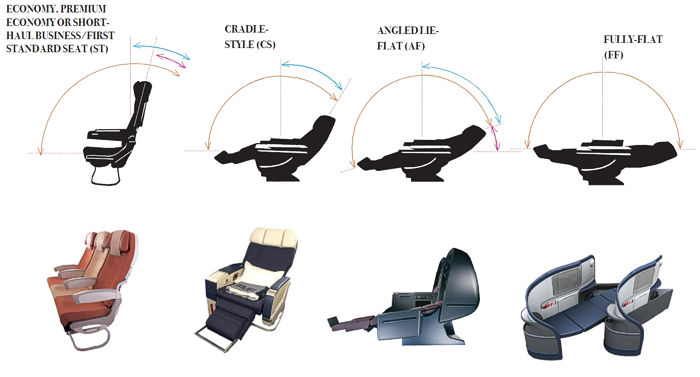
Many airlines now have fully-flat seating, and even the much-complained about lie-flat seating of airlines such as Air France/KLM and Lufthansa could be regarded as revolutionary compared to the old cradle-style seats of the 1990s. Finally, there’s first class, at least for a few airlines, which continues to struggle to define itself beyond the improved business class cabin, but which on certain important routes will probably continue to be offered for the foreseeable future, recession or not.
Read editorial reviews of all of these services and classes, plus user reviews, at www.businesstraveller.com or www.seatplans.com
how we work it out
01 PLANE TYPE AND CLASS
We have arranged the survey by airline to allow you to compare products in each class across the fleet. We have focused mainly on medium- and long-haul aircraft but some short-haul fleets have been included as well.
02 SEAT CONFIGURATION
This is the way seats are arranged across the aircraft. At first you might think this is a little too much detail, but you may change your mind once you are halfway into a long-haul flight and realise that on a different aircraft, or with a different airline, you could have had a seat with direct aisle access – and a view out of the window.
03 SEAT PITCH
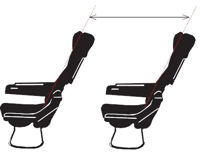
This is the distance between seats, measured from a fixed point on one seat to the same point on the one in front. The exact point differs from airline to airline, but note that new seats often have thinner cushions so offer more room, despite the seat pitch measurement remaining unaltered. Pitch is an indication of how much legroom you will get.
04 SEAT WIDTH
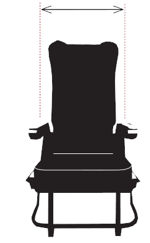
This is more complicated than you might think. Airlines obtain the seat width either by measuring the cushion, the distance between the armrests or, in some examples, from the outside of one armrest to the outside of the other (using the justification that the seat cushion is this wide). See facing page for details.
05 SEAT LENGTH
A measurement for fully-flat seats only, here the pitch becomes redundant – the length of your bed is what matters.
06 RECLINE
This can be measured in a number of different ways – from horizontal, 90-degrees upright or the take-off position. See facing page for more details.
07 SEAT TYPE
This mainly depends on how far a seat reclines. We have identified five main types: standard (ST), cradle-style (CS), fixed shell (FS), angled lie-flat (AF) and fully-flat (FF). See facing page for details.
08 INDIVIDUAL SCREEN AND SIZE
With more airlines installing personal screens, it can be a shock to discover one that hasn’t. But the size of the monitors can differ significantly.
09 AUDIOVIDEO ONDEMAND
AVOD in-flight entertainment – the ability to stop, start, rewind and pause movies, music, games and TV shows – is becoming a must-have feature across the classes. If it’s not installed, the system will probably run on a continuous loop, so if you miss the start of a film you have to wait for it to come around to the beginning again.
10 POWER SOURCE
Airlines were asked which type of in-seat power source they offered, be it UK, EU, US, SA (South Africa) or UNI (universal).
It’s all in the detail, so here is the low-down on how airlines measure their seats
SEATS WITH SMALL RECLINE
RECLINE IS PARTICULARLY IMPORTANT if you are hoping for a decent night’s sleep. In economy class, airlines take the measurement in three ways, but we have opted to avoid giving the first measurement.
- From horizontal to the furthermost recline
- From vertical to the furthermost recline (given either in degrees or inches)
- From the upright, take-off position of the seat to its furthermost recline
|
SEATS WITH LARGE RECLINE
IN BUSINESS AND FIRST CLASS, the options for reclining seats are broadly cradle-style (CS), angled lie-flat (AF) or fully-flat (FF). The measurement of the recline is taken in a number of ways – most controversially when it comes to angled lie-flat, which may sometimes be expressed as 180 degrees, the same as fully-flat beds. We think this can be misleading, so have clearly identified these seat types in the table of measurements for each airline.
In premium economy, some carriers (such as Air France) are introducing fixed shell (FS) seats that recline into a hard plastic surround, not into the space of the person behind you. Others, such as Air New Zealand, have introduced premium economy seats without backs that recline at all, instead opting for a seat base that pivots upwards to give you the feeling of leaning backwards. These are called Space Seats (SPS).
|
|
SEAT WIDTH IS MEASURED (in inches) between the armrests when the seat is fully upright. The measurement is usually taken as the space between the armrests – so from the inside of one armrest to the inside of the other – or can be the seat cushion width or even the distance between the outside of the armrests. The optimum seat cushion width, based on passenger feedback, has been found to be about 20-21 inches (51-53cm).
|
SEAT PITCH IS THE DISTANCE between the back of one seat and that of the seat in front, broadly regarded as legroom. For the fully-flat beds in business and first class, seat pitch is not really applicable, as there is usually a lot of space between seats and the only limiting factor is the length of the bed.
|
AS IN-FLIGHT ENTERTAINMENT (IFE) SYSTEMS become more sophisticated and are upgraded from simple multichannel offerings to interactive systems that allow for AVOD (audio-video on-demand), economy passengers often benefit from the range of choices available as installation takes place throughout all cabins.

|
Download the 2012 Airline Survey