The volcanic ash cloud was one crisis no one could prepare for. Or could they? Bob Papworth talks to the people who may be able to help when the next disaster strikes
Assuming their travel plans weren't disrupted, a select group of un-named travel industry professionals was due to gather on June 1 at an undisclosed location for the first-ever meeting of the mysterious-sounding Phoenix Group.
What sounds suspiciously like one of Sir Arthur Conan Doyle's more fiendish creations is in fact altogether more humdrum - a group of "key stakeholders" pulled together by Institute of Travel & Meetings (ITM) chairman Jamie Hindhaugh in response to this spring's ash-cloud crisis.
Phoenix will, the ITM says, "act as an operational support group to facilitate communication between government, media, suppliers and buyers at times of crisis which affect the business travel and meetings industry".
The group's first task will be to form a substitutes' bench of industry experts whose particular skills can be called upon when needed. Its second task - and here we enter the realms of pure guesswork - will be to discover just how 10 per cent of ITM's buyer members appear to have had advance knowledge of the Eyjafjallajökull threat.
At 9.50am on April 15, air navigation services provider NATS announced that it had "just" warned airlines that UK airspace was to be closed from midday "until at least 6pm", and yet one in 10 respondents to an ITM poll claim to have been aware of the impending crisis already.
As the Institute's Strategic Crisis Management research document says: "Understanding why and how approximately 10 per cent of buyers were able to identify the ash cloud as a major threat and implement their crisis systems at least one day in advance of the majority is key." With what must rank as the understatement of the year, ITM chief executive Paul Tilstone adds: "The advantage such companies may have had in terms of operational servicing cannot be underestimated.
"Getting the last seats on flights or booking the nearest hotel rooms before the true scale of any disaster becomes clear must be a real boost for their programmes, both in terms of cost and duty of care."
Then again, getting seats on the last plane to take off before the volcanic murk becomes engine-threateningly thick is only a good trick if it works; get it fractionally wrong, and your company's duty-of-care reputation is in shreds...
Nevertheless, given that NATS, with all the highly-specialised data it had at its fingertips, implied that the airspace shutdown might only last until 6pm on 'ash Thursday' (and then proceeded to close airspace for five days), those corporate crystal balls might be worth a bob or two - though they may well be beyond the financial reach of a sizeable number of business travellers, if survey findings from the Association of Corporate Travel Executives (ACTE) are to be believed.
ACTE members' employers appear to take a dim view of travellers who used their own initiative to get back to base or continue their business trips. Fewer than half the survey's respondents (46 per cent) said extra expenses incurred would be met by their companies; 44 per cent said claims were going to be reviewed on a case-by-case basis.
The remainder said their companies would flatly refuse to reimburse extra expenditure, despite the fact that 44 per cent of those polled had been unable to make alternative travel arrangements for their stranded employees.
The impact on corporate travel budgets has been significant, ACTE reports. Nearly three-quarters (71 per cent) of respondents said they had taken a "substantial" hit; of those, 36 per cent said the unanticipated expense would be severe.
Ironically, ACTE president Chris Crowley, BCD Travel's UK-based senior vice-president of sales for Europe, the Middle East, Africa and Asia-Pacific, was himself a victim of the airspace closure - he was stranded in the US. "The unanticipated loss of air service for hundreds of thousands of business travellers has played out in dramatic fashion," Crowley said at the time. "Travel management resources are being stretched to the limit as every effort is being made to return travellers to their families."
Travel management companies (TMCs) would appear to have come up smelling of roses, at least as far as ITM members are concerned. TMCs either instigated, or were involved in, the start-up of crisis management measures in more than 50 per cent of cases, with a further 18 per cent on board within the hour, and another 21 per cent kicking in on the first day of events.
An overwhelming 82 per cent of those polled said their TMCs were supportive, although a worrying 15 per cent ticked the "not very supportive" box, and 3 per cent thought their TMCs provided no support at all.
That accusation could not be levelled at BCD Travel, which even went so far as to provide an Eyjafjallajökull pronunciation guide - apparently it's "AY-yah-fyah-lah-YOH-kuul".
"The chaos this volcano created in the travel industry demonstrates the true value for corporations of forming partnerships with TMCs and other suppliers," says John Snyder, BCD's global president and chief operating officer, presumably while wondering where in hell Chris Crowley had got to.
"The volcano and its after-effects put those partnerships to the test and, in the end, reasserted the value of those relationships. We believe the tireless efforts of our counsellors and staff around the world highlighted our reliability, creativity and proactive approach, and solidified the trust our clients place in BCD Travel."
More than 300 HRG (Hogg Robinson Group) staff volunteered to work overtime as the company fought to repatriate or redirect some 40,000 stranded travellers; the company's crisis management and emergency telephone lines handled 25,000 calls.
In addition to all that, chief executive David Radcliffe said: "If appropriate and available, we have chartered aircraft to meet client needs. Where repatriation has not been possible, HRG has not only secured and extended hotel rooms for clients whose travellers are having an enforced extended stay, but we have also guaranteed payment on behalf of stranded clients where credit card values and ceilings have been exceeded."
Debbie Carling, executive general manager of FCm Travel Solutions and sister brand Corporate Traveller, didn't claim to have bankrolled her clients' travellers, but she did say: "We did everything we could to ensure our clients were looked after as well as possible in the circumstances. The task was huge but our staff were amazing."
American Express Business Travel, which says 150,000 of its customers were "affected" by the crisis, issued 10 handy hints for dealing with unforeseen travel disruption, pointing out that "distressed travellers seek solace in their travel managers" - as if the job wasn't tough enough already - and, rather more pertinently, urging companies to track and recycle unused tickets.
Over at Carlson Wagonlit Travel, Nigel Turner, director of public sector and industry affairs, takes a forward-looking approach. "The big learning for us has been the importance of passenger profiles," he says, "because if you don't have a passenger profile, your ability to help is limited - the booking might well have been made by an intermediary, but it's the passenger that counts. That's the biggest push we are going to have to do now ," says Turner. "The other thing is that communication is absolutely vital - not just to keep on top of what is happening, but also encouraging our customers to communicate internally to their travellers, such as people who need to travel within the next three to five days, to hold off from making any kind of booking so that we can deal even more effectively with those who need to be repatriated."
Perhaps the most interesting response to the crisis has come from new Guild of Travel Management Companies (GTMC) member Giles Travel. The Guild has been uncharacteristically quiet on this issue, but Giles' director of marketing and communications John Cooper is about to hit them with a bombshell. "We will be talking with colleagues across the industry to explore the benefits of shared resources in such extreme circumstances," says Cooper.
A statement from the ITM delivers another jolt - airlines and TMCs have been generous in relaxing normal contract conditions, but the Institute points out: "Whilst there is a recognition that suppliers have to manage supply and demand, even at times of crisis...there appears to have been a marked rise in prices by all supplier types, and across the hotel sector in particular." Now, it seems, is not a good time to be a hotelier.
One final thought on the ITM's Phoenix Group. Part of Egyptian mythology, the phoenix faces its crisis - becoming consumed by fire before rising from its ashes - every 500 years.
What's the betting the corporate travel industry would pay good money to guarantee crises came around so infrequently?
Crater love hath no man ...
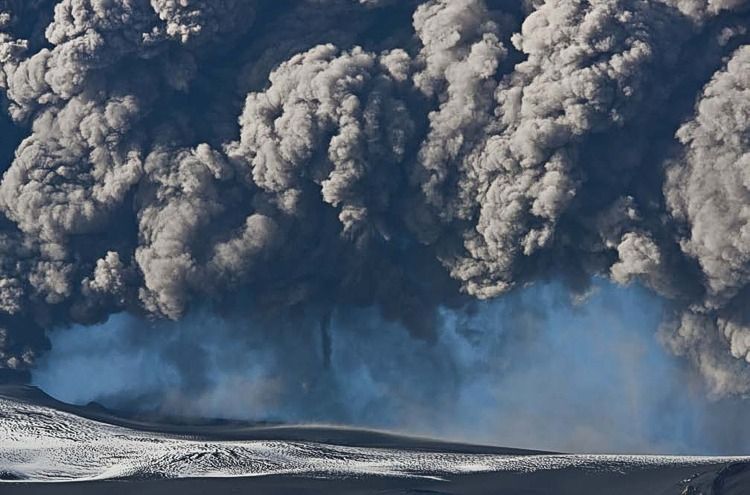
The trouble with Icelandic volcanoes - apart from their tendency to belch tons of ash into European airspace, doing irretrievable damage to the aviation industry's bottom line and ruining just about everyone's travel plans - is that their names are extremely difficult to type.
No sooner had those of us in the scribbling fraternity managed to get our heads (and fingers) around Eyjafjallajökull, than up pops Fimmvörðuháls, requiring multiple visits to the 'insert symbol' tab on the toolbar.
Katla is a comparative doddle, or would be if she wasn't located under a vast glacier called Mýrdalsjökull (jökull, as Buying Business Travel readers will hardly need telling, is Icelandic for 'glacier').
Fortunately for those of us fast tiring of umlauts, if for no-one else, Katla is the one to worry about. Just shy of 5,000ft high, she has a crater diameter of more than six miles, four times as big as Eyjafjallajökull's.
The bad news is that just as Eyjafjallajökull's April 12 eruption was triggered by Fimmvörðuháls', Eyjafjallajökull's eruptions have historically set Katla off in a sort of volcanic chain reaction.
The really bad news is that Katla tends to blow her top every 40 to 80 years. The last major eruption was in 1918, with a smaller outburst in 1955, so experts reckon another big bang is long overdue.
The only consolation, if and when it comes, is that we'll all be able to spell it ...
Voices from the FCm frontline
Being stranded mid-trip is stressful enough, but what about those trying to sort out the volcano-induced mess? Buying Business Travel asked crisis management frontliners from FCm Travel Solutions and sister brand Corporate Traveller for their thoughts ...
"Clients were stressed and afraid, initially rude, then calm and grateful. We were the fourth emergency service to them - a lifeline, a comforting voice to get them back to their loved ones. When people are put in a situation where they have no control and feel vulnerable, you are the voice that matters, and that's so rewarding. "The relationships and friendships that have developed as a result are excellent. We all feel proud to have done our jobs extremely well and to prove we can go above and beyond the call of duty."
Yvonne Knox, team leader, FCm Loughborough
"The situation was very surreal - how could a volcano in Iceland cause such havoc? It all felt like a disaster movie and as each hour passed it seemed to get worse. What generally happens in such situations is the adrenalin kicks in and people start to show their leadership qualities. "The travellers were unbelievable - very calm, some obviously concerned, but realising this was something outside our control. Our staff were getting a real buzz out of being able to help, providing expert advice and keeping clients updated."
Gary Jones, business development manager, Corporate Traveller
"It really tested our knowledge of finding alternative modes of travel to get these travellers home. Some clients were calm and understood the situation, and were quite happy to stay where they were. Others were stressed and wanted to get home as quickly as possible. It's certainly not a time I will forget in a hurry. It was a pleasure to be able to assist, and the commendations we have had in since these travellers returned home are amazing."
Helen Cochrane, senior team leader, FCm Leeds
"I worked an overnight shift on the Saturday and I imagine it was comparable to working on the London Stock Exchange floor at times - chaos on the outside, but expertly organised on the inside. "The vast majority of clients were very appreciative and calm about the situation, as they knew that it was out of our control and that we were doing our very best to get them back home. It really felt like working in a true crisis centre and was so rewarding, not just because we were solving clients' problems and making them happy, but because it was probably the best example of teamwork I have ever been part of."
Will Leonelli, area leader operations, Corporate Traveller