Traditional hotel concierges are under pressure from the growth of online rivals, reveals David Churchill
Regular guests returning to the newly-revamped Savoy Hotel in London, which finally reopened this October after a £200million-plus face-lift, will immediately notice one key change: the reception desk, which used to be the first thing that greeted arrivals entering through the revolving doors, has been relocated to the former Reading Room, close to the Grill, to provide a more discreet check-in for the hotel's well-heeled clientele.
But while the receptionists have moved, the concierge desk remains in its pole position in the lobby, reflecting its importance to the hotel in having a level of service to match its top-end room rate, averaging around £500 a night, including VAT, for a fairly standard business room - double for a junior suite overlooking the Thames.
So highly-regarded is the concierge's job at the Savoy that it has poached probably London's top concierge - 34-year old Ben Malpass from The Cavendish in Jermyn Street - to head a 30-plus team aimed at keeping guests happy, whatever their requests. Earlier this year Malpass, representing Great Britain, beat off competition from 11 other concierges around the world to win the International Concierge of the Year title awarded by Les Clefs d'Or, the international society of concierges.
Yet while Malpass says he is relishing the challenge of meeting the expectations of the Savoy's demanding guests, he may be among the last of his generation of concierges to wear the fabled 'golden keys' lapel badge, signifying their status in the profession.
Traditional hotel concierges in the 21st century look something of an anachronism in a world where individuals can use mobile technology to hunt out the best restaurants, book limos and flights online and are guided to their destinations by the smartphone in their hand. Even hard-to-get theatre and restaurant reservations can now be sourced through 'personal concierge' organisations such as Ten Lifestyle and Quintessentially, while some top-of-the-range credit and debit cards also offer such personalised services in their fees.
But it could get even worse for hotel concierges. Apple is reportedly developing a suite of its own applications under an 'iTravel' umbrella, on the basis that controlling the flow of information available to travellers on the move is something it should be involved in rather than leave to third-party developers.
A recent US patent application made through a third party, as is usual with Apple's excessive desire for secrecy, describes the process of making an 'in-person' request of a hotel concierge as 'cumbersome', therefore justifying the need for an application to integrate hotel services into a portable electronic device which would bypass the traditional concierge function. Of course, seeking patent approval does not guarantee that Apple will go ahead with its plans, but it is a clear indication of which way the trend is going.
Yet it is not just new technology that is putting the concierge function under pressure. Most hoteliers have just gone through the worst two years' trading experience of their careers and it is hardly surprising that concierge desks have been among the prime targets for pruning under cost-cutting drives. An increasing number of hotels have found that concierge services can either be outsourced or dispensed with entirely, while others try and make do with a limited service.
But the trend to cut concierge costs was apparent even before the recent recession, starting several years ago in the post 9/11 environment. Away from the luxury sector, mid-market hoteliers have increasingly come round to the view that guests are less interested in using traditional concierge services - possibly because the sort of restaurants the guests may want to access are more likely to welcome them with open arms, in contrast to those that you need a concierge's black-book to get into.
At the same time, tighter and more effective expense management systems have contributed to this trend. Corporate travel buyers seeking better deals from hotels do not perceive the ostensible added-value from concierges is worth the money - and hoteliers are starting to understand this.
Travel management companies are also stepping into the information gap traditionally provided by hotel concierge desks, giving their corporate travellers details of what they need to know 'on the ground' to ensure maximum effectiveness from their trip. According to recent research from US analyst PhoCusWright, some 75 per cent of regular business travellers (those making five or more trips a year) now have use of a smartphone when travelling. "Smartphones and business travel are made for each other - they're always with us, always on and provide a feeling of security when travelling," it points out.
Carlson Wagonlit Travel, for example, recently extended its links with online mobile travel assistant platforms such as ConTgo which enables travellers to get instant feedback to specific requests, including destination related information.
But, in some ways, the image of the top hotel concierge fulfilling difficult tasks for a relative handful of guests with more money than sense is rather a fanciful notion. Most concierges, in fact, have much broader responsibilities and are, in effect, really duty managers or front-office managers in charge of such areas as cashiering, reception, reservations and so on. Malpass, in fact, won the 2009 Hotel Catey award for Front of House Manager of the Year as there was no separate concierge category in the awards.
Some hotel chains have already moved on from the traditional view of hotel concierges. The Andaz hotel at London's Liverpool Street, part of the Hyatt group, has eschewed concierges altogether (and other front of house job titles such as receptionist and bellboy) in favour of making its public-facing staff 'hosts' who can handle all guest queries, from checking-in and out to recommending and booking restaurants, shows and other local attractions.
When the concept first launched a couple of years ago, these hosts used rather clunky tablet PCs; now they have been given iPads. Hyatt, in fact, is rather keen to roll-out its iPads to its other hotels to help regular concierges gain faster access to local information in response to guests' queries. Other hotel groups are also embracing iPads with Sofitel, for example, already offering them to guests at several of its city hotels on the Continent.
Hyatt's enthusiasm for deploying cutting-edge technology also saw it become the first major hotel group to offer a Twitter-based e-concierge service, available round-the-clock, which enables guests (or anyone, in fact, with a Twitter account) to obtain specialist information on where they are staying - such as getting from the airport to the hotel or good places to eat. The downside, however, is that the tweeted information does not come from a 'local' source but from someone potentially thousands of miles away; the online concierges are based in places as far apart as Omaha, Mumbai and Frankfurt.
Hyatt has about 12,000 'followers' on its Twitter account, which makes it a useful rather than an essential communication tool. But other hotels have taken note, with Hilton, for example, also offering Twitter concierges, although on a more hotel-specific basis.
Yet the real advantage of Hyatt's Twitter concierge service, as well as the on-the-go information from smartphones, iPads and laptops, is that it is always available. There is no 'closed' sign on the concierge desk when seeking that urgent help that inevitably is only needed out of hours. In fact, one of the biggest gripes about traditional concierges is that they are often physically unavailable to help, especially when hotels have cut-back on resources. It is all very well concierges heading off on an errand for a needy (some would say selfish) guest, but that leaves the desk undermanned. In addition, it is frustrating when you have a fairly simple request to have to queue at the concierge desk behind someone who is seeking basic travel information and see the concierge spreading out a city map to show the route - you just know it's going to take at least 10 minutes before the befuddled guest gets the hang of the street system.
But even traditional concierge desks are being forced to move with the times. London's Dorchester hotel, for example, last year ditched its paper-based log book system of keeping track of guest requests and other information and installed specialist software developed by US consultancy GoConcierge.net.
GoConcierge has also installed its customised systems at a number of leading hotels around the world, such as the InterContinental in Vienna and the legendary Mandarin Oriental in Hong Kong.
"GoConcierge has made it easier to see everything that is going on at individual times in the hotel," says Dorchester head concierge Andy Davies. "We can also now text guests directly via the system."
Yet even while embracing new technology, traditional concierges still feel they have the edge. "While the internet is a very useful tool, it can never replace personal contacts," points out Paul Still, head concierge at the Hilton on Park Lane and immediate past president of The Society of the Golden Keys, the UK chapter of Les Clefs d'Or. He says that, in particular, access to smart restaurants and sold-out shows was still the "top priority" for guests.
Yet is this ability to get seats for Love Never Dies or a table in The Wolseley or Scott's so vital for modern business travellers? As noted before, there are a number of ways of getting such tables and tickets from specialist 'personal concierges' and even through online agencies such as Toptable.com, which has recently increased its considerable clout with restaurant owners following its $55m takeover by US rival OpenTable.
And the unspoken concern, of course, is over just what hotel concierges are offered in return if they can get tables at booked-out restaurants. More to the point is what the concierge is getting out of it when he directs guests to less-popular restaurants. Obviously, there is some mutual back-scratching going on in many cases, which can range from just a thank-you gift of discounted accommodation, or something such as tickets to a football match, to a straightforward kick-back. The concierges' response is that if they fail to provide the best service, rather than the one they are allegedly being rewarded for, then guests will simply go elsewhere.
While there clearly remains a demand from high-end hotels for concierges who operate in the traditional way, it is perhaps significant that the International Concierge Institute - where Malpass trained - has now closed, and with it the world's only formal training programme for concierges. The guys from Apple may yet have the last laugh.
CONCIERGE WANTED
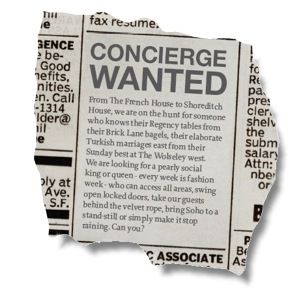
Job advert for a concierge at the new Starwood W Hotel due to open on Valentine's Day next year in London's Leicester Square.
TO BOLDLY GO ...
WHEN BEN MALPASS wants to get in touch with his one of his concierge team somewhere in London's newly refurbished Savoy Hotel, he simply says their name into his lapel microphone and a specially-developed voice recognition system immediately connects him to his colleague.
If this sounds more Star Trek than Savoy, it emphasises that even if Malpass's job is firmly based on the traditional concept of a hotel concierge, he is not adverse to using new technology as well. The Vocera communications system is one of the benefits of the Savoy being managed by Fairmont, which uses it alongside the latest version of its own proprietary concierge software to keep track of guest requests, and their likes and dislikes.
Malpass, 34, is the rising star among London hotel concierges after scooping a couple of prestigious awards over the past year (see main feature) and subsequently being poached by the Savoy from The Cavendish. He believes the job of concierge is one of the most demanding to be found in a hotel, and says concierges have to be "totally dedicated" or else will struggle.
While, like most concierges, he has had to deal with some unusual requests (a £7,000 bespoke dog bed made of leather and wool was one of the more unusual demands he's had), he says it is hard-to-get theatre tickets and restaurant bookings that guests seek most.
Although he had a good track record of fulfilling such requests while at the four-star Cavendish, he thinks that the Savoy's prestige will open even more doors than his previous powers of persuasion could achieve.