Lord Norman Foster’s proposals for a new airport in the Thames Estuary have grabbed the headlines, but his vision for the future of transport in the UK doesn’t stop there. He envisages a Britain where a high-speed rail line that runs the length and breadth of Britain can also be adopted by hikers and cyclists as a tranquil route to navigate the countryside.
In his all-encompassing plans, Lord Foster’s “spine” will also include fibre optic cables, distribution lines for electricity, a second train line for local and regional trains and a third for freight, which would remove thousands of trucks from Britain’s roads, easing congestion on the motorways. “There are a whole range of issues,” said Foster, which will come to the fore over the next 15 years. “Some £150 billion is proposed to be invested in energy and the distribution of energy, including planned transmission lines and pylons,” he continued, while other projects in the development pipeline include high speed rail and a new Thames Barrier.
Under Lord Foster’s plans, the funding and building of these disparate infrastructure projects would be brought under one holistic approach. “The concept really is to bring all those separate entities together as a spine which would run the length and breadth of the nation,” he said. “By bringing them together in an integrated holistic way, you would have a number of benefits: compactness, economical benefits, benefits in terms of proximity to populations, and you would vitally also reduce the environmental impact.”
The architect is keen that his project also has an aesthetic appeal – and this is where he has sought inspiration from some of the great industrialists of Britain’s past, namely Isambard Kingdom Brunel and Capability Brown. By Brunel, he was animated by the creation of “an extraordinary network of information in the 19th century in the form of cables which extended out to India”. And from Brown, he took the idea of the haha, a trench which is concealed from view on one side, allowing an unobstructed vista of a garden or park.
“The haha is in part an inspiration for the way in which you could economically create a route for the train tracks,” explained Lord Foster, “which would be depressed slightly into the ground for acoustic reasons. You would use the fill from that and the tunnels, which are part of any rail network, and create a landscape mound at the side. In that
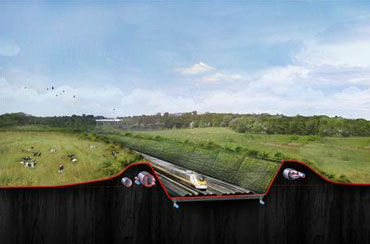
way, for significant stretches, particularly through areas of outstanding beauty, this spine would be very much in that green tradition... Landscaping is a key element.” With the train tracks and cables largely hidden from sight and sound, there is the possibility of “a different kind of mobility”, he added – the creation of 250 miles of cycle and hiking trails.
Some have decried the practical nightmare of moving one of Europe’s largest airports to the other side of a city the size of London, not to mention the financing and politics of it all, while others have declared development in the Thames Estuary a form of environmental desecration, given the large numbers of birds that live there. Still more cite the problem that flights coming into land so far east will be in foreign airspace until too late in the landing process. The idea of a second high speed rail line linking London with Birmingham, Manchester and eventually Glasgow has also come under fire.
Birds can be moved, argued Lord Foster, a new island can be built – witness Hong Kong’s Chek Lap Kok Airport, he said, where not only did they need to reclaim land, they had to remove a mountain – and, crucially, funding can be found in the private sector if the public sector won’t come up with the cash.
Lord Foster said he welcomes discussions about the best way to develop rail and air travel in the UK, but warns it is vital to have them now and to reach a decision before it is too late. UK infrastructure is “creaking”, he said – it’s time to stop taking a “make do and mend approach” and imposing “band-aid solutions”. Instead, Britain deserves a transport network to serve future generations, “with the kind of infrastructure that we have benefitted from, thanks to the foresight of those 19th century heroes”.
www.fosterandpartners.com