At BTiQ we've often raised the question over whether anywhere is really now deemed 'safe' after a growing number of attacks and unrest in what have been traditionally thought of as low risk areas.
It appears travel managers are on the same thought process. In a recent survey, 30% of 230 European travel buyers chose Europe as one of their top three high-risk territories (see other regions in box), with 56% citing terrorism as driving behaviour.
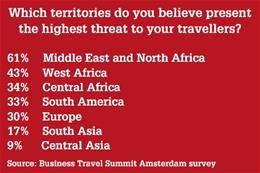 There is a possibility that the respondents only look after particular territories, but is still a sizeable number. Is their concern justified?
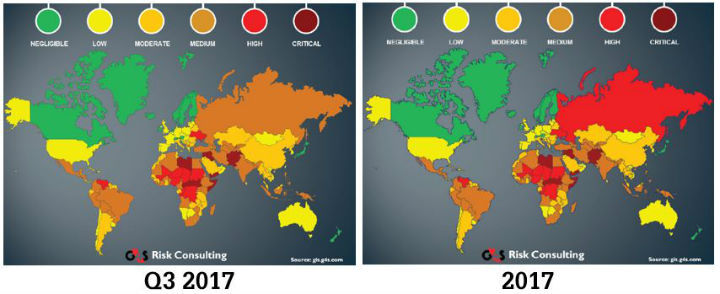
The latest political and security outlook from G4S Risk Consulting for Q3 illustrates the majority of Europe at either a negligible or low level of risk, moving into a moderate level in South East Europe and high in Turkey.
As you can see in the map below - there are parts of Asia that could be deemed as more dangerous than Europe, and risk levels have remained largely unchanged since the start of the year. Despite the level of concern among buyers only 7% had stopped, or plan to stop, travellers going to Europe, compared to 36% to MENA, 30% to Central Africa and 25% to West Africa.
But as we all know, situations are changing quickly and different, unexpected types of attack are taking place. 64% of buyers told Business Travel Summit Amsterdam that they renew risk strategies once a year, although 15% of companies had only implemented a risk strategy less than 12 months ago.
Less work has been done in training. An ACTE/Amex GBT survey found 49% of travel managers don't provide traveller safety training while 60% of buyers told the Summit survey they do not have scenario training.
Travel buyers will put their own crisis responses to the test in what's set to be a thrilling session at both the Summits in London (14th September) and Amsterdam (26-27th September). Can you cope under the pressure?