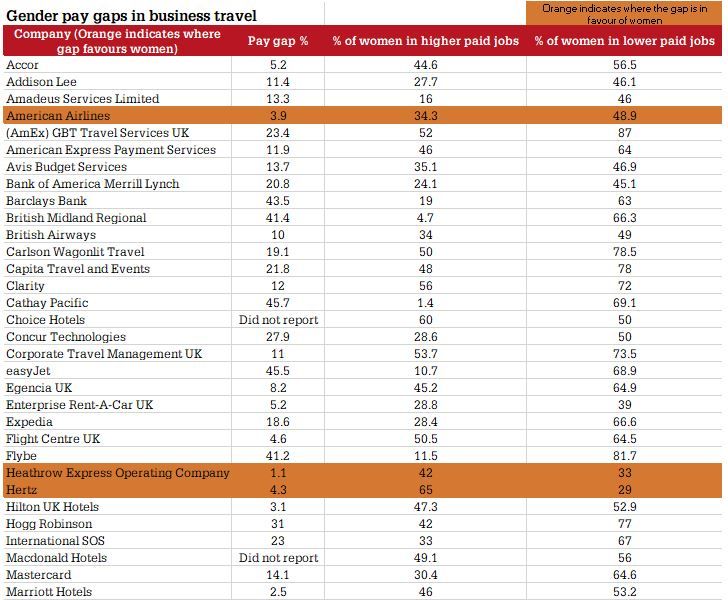
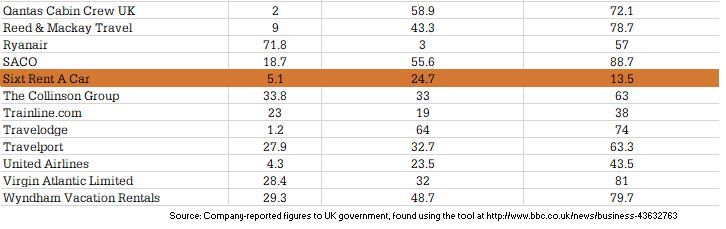
 UK companies with more than 250 staff are now required to submit a gender pay gap figure. Businesses have to state the average difference between the salaries of male and female employees and many also declare the percentage of women in higher paid and lower paid roles. It is not easy to make like for like comparisons as jobs and the way companies report the figures varies, but I've been looking at where business travel companies sit.
In line with the UK averages, most companies in our industry pay men more than women and the finance sector (ie card providers) has the biggest gap, although airlines generally have larger pay gaps than other travel company types. Those two sectors are also more likely to have fewer women in higher-paid roles.
While there is still a way to go I think it's encouraging that some report half, or close to half, of higher paid positions are filled by a woman — particularly within TMCs and hotels. In the table below hotel chains are also among those with the smallest pay gaps; car hire companies also generally reported a lower gap compared to other sectors.
The average number of women in higher paid roles is just over a third at 36% and you'd think this is only going to go up considering the percentages of women in the overall travel workforce. However research such as this by BCD Meetings and Events cite 'traditional bias' and maternity leave as some of the barriers to women getting higher and many are opposed to quotas.
Analysis by the BBC found the UK has the 11th biggest median gender pay gap at 18.4%, based on countries in the Organisation for Economic Co-operation and Development (OECD). This is close to national averages reported by Austria, Switzerland, Czech Republic, Germany and Ireland. European countries in the highest 10 include Estonia, Latvia, Portugal and Finland.
Belgium, Luxembourg and Slovenia are the only European countries with a national gender pay gap average of 5% or less but Italy, Denmark, Greece, Norway, Hungary, France, Iceland, Poland, Spain, Lithuania, Slovakia, Sweden and the Netherlands are all under the OECD average.