Paying with the smartphone will be the norm soon and it will disrupt the world of classic payments. To integrate mobile payment in an efficient corporate travel management offers great opportunities; the goal is to make payments for business travellers practically imperceptible and to reduce the required steps to buy and expense to a minimum.
More and more business travellers use new technologies and apps inspired by the private travel and retail sectors. These include mobile and virtual booking, payment solutions for smartphones, shared economy offerings and personalised travel recommendations based on big data that takes travellers' preferences into account.
These new trends offer travellers much more convenience than traditional business travel tools, all while providing increased benefits for businesses.
Thanks to the booming market of FinTechs, a lot of new technologies have entered the market. A big variety of apps and services offer countless smartphone solutions; main app stores currently offer 65,000 travel-related apps and 32,000 finance apps, which have effectively become the competitors to operators in managed travel.
Buyers should be working with travel management suppliers to identify services that are the most beneficial to their travellers and programme; matching them with innovative solutions to improve convenience, manage payments and integrate it into the ERP system. Buyers and suppliers must think about ways to implement these trends:
- How can travellers' preferences be aligned with company requirements?
- Benefits exist for both the company and the traveller — where do these benefits correspond and where might they conflict one another?
By using travel payment examples, it shows that cooperation between classical suppliers and new players from the FinTech scene might bring the best solutions for corporate customers and travellers.
Pilot projects: cooperation is growing
I give you an example: we have launched a pilot project in cooperation with Orderbird. This Berlin-based restaurant mobile point-of-sale supplier launched in 2011 with the goal of overhauling the traditional point-of-sale suppliers and adjusting to the needs of modern restaurant businesses.
The programme allows travellers to pay for their meals in restaurants utilising cards via mobile payment. Upon entry, the user's smartphone establishes a W-LAN connection with the restaurant's cash desk system and links it to their smartphone. This allows easy tracking of every order throughout the visit. Once finished, the app transmits the total and charges the corresponding credit card. This intuitive process vastly improves the formerly least pleasant part of a restaurant visit: waiting for and paying the bill. Also, after the traveller has paid the bill, they will receive the business receipt automatically via email.
The project is on-going but will hopefully serve as an example of mutually beneficial cooperation between established businesses and up-and-coming FinTechs and startups.
Continued below
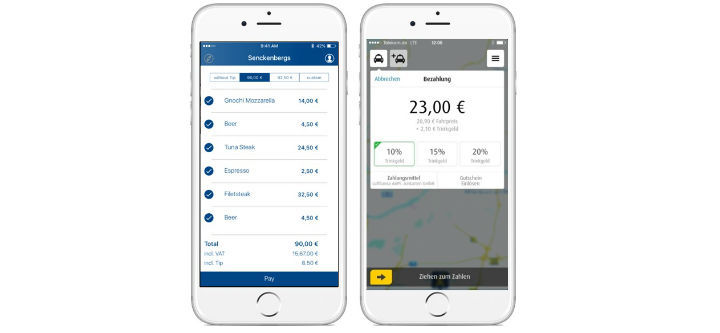 Restaurants and the ground transport sector are among those testing mobile options
Mobile payment has the biggest potential to disrupt corporate travelling
The process of wireless payment transactions doesn´t need cash, checks or physical credit cards. The smartphone turns into an intelligent electronic mobile wallet with access to online accounts and different payment methods like private or corporate credit cards, loyalty programme memberships or many other applications.
The software behind it is able to manage big data for many kinds of useful purposes. iOS and Android are keeping up with all kinds of expected demands. A wide range of providers like Google Wallet or Apple Pay offer APIs for applications to connect with which will create thousands of new businesses.
The latter could be the final step to establish mobile payment in the mainstream.
Within 72 hours after launch, Apple Pay registered more than one million credit card activations, making it one of the largest mobile payment system providers almost instantly. The prevalence of Apple's smartphones in the business world could give a push to the present reluctant situation especially in the retail industry. Apparently, there are big differences in Europe: other than in Poland or Turkey only a smaller part of German retailers are introducing mobile payment although all are convinced that it will be payment standard sooner or later.
Corporate executives: interested but not enough knowledge
In addition, mobile payment enhances the visibility and availability of data and offers more tools for travel managers to augment process efficiency and control. Presently, however, this potential remains largely untapped in the corporate world. This is partly due to a lack of consistent implementation of mobile payment in the travel and retail industry, as well as a limited understanding of the technology on the part of businesses.
A recent survey among the buyer members of the Association of Corporate Travel Executives found that more than half (53%) of the respondents rated themselves as "beginners" when asked about their knowledge of mobile payment technology. Another 41% responded with "moderate" and merely 6% described themselves as "experts" in that regard. These numbers are hardly surprising when considering that only 22% of the companies asked stated that their corporate travellers had used mobile payment at all.
Yet businesses would greatly benefit from implementing mobile payment. The process is currently unmatched in providing data on transactions in real-time, thereby streamlining expense reporting and enabling on-the-spot compliance checking.
During the research process for the ACTE survey one expert for travel and technology stated, "There is no adoption yet of mobile payment in the corporate environment but there is a lot of interest."
It is essential that travel companies and suppliers don't let preconceived notions get in the way of their desire to innovate, so they are ready for buyers when they ask about solutions. A certain willingness towards a "trial and error" mentality is necessary; as I said during the GBTA conference earlier this year, a major mind shift is needed in regards to placing technology in the traveller's hands. It is the best way to create a mutually beneficial travel experience for users and employers. For that to be achieved we need to improve the knowledge base of new technology and be ready to implement it in order to determine its effectiveness.
Cooperation is key
Time is the most valuable resource in the business world of today and fast-tracking the payment of a traveller's catering and lodging will certainly turn out to be a real timesaver. Suppliers are looking at how to integrate similarly innovative payment tools for parking and taxis into the corporate lineup in the near future, which would allow tools to cover the similarly relevant transportation sector.
It is important to implement new technology on a big scale in every appropriate sector in order to allow for the advantages to be maximised.
Fast growth expected
The public continues to embrace mobile payment. Visa's Manager of Europe Volker Koppe said that come 2020, all retail terminals throughout Europe are likely to be equipped for mobile payment. Visa Europe projects that the weekly value spent via mobile payments will continue to rise and hit £1.2 billion (EUR1.6bn) by 2020.
Overall adoption of mobile payment methods in the UK is also skyrocketing: 60% of Britons are expected to use their devices for payment at least once a week, according to research by Visa Europe. Jeremy Nicholds, Executive Director for Mobile, commented on the numbers: "While we're excited to see consumers saying they expect to triple their weekly spend using mobile payments over the next five years, we at Visa think those numbers could be rather conservative and that the actual adoption rate will be much higher."
The biggest opportunity lies in combining know-how and experience of "old" and "new" players to deliver solutions that meet the demanding needs of corporate customers, which are different from private user needs in so many ways.
With travel and commerce being among the most common industries these companies focus on, there will be an abundant supply of ideas and inspirations for payment solutions in the future. Like the "invisible payment" that mobile payment enables, it not only reduces payment processes from more than 12 steps down to three clicks on the traveller's phone, but also offers a seamless, safe and cost effective solution for the company.
When mobile payments are linked to expense management systems, travel managers will see these benefits:
- Pocket-sized compliance manager — policy management at point of sale is more effective but less intrusive
- Faster data capture — real-time payment data capture enables faster decision making
- Greater visibility — more electronically captured payment methods means more, and more accurate, visibility of spend
- Greater policy sophistication — mobile payment and expense reporting apps can link with GPS for policy refinement based on location