Have you ever given money to a street musician through your smartphone or paid at the fruit stand using a QR code? Probably not. I certainly haven't.
These scenarios are in the distant future, especially in Germany. People in Germany still love cash. Not even one out of 10 settle store or restaurant bills by smartphone.
Yes, we have a hard time letting go of paper banknotes and are hesitant when asked to replace them with our smartphones, let alone with a wearable device. We are stunting our country's development in the field of cashless payment because we fear data may be abused in the process. Add that to the fact that we simply don't have a sufficient number of suitable interfaces facilitating seamless digital payment processes in the first place.
China is skipping steps in the development of technologies
Not so the Chinese. In their very unique way they are showing us clearly where the journey is headed when it comes to payment and travel technologies. On the way to becoming an entirely cashless society, China simply leapfrogged the western model of online bookings and corporate cards and went straight to mobile bookings and payments.
What is truly fascinating is that the Chinese have organised themselves entirely on two payment and recreational platforms: WeChat and Alipay.
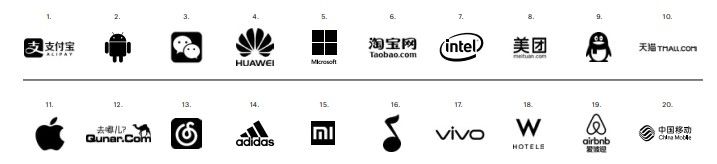
Astoundingly, all monetary transactions flow through these two venues, let's call them digital ecosystems, regardless of the user's age or gender. I learned this recently from a study on the Prophet Brand Relevance Index (BRI). According to the study, Alipay is the most relevant brand in all of China — equally so for men and women, for millennials and for non-millennials. Currently, WeChat has close to 900 million users in China every month; Apple can only dream of this figure. WeChat's competitor Alipay is accessed by about 500 million people per month in China.
Top 20 brands in China, according to Prophet Brand Relevance Index (BRI)
In addition, according to statistics published by the People's Bank of China, the number of transactions settled through mobile apps outside of the banking business skyrocketed from 1.7 billion to more than 38 billion between 2013 and 2017. Our own study confirmed this trend: 91 percent of respondents in China said they pay with their mobile phones. Nowhere in the world is that figure higher.
No chance for credit cards
Ten years ago traditional behaviour still influenced the market strongly. Staff members booked their trips individually over the Internet or through local travel agencies and paid in cash or through a bank. At the time, China did not have structured business travel management as we know it today. As travel management gradually became modernised, some have been able to benefit from the trust built over time and suitable products launched accordingly.
The numbers previously mentioned clearly demonstrate that the Chinese market is unique in our industry. Because the Chinese do not need plastic to organise their lives; they simply skipped the classic credit card. It never had a chance to blossom in China and it never will. There are two indicators: the country's infrastructure which has become geared entirely towards digital payment, driven by WeChat and Alipay; and Visa and Mastercard's painstaking attempts at obtaining licenses for the People's Republic.
Learning from China
Each year the usage of products and services, as well as revenue, from China continues to increase.
Our industry has to learn from this special market. China's stand when it comes to new developments is extremely interesting because it has paved the way for numerous mobile solutions for the intelligent booking and payment of business trips. These solutions were established technically very early on to satisfy the demands and needs of Chinese society and most of them still are nowhere to be seen in the west.
Today we know that China absolutely is a consumer-centered market. We also know that customers, not companies, determine the methods of payment. This knowledge should be the foundation for western businesses in this market going forward. Consumers in China demand customised products designed to meet their specific needs, for example, sophisticated integrated payment solutions that cover the entire business travel process. To do this businesses need to focus on the customers and find out what they genuinely need and want.