There is an ongoing discussion about the how much pollution aviation accounts for. In general, CO2 is recognised but many others such as nitric oxide, nitrogen dioxide (together termed NOx) and carbon monoxide are included but not registered. Aviation accounts for 2% of total global CO2 emissions, but since most of the pollution happens at 10km altitude, scientists claim it is necessary to double the direct emission number to 4%.
The numbers are frightening
IATA reports that CO2 emissions in 2017 will amount to 853 million tons but this is only for members of the cartel. When you add the emissions from the military, low-cost airlines, charter, freight and small aircraft, as well as the multiplying factor, it means that the emissions come to more than one billion tons of CO2 alone in 2017. This does not even factor the dangerous chemical substances being part of the exhaust.
Overall, the latest scientific estimates put the climate forcing impact of global aviation at a 4.9% share, while its contribution to global GDP is 0.7%. This makes aviation seven times more polluting than average economic activities. If the existing annual growth in traffic (5-10% annually) continues, the impact will double in 15 years. The growth varies quite a lot and is fastest in Asia.
These emissions from a litre of jet fuel are similar to a four-seat car with one person on board, however, the total emissions are obviously much higher due to distance. For perspective, per passenger a typical economy-class New York to Los Angeles round trip produces about 715 kg of CO2 but is equivalent to 1,917 kg of CO2 because of the high altitude "climatic factor".
Just the impact from airports influences others seriously. This video gives you an idea about how much pollution you generate when travelling.
Where are we from a public point of view?
Just searching the internet shows how little this subject has been mentioned. Globalisation, the arrival of low-cost carriers and, in recent years, cheap jet fuel has worsened this situation.
In 2016 an ICAO (UN) Assembly programme named CORSIA was brought forward. The core content was establishing an emission offsetting scheme forcing airlines to buy CO2 quotas when trespassing certain thresholds. There is a schedule in the agreement that allows time to implement these systems and reporting structures; the deal is expected to be active from 2021 but is voluntary until 2026, after which it will be mandatory. The system will require airlines to monitor and report their annual CO2 emissions on international routes and offset those exceeding the 2020 levels. The agreement is already signed by 66 out of 191 countries but is far too weak.
Though the agreement may have its flaws, it is worth considering what the world might look like without it. If nothing is done to curb aviation emissions, and all other things being equal, by 2050 aviation emissions are expected to triple. This would account for 27% of the global carbon budget if we are to meet the Paris Agreement goal of keeping temperature increase below 1.5c. This would require every other sector to rein in its emissions to the point of absurdity, just to accommodate for aviation's growth.
The EU parliament has voted yes for extending free emission on international flights in and out of EU until 2023 when CORSIA is being forced on the industry. This will increase emissions by 30% and there is no plan to offset it.
Most people, companies or institutions looking at or being involved in the industry claim to be working to create a CO2 neutral environment. From airports and airlines to aircraft and engine manufacturers: we have heard them all pledge to decrease emissions through bio fuel, electric cars at the airport, lighter planes and more efficient and/or electric engines. However, every day there are still thousands of aircraft flying that were built 20-30 years ago; we see airlines actually cancelling or delaying orders for more fuel-efficient aircrafts due to cheaper jet fuel.
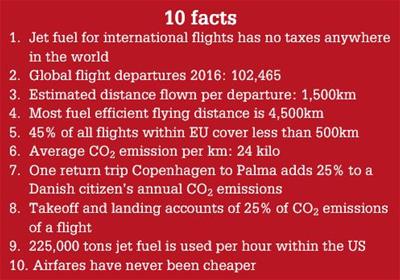 Together with these aircraft spending more time in the air, the world will experience increasing emissions in the years to come. The global population of 7.5 billion people that will be feeling the changing weather should not be penalised due to the impact made from 3.5 billion passengers travelling by air, and of which many are frequent travellers.
On top of this there are questions being raised about the true value and documenting of emissions and whether they are really being offset. What is even worse is the fact that this trading structure is invisible to consumer and travellers.
One billion tons of CO2 is entering the air in 2017, 2018, 2019 and 2020 and perhaps until 2027 and not a lot, if anything, is being offset. If not offset, the pollution from aviation will raise to 10% of world CO2 emissions.
Next step: the world cannot live with the current emission situation
Aviation has changed the way we see the world. It has helped the globalisation of trade and manufacturing, brought tourists to developing countries and transported workers from home country to workplace. Aviation can't stop but should be treated like any other industry and CO2 polluter. Something needs to be done to lower the emission from aviation and finance projects offsetting pollution. Many airlines have unsuccessfully tried to offer voluntary CO2 programmes, some participate in offsetting programmes and many companies are registering their pollution footprint.
But the proposed structure with a global quota structure to offset future increased emissions is simply not enough. The world cannot live waiting until 2021 to act. Experience has already shown that the airlines' lobbying work has delayed any development for the next nine years. How can we be sure that no further delays will happen?
Passenger or aircraft levies
A levy is the fastest way forward. It could be introduced by local governments and paid at departure country via the ticket. Governments can force a levy through the airport structure and decide if it is based on individual passengers or per aircraft departing. It will force the airlines to raise the ticket price, but an OECD report shows that a 5% increase in airfares only reduces traffic by 0.6%. If the world was to use the California levy of around $12 per ton of CO2, the income from a levy would bring in $12bn to be used to offset the pollution. The levy per single transaction would be $6.
It is not a tax, but a collection of funds to be invested in CO2 offsetting projects, so it should be charged and administered by each individual country against its GDP and the amount of pollution it generates. For example, EU could claim 10% VAT on aviation within its borders, including domestic traffic. All the income could be given to a fund with its purpose to finance projects or invest in alternative type of environmental friendly transport types ie high-speed rail. The fund should be managed by people experienced in creating and manage pollution offsetting projects. Projects could be local or global, although this article explains some of the issues facing CO2 offsetting projects.
Looking at the possibilities the following items should be taken into account.
- Age of aircraft
- Size and design of aircraft
- Engine fuel efficiency
- If fuel usage is lower because of better handling
- Distance
- Cabin classes
- CO2 emissions created, the altitude factor and other chemical substances sent into the air
A levy is effective for the below reasons.
- It creates awareness of the pollution
- Only those travelling are paying and not the global population
- It is visible
- The country population can be informed where their money is going
- Companies can document their CO2 footprint
I believe companies, passengers and the airline industry will initially cry wolf and talk about how bad this will be for businesses and the travel industry. However, the last year's catastrophic weather with increased draught, bigger storms and flooding must have an impact on peoples' thinking about our climate.
Any responsible government should start immediately start to act. Better sooner than later.