Within the next decade the whole structure of payment and settlement will change, decrease the cost of moving funds internationally and see a surge in new products.
It is already happening nationally from the smallest village in Africa to the sophisticated environment in China, where mobile payments are 53% of all transactions. Development is mostly supported by local mobile carriers and banks but also by local or regional software developers.
The past
Vendors accepted decades ago that doing business had a cost in relationship to payments, whether using cash and cheques. This ancient structure is still in place in many countries in the world; not just in the developing world but also countries like US, Germany and France.
After the Second World War and increasing globalisation a plastic card was a revolution from travellers cheques and various chains of banks invested strongly in this infrastructure. We all know the major global brands.
- Mastercard
- Visa
- American Express
- Diners/Discovery
The major cards had one of two core earnings.
- Making money from the vendors by claiming a commission
- Making money by offering credit and longer repayment time and charging interest
The airlines were among the first vendors to identify the value of this payment structure and their association (IATA) was quick to introduce the UATP credit card structure with fixed costs to the individual airline.
Individually Mastercard and Visa targeted the consumer through the banks using a strong franchise model while American Express, Diners and AirPlus targeted the companies and their need of payment structures.
Their strength is in all the agreements they have with vendors around the world based on those terms set decades ago. Most people can use their credit card in most shops from Ulaanbaatar to New York.
Today
Vendors are still using the same infrastructure even if it has become more electronically sophisticated. The system is quite secure and there are many reasons it is still in place and actually growing in some regions. What are the advantages?
- It works and is normally free to the consumer except, in some cases, an annual subscription fee
- They bring a security and data structure everyone is depending on, from suppliers to customers
- If a card is lost or stolen, the money is protected and the card can be replaced from anywhere in the world
- To vendors and companies, the sophisticated credit control in place creates certainty of receiving money
- With loyalty programmes they have strengthened their position towards the new generations
Why look for alternatives? The costs!
The internet and new electronic infrastructure has decreased the cost of providing payment services substantially; it has made the old cost structure obsolete. The card companies are on top of the world and their return on equity is enormous - they can afford advertising through the Olympic Games, football games and Superbowl. The banks like to stay with the card providers as the involvement is substantial; that is why so few made their own card structure.
Continued below
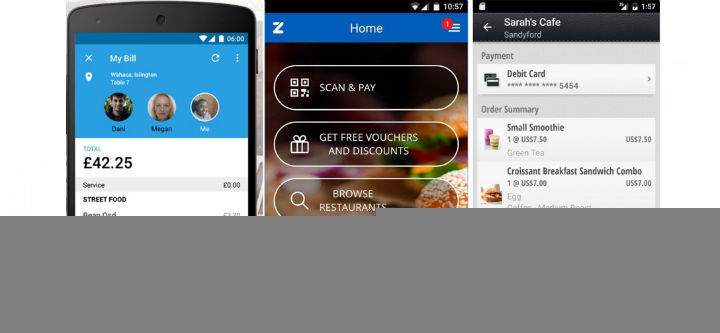 Restaurants have already taken up app payments through providers like (L-R) Flypay, Zapper and Mastercard's Qkr
Now most vendors are looking into what the new world offers and at what cost. The cost to the vendors can vary from 1.8% to more than 6%. The airlines usually negotiate to around a maximum of 3.5% and the UATP fixed cost is 1.8%. However, you have to add
- The time until the money is in the account (one to eight weeks)
- The cost of the card owner (subscription and currency exchange cost)
- The indirect cost of loyalty programmes
Take the airlines as an example. With 2-3% processing costs and late payments, the value of having the money direct from customer into the bank account is serious money. Many airlines have most of their income through credit cards and it costs millions.
If they can lower this structural cost to less than 1% you will see smiles all around the management tables. Airlines are looking to add new product and offerings to try and increase income substantially beyond the ticket, so if they can find ways of getting the money direct into their account, it will make launching new services much easier.
The software products available to launch this solution are there. Currently only a few have the sophistication in place, but by developing the New Distribution Capability (NDC) airlines hope new players will come out in the open.
In the travel industry, with hundreds of billions of US dollars spent every year globally, the credit cards still enjoy a dominant position. Their income is on the rise as developing countries become more sophisticated and move away from cash. However, the threat from alternative systems is serious and will change the markets rapidly.
The future
In a few years travellers will use the nearest WiFi hotspot (every shop will have one), open apps and enter the amount and relevant information to transfer the payment for the product purchased. At some point the user will just check if the amount loaded into the apps from the vendor is correct. They press pay and voila, leave with the new products or receive a ticket number or identification for the next trip. The vendor will give a discount as it saves them the 2-4% merchant fee they used to pay the credit card provider.
When travelling abroad travellers will identify the best local payment apps at the destination, load it into their smartphone and transfer the amount they plan to use. It won't be the bank doing this, but a currency company doing the exchange much cheaper than the bank.
A new world of payment and settlements is seeing the light. We all read about Apple and Google Pay, but the payment infrastructure is already changing rapidly.
- In Kenya a combination of mobile phone and local representation has made it incredibly cheap to transfer funds to rural family members or vendors.
- From sophisticated mobile payment systems in Japan and Europe to fast-growing local systems in Eastern Europe; payments and settlements are moving from credit card companies and banks to software houses.
Interference by the lawmakers
From 2016 new European Union laws will force the credit card companies to lower their vendor fees for private cards, where the individual consumer has personal liability towards the card provider.
When companies have the liability, the existing rules apply. This means that the annual subscription fee will increase dramatically for private cards and remain the same for corporate cards. This will help new entrees and payment providers get a foothold in the market.
The power of the cards is diminishing and the recent verdicts have forced providers like American Express to change their contracts and the payment terms towards vendors.
What should you do now?
Companies based in the European Union need to review policies on company cards. With the expected increase on annual subscription for private cards, managers may wish to take liability responsibilities otherwise the company will be faced with an indirect cost when travellers wish to have the annual fee refunded.
Companies may also review local payment products and have an eye on new mobile offerings.
You may need to change your booking and expense management structure and enforce some kind of a uniformed gathering of data. There are already systems in place to help those tasks.
Vendors should be looking to accept a mixture of local mobile payment systems as well as the old structure. This is not the end of credit cards by far; it is just a situation with new entrees and new ideas.
With more products in use the collection of data becomes more difficult and the security less strong. But I believe that new players will solve this issue and even improve the data quality and usage while building a very secure structure and lowering costs. It is by the end of the day our money.