Each and every meeting that takes place outside the normal working environment carries an extra direct cost and time. In a world where cost savings are seen as the ultimate goal for financial managers, business travel is often seen as a non-essential cost for a company. However, should this really be the case?
Travel cost usually has a prominent place in the top 10 costs for a business and, contrary to many other cost areas, it has many stakeholders. This makes travel very valuable as a management tool because it may be the best communication tool to signal future changes to the whole company.
To put this into context, I have made an analysis based on a company that books 4,500 trips a year. I set the internal cost at €55 per hour including direct salary, social cost and other costs. My findings showed that the indirect costs were five times larger than the airfare and three times larger than estimated total travel cost. Airfare is about 50% of total travel cost.
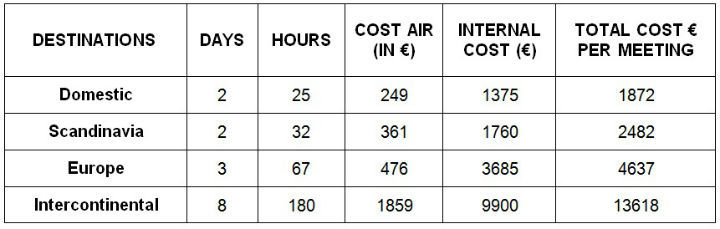
This means that even a short domestic trip will carry a price tag of almost €2,000 including the hours away from the base. This does not even consider the inconvenience to the traveller's family, physical well-being and the wasted time on the road.
In a globalised world there seems to be an expectation that developing your business means excessive travel spend. Cultures are different and some people or partners need more face-to-face meetings than others, but most companies are not aware of the total cost of trips including the time the traveller is away from the work place, and perhaps more important, the family. This might become more important as millennials move up in the ranks. This group are more unlikely to accept that travel is just something they are required to do and may oppose spending their free time being in a plane 35,000 feet above the ground for work.
Every company monitors costs carefully and has various policies in place in order to control it. In the new world of strategic supply chain management, the return of investment gets the priority it deserves.
Does this imply that you need to avoid travel? Absolutely not. You just need to be aware of whether the meetings including travel are loss-giving or profitable. You will always have some 'loss-giving' trips, but the meeting could bring other values like a better relationship, better communication or long-term return of investment which would be more of a reason for the trip to take place.
What should you look at in order to create the ROI on travel?
One way to look at influencing travel and meetings spend is to increase the use of virtual technology. Many companies have already embraced a wide range of virtual meeting capabilities from mobile for employees on the road to video conference rooms or PC-based products. Companies have already changed communication and this will continue in the future. New video technology can be used to train local workforces on the other side of the world with perhaps your own cameras or basic options like Skype. Video conferencing is not free of charge though, so you will still need to factor this fee into the cost of the meeting.
However, the business will still need to conduct face-to-face meetings and talks. Ideally any meeting outside your work base should carry a measurable value of more than €2,000. You need to reflect this information in your travel policy and have a key to compare with other communication possibilities. Of course, deciding on some of the rules will not be rocket science. If you are working for a company that installs a particular system then the fitter will need to travel and an engineer will go with them to monitor progress. Here are some ideas when face-to-face meetings and physical travel is relevant.
- To become acquainted internally or externally with new employees, contacts, dignitaries or networks
- Introducing yourself to prospects
- When it is the local culture of your customer or relevant to you relationship to meet
- Agreeing how experts will assemble a product at a destination
- Board meetings
Encourage or put in the policy that employees should avoid travelling for meetings that are just an update and/or where there is a fixed agenda covering the same subjects. Also cut out the 'used to be' or 'nice to have' meetings.
When in doubt, document a return on investment for the meeting.
Here are some examples of policies that you may consider
- Internal meetings should always be Skype, video or phone calls. Travel should only take place when introducing new people, complex products projects or parties. If it's an internal meeting with several participants, the meeting should take place at the site where most have their work base.
- The rules for internal meetings are also applied to administrative meetings and conferences.
- Customers in existing accounts should always be met face-to-face. However, their time is also valuable so video conferencing or calls may apply. Remember to register if billable to the customer.
- Relationships are important so there is a need for face-to-face meetings with those in the supply chain. Smaller and less important suppliers could be handled electronically, but it depends on culture.
- There needs to be some flexibility with sales meetings and these can be looked at on a case-to-case basis. However the sales person should try getting other sales meetings at the destination to maximise the trip.