The middle market of the hotel industry seems to be disappearing. There's no question it's being squeezed and has been for some time. I must be getting old as this is the second time I've written on this subject but I suppose everything is cyclical and what goes around comes around.
As major buyers of hotel product you should have a voice in the shape of the emerging industry. To have a voice you need a view and if this missive helps that then good, I'm happy.
Why is there a vanishing mid-market and where will it end?
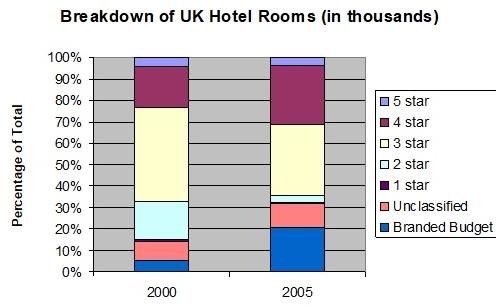
In 2008 I wrote about the vanishing middle market and from the graph you can see just how pronounced that was between 2000 and 2005. At that time we spoke of the 'undefined' mid-market; hotels that were generally converted from residential houses which were banged together to form one viable hotel unit.
They were never designed around the needs of consumers or operational efficiency and as a result they were usually quite expensive to operate because their lack of thoughtful design eg rooms of all different sizes or a kitchen on a different floor to the restaurant. Consumers put up with them rather than desired to stay, and at best they didn't make a lot of money unless the market was stonking.
Then along came Travelodge and Premier Inn which offered the simple proposition of a basic but clean and functional bedroom, either no or a breakfast-only restaurant and a standard, predictable guest experience that could be defined as 'everything you need and nothing you don't want'. That was the tagline for Purple Hotels when I ran the company and is now being used in a very similar way by Holiday Inn Express. I'm not sure whether I should be happy that imitation is the highest form of flattery or whether I should call a copyright and trademark lawyer!
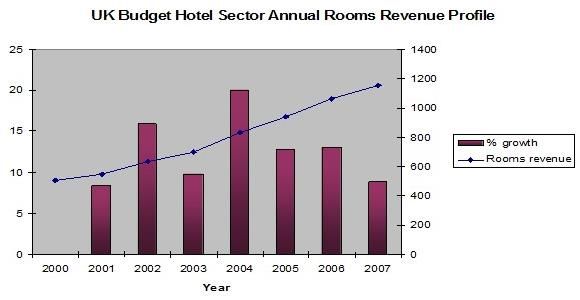
Anyway, those two grew by something like 60% in 2000-2005 and in so doing knocked the stuffing out of the undefined mid-market hotels which were generally more expensive and a worse experience than the budget hotels. The latter recognised that there were enough high street restaurants, local gyms etc and that customers could bundle their own package of services rather than rely on the hotel to do it for them. It worked, partly because of the above and partly because of the way that investors look at hotel developments.
The capital structure of hotels matters
The problem with hotels, unlike other businesses, is that when they fail they don't go away. For the most part hotels are very difficult to convert into any other form of alternate use; there's too much plumbing and electrics for a commercial office building and way too many bathrooms to economically convert to residential. So rather than disappear they are refinanced until they reduce to a level of capital cost that can be supported and they stay in the market, albeit as also rans.
That's exactly what happened during the financial crisis of 2007-2008 when hotels all over the world were going into administration and receivership. All of a sudden there was a flood of cheap, if not very good, assets coming onto the market and those that were bought then received minimal amounts of new capital to refurbish to minimum viable operating standards.
And so back came the undefined mid-market. A few firms and people made quite a lot of money on buying cheap assets and then selling on.
 Quite a few got stuck with underperforming businesses because the underlying problem was that consumers, now powered by endless amount of information and choice, were demanding more than just an unlovely hotel and restaurant. Instead they stayed with their preference for either cheap and no frills, or expensive but really good. The world changed; travellers were no longer 2-star or 4-star customers; we were all of them at different moments along our purchasing timeline. We wanted black or white, not grey.
Fast forward to the present and what do we see?
There are two drivers between hotel development and the affiliation of hotels to brands. One is the real estate play that is the underlying capital structure of the hotel and the other is the operating requirement to build products and services that consumers want and are prepared to pay for — which is now defined by the brand standards of the major brands; Marriott, Intercontinental, Hilton etc.
Today it is unusual for hotels to be managed by the building owner. 95% of all rooms worldwide are now operated separately from their ownership. The market for new build hotels therefore splits into two blocks; a fit to brand standards for high volume, mass market brands and the perceived growth in asset values for high end 'trophy' hotels.
This is polarising investment into the two ends of the spectrum. There is the luxury sector of the market where assets over time become trophies like the Ritz in Paris or London or Waldorf Astoria in New York. The Sheraton in Doha, Qatar is a really good example of this - an extravagant design built 30 years ago on a barren sand spit on the Doha Corniche now standing on some of the most expensive land in the Gulf.
At the other end of the scale, budget hotels have low entry costs, low development costs and lower operating costs therefore higher margins. As a consequence, they are very attractive to both developers and operators particularly those with a franchise, 'asset light' model. They can quickly develop very cash generative, profitable businesses while accepting that the building will never be a trophy.
New kid on the block: luxury and lifestyle
When luxury and lifestyle properties first appeared back in the 90s they were quirky, different, uncorporate, unstuffy and lots of fun. It was also a relatively low entry cost for investors.
Now all the big operators have lifestyle brands. In the early days they were 'cheap chic' conversions (the first Ws were Sheraton or Holiday Inn conversions) and it was inexpensive to develop the minimalist decor that was so cool and trendy. Now the development costs of a W are pretty much the same as any other luxury hotel so luxury and lifestyle have largely merged into one. However, whereas a traditional luxury hotel requires the best address in town (Park Lane, 5th Avenue, Rue St Honore), part of the lifestyle proposition is that they are in up and coming places like Shoreditch or  Harlem which have relatively low entry costs on land. That translates into very big asset gains if the area develops. Lifestyle and luxury are virtually inseparable now; it isn't about fawning service, it's about guest experience.
As a result, investment in luxury and lifestyle is strong. Unsurprisingly, these hotels command a high price point due to the high staff-to-guest ratios but they have high development costs. Nevertheless there is a lot of investment appetite for these businesses because the capital appreciation is potentially so good.
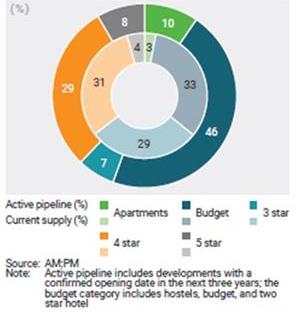 UK supply and pipeline
The graph here (from HVS) shows UK current supply on the inner ring and new supply on the outer. Budget dominates with 29% of existing supply and 46% of pipeline. Premier Inn and Travelodge alone account for 52% of this.
Luxury is 35% of current supply and 37% of pipeline.
And where's the mid-market? 29% of current supply but only 7% of pipeline. Not much investment appetite for that then.
Investment across Europe
The 10 largest hotel investors in Europe in 2016 and Q1 2017 accounted for 221 transactions (sale and purchase) and €7.4bn in value over the past 15 months. And this is the tip of the iceberg.
In total Catella reports €17.8bn invested in hotel assets in Europe last year. It goes on to state that there were 192 single asset transactions, ie one property, at €4.7bn with an average transaction value of €24m. 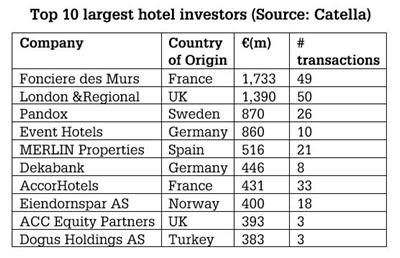 These are all likely to be trophy or potentially trophy assets; luxury and lifestyle (not all details are made public due to commercial sensitivity).
Bottom line: there's plenty of investment going into hotels but it's polarising towards both ends of the spectrum; no frills budget and affordable luxury/lifestyle.