What a journey the miniaturisation of computing power has taken us on. Intel's first chip released in 1971, the 4004, contained 2,300 transistors on a 12mm2 square chip. The company's Xeon Haswell E-5 chip launched in 2014, which admittedly is ten times bigger in physical size than the 4004, has 5 billion transistors on it.
And that's what drives the fact that we all have more computing power in our pockets on our smartphones (not really phones at all) than Apollo 11 had on its journey to the moon in 1969. Moore's Law has moved computing from entire floors of big buildings to desktops and now pockets. The weird thing is that just as the growth in computing horsepower emanating from ever more powerful microprocessors is finally slowing down, computing power is growing exponentially — what's happening and how will affect the travel and hospitality space?
The next three big things in automation — a summary to make everything else fit into context
1. The Cloud - large data centres that hold individual and organisational data rather than leaving them on individual servers and computers means that the amount of relevant data that is searchable and usable in forming insights, big data, has grown and continues to do so geometrically. Goldman Sachs reckons that Cloud computing grew by 30% in 2015 and will continue to do so until 2018. Oracle say that this year 51% of all work will be done in the Cloud and that by 2020 one-third of all data will be in the Cloud.
2. The Internet of Things (IoT) — everything is becoming connected to the web, not just computers. Example: the inkjet printer in my office had a pop up window which showed ink levels, helpful. Two software upgrades ago they added an 'easy purchase' button so that I could buy new cartridges online, even more helpful. Last upgrade the printer now orders cartridges when the ink levels run low and charges my stored credit card. The Internet of Things. Cheap chips and sensors in everything from printers to fridges to cars to aircraft engines and showers and clothing and more ad infinitum. Gartner, a consulting firm, thinks that by 2020 there will be 21 billion devices connected to the internet worldwide
3. Deep data analytics — with everything connected it's possible to know where someone is, what they are doing, buying, using at any time. Yes, there is a huge privacy debate which will have to happen about that, but analysing all of the data in the Cloud to make relevant and genuinely helpful interventions will become the new marketing. This will be largely powered by new computing developments particularly in artificial intelligence (AI) all of which will lead to a huge disruption in the way we do things - the digital disruption.
'Ah but you can't replace good service with technology.' Wrong. Service is dead, experience is everything. It's all about YOLO and FOMO
YOLO, 'you only live once', and FOMO, 'fear of missing out', are what drive the expectations and desires of millennials. Great service isn't going away; it just isn't enough. There's nothing aspirational about forelock tugging, scraping and bowing, yes effendi, no effendi, quiet service. In fact, it's rather dull. Millennials, often the drivers of change, want experience and something to remember, which has bragging rights and they want to get it now, immediately. Google has made us all very impatient. The problem is that delivering experience and service is so expensive that it isn't commercially viable on anything less than a Disney scale. That's where AI comes in.
Artificial Intelligence - Hilton and a small but innovative group of hospitality providers are already using IBM's Watson, an AI technology, to provide a virtual concierge. As AI becomes cheaper it will take over many call centre and information source tasks which it will perform in a human voice or in speech to text, or vice versa; these are functions which users will access through their mobile and tablet devices. AI, which isn't just dumb computing crunching through vast amounts of data, will, with the user's permission, access their social media sites, learn what they like and don't and then using advanced search techniques provide answers to unstructured questions based on each individual's preferences and wants. If you can remember HAL in the movie 2001 A Space Odyssey, it's that without the malevolence.
Continued below
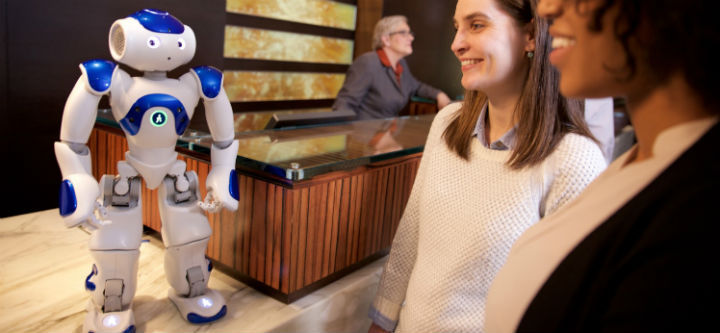
Hilton has introduced 'Connie' in some hotels
In hotels the need to check in at the desk will disappear and keys will become redundant. Check in will happen remotely on mobile devices, as it does now for airlines.It's a bit trickier for hotels than airlines; a boarding pass is only used once, a door key many times and double occupied rooms need two keys so security becomes an issue to manage. Keys will be mobile phones or even the person themselves by means of a biometric code, a thumbprint, retinal scan or facial recognition, like your electronic passport. Many phones already use a thumbprint to unlock so the technology exists.
Building management will allow each room to be pre-programmed to the user's preferred room temperature, ambient lighting, even shower or bathwater temperature. Right now buildings are managed around the space they occupy. Smart controls, AI and deep data about customers will allow the person rather than the area to be the focus of environmental controls.
Customer relationship management — CRM will combine AI to understand sentiment behind communications and react appropriately based on whether the customer is happy, sad, angry, etc. Combine that with geo location to make relevant offers and suggestions based on where you are and for the generation that never puts their phones down, 'speaking' to their virtual assistant' will not represent a drop in service levels, it will be a rise in experience value. Permission marketing, for their certainly is a privacy issue to manage here, will return in spades from a short and relatively unsuccessful start in the 1990s.
Asset light — the brains will continue to be separated from the bricks as the business of owning customers and their permission to market and the delivery of the customer experience will move even further from the ownership of buildings and real estate. Which will be the first of the big hotel brands to neither own, lease or manage a single building? My guess is IHG. This is digital disruption writ large.
Digital disruption — it's here, it's now
Digital disruption is the change that occurs when new digital technologies and business models affect the value proposition of existing goods and services. Here's a few generic types and they aren't, 'coming to a neighbourhood near you' soon. They're here now. Look at some of the brand names.
- The Subscription Model (Netflix, Dollar Shave Club, Apple Music) Disrupts through 'lock-in' by taking a product or service that is traditionally purchased on an ad hoc basis and locking-in repeat custom by charging a subscription fee for continued access to the product/service
- The Freemium Model (Spotify, LinkedIn, Dropbox) Disrupts through digital sampling, where users pay for a basic service or product with their data or 'eyeballs', rather than money, and then charging to upgrade to the full offer. Works where marginal cost for extra units and distribution are lower than advertising revenue or the sale of personal data
- The Free Model (Google, Facebook) Disrupts with an 'if-you're-not-paying-for-the-product-you-are-the-product' model that involves selling personal data or 'advertising eyeballs' harvested by offering consumers a 'free' product or service that captures their data/attention
- The Marketplace Model (eBay, iTunes, App Store, Uber, Airbnb) Disrupts with the provision of a digital marketplace that brings together buyers and sellers directly, in return for a transaction or placement fee or commission
- The Access-over-Ownership Model (Zipcar, Peerbuy, Airbnb) Disrupts by providing temporary access to goods and services traditionally only available through purchase. This includes 'Sharing Economy' disruptors who take a commission from people monetising their assets (home, car, capital) by lending them to 'borrowers'
- The Hypermarket Model (Amazon, Apple) Disrupts by 'brand bombing' using sheer market power and scale to crush competition, often by selling below cost price
- The Experience Model (Tesla, Apple) Disrupts by providing a superior experience, for which people are prepared to pay
- The Pyramid Model (Amazon, Microsoft, Dropbox) Disrupts by recruiting an army of resellers and affiliates who are often paid on a commission-only model
- The On-Demand Model (Uber, Operator, Taskrabbit) Disrupts by monetising time and selling instant-access at a premium. Includes taking a commission from people with money but no time who pay for goods and services delivered or fulfilled by people with time but no money
- The Ecosystem Model (Apple, Google) Disrupts by selling an interlocking and interdependent suite of products and services that increase in value as more are purchased. Creates consumer dependency.
The reality we are living through now gives rise to some stunningly disruptive business models.
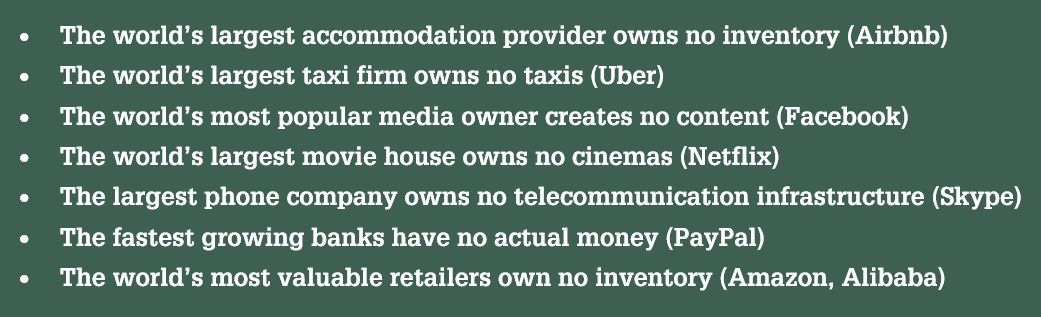
So it's more than academic to ask 'where will hospitality and travel fit'? Airbnb and Uber are already disruptive new entrants to a long established market. Who's next and in what shape?
There's a joke among computer geeks that goes, 'There's a law that states that the number of people who predict the death of Moore's Law doubles every year'. That has them rolling in the aisles in Silicon Valley but the serious points it underlines are
- That Moore's Law (the self-fulfilling prophecy more than law), coined by Intel co-founder Gordon Moore in 1965, stated that the power of computers would double every two years is finally coming to an end after 44 years.
- People have been predicting that this would happen within a year (including Gordon Moore himself) since 1995! This time it does seem to have some validity inasmuch as the cost of designing microscopic chips is growing at twice the rate as the amount chip makers can charge for them. It's an economic end to ever more powerful chips as much as a technological one.
So, finally,what role will people have in this brave new world? A good one for sure but if you don't need people to do mechanistic tasks such as check in and out, reservations and concierging, what do you use them for? To deliver an experience that makes customers go wow. And right now the only computer powerful enough to figure that one out from start to finish is the human brain. We're not dead yet!