Since it's almost silly season I'm taking the opportunity of talking about food, the final frontier in business travel management; a place behind, beyond which no travel writer or blogger has gone before.
Well some, but not many, and it's an interesting area for discussion.
In an ever more managed, directed and wrapped-up world should the choice of what we eat and drink and how we live when we travel on business be brought into the remit of procurement, compliance and oversight? Or is this really the final frontier, the one area that organisations should just stay the hell away from because not to do so crosses the line between dictating corporate behaviours and respecting individual freedoms?
Let's look at that from both sides. There's the supply side where there is a ton of innovation happening in restaurants and catering (all of it good) and the demand side. Just how far should the firms' CSR for the well-being of its employees and the management of their behaviours actually reach when they are travelling at the firms behest and for its benefit?
Corporate social responsibility or interfering busybodies?
I am a liberal economic and open markets guy to my boots. I believe that governance is best when it's light touch and long range, governments are best when they're small and that self-regulation is best– with the possible exception of football associations in Switzerland (although maybe FIFA is the exception that proves the rule in that its antics are rare to the point of unique).
The same applies to companies. If firms ever more tell managers what they should and shouldn't do then managers will stop thinking for themselves. Not helpful. But in this instance, as ever, there's a but. A 2011 study in the Journal of Occupational and Environmental Medicine by Andrew Rundle and Catherine Richards of Columbia University's Mailman School of Public Health has found that frequent business travellers who spend the most time on the road tend to have higher rates of obesity and poorer (self-rated) health than those who travel infrequently.
Frequent travellers had worse outcomes on various health measures, the study found, including
- a mean body mass index (BMI) of 27.5, versus 26.1 for light travellers
- a mean 'good cholesterol' (or HDL) level of 53.3 mg/dL, versus 56.1 for light travellers
- a mean diastolic blood pressure (the bottom number) of 76.2 mmHG, versus 74.6 for light travellers
- a 260% greater likelihood of rating their health as fair to poor, compared with infrequent travellers
Given these findings, does the firm have a duty of care to save us from ourselves? We all know it's easier to order a club sandwich and fries for dinner and veg out watching a movie or sport on the road than we would normally do at home. If the hotel doesn't have a gym, you have an early meeting or something gets in the way the thing that will be sacrificed first is the healthy regime that most of us maintain at home. To put food and drink in focus within the travel or procurement department travel managers could ask themselves the below.
- Should expenses be used as a tool to promote healthy living?
- Should the firm's travel policy drive travellers towards hotels that have fitness facilities – and ensure from the folio and the annual medical that they are used?
- Most contentious should the firm exert influence over individuals' choice of healthy restaurants and eating, even if this is more expensive?
This economically liberal, free market, non-interventionist thinks that in this case the answer is a limited yes. Obesity and other self-inflicted illnesses (acknowledged not all obesity cases are self-inflicted) not only have a hidden cost to society but also to the firm. We prevent travellers from using what we deem to be unsafe airlines or staying in unsafe hotels so why not extend that to unsafe eating and drinking?
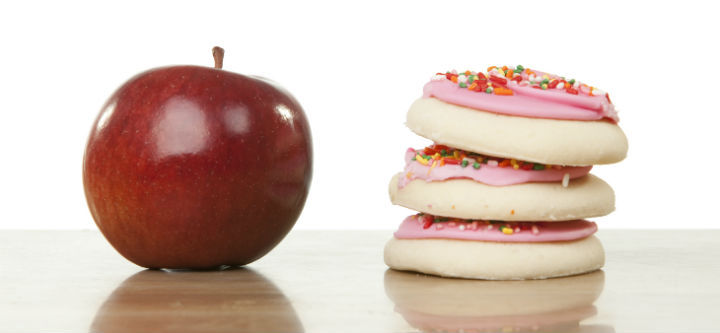 We know what the healthiest option is but how often do we choose it? ©Christine Glade/iStock
As long as it's light touch, measured by the consequences rather than dictating exact behaviours, why shouldn't the firm reward healthy living on the road and penalise unhealthy through a mix of it's
- Procurement policies: don't cut budgets so that the only affordable dinner is a meal deal from McDonald's. List 'recommended' restaurants that have or promote healthy food options at least in high volume destinations and only use hotels with gyms/fitness rooms
- Expense policies: don't reimburse junk food and excessive bar bills, reimburse gym use
- Annual medical: validate that travellers are following these policies
Hot things happening in food this year; it's never been easier to eat and live well
Grilling: In Europe they've known for years that grilled food is healthier than fried. The cooking burns off most of the fat so the 'grigliata mista' rather than the 'fritto misto' is set to take off beyond the shores of the Med. In London places like The Chicken Shop, The Ivy Market & Grill as well as a host of low-cost street food stalls and pop-ups are making this real now.
Fire: A more extreme version of grilling - cooking on open flames so the ash, embers, soot and other residuals makes for low fat, lean food. The most famous practitioner is Ekstedt in Sweden but they will be followed by others. The French Horn in Sonning, England has been roasting ducks in front of their fireplace as long as I've known them and almost all Turkish food is cooked over flame or embers - not to mention anything cooked in a proper wood fired pizza oven or tandoor.
Tahini: The latest superfood. British chef and restauranteur Yotam Ottolenghi has been raving about this Middle Eastern paste made from sesame seeds, which is one of the essential ingredients in hummus. It can be used in salads by itself which is a fantastic source of Omega 3 and 4.
Freekeh: Pronounced 'fari-keh', this other Middle Eastern grain is made from green wheat. Used in more or less exactly the same way we use quinoa (that's 'keen-wah', which is so last year) as an ingredient in salads, or an alternative to rice or couscous with an evening meal, it's going to find its way onto lots of menus this summer.
Cross-bred vegetables: Have you heard of kalettes? That's a cross between kale and brussels sprouts. Broccoflower? No? Oh yes you have – it's marketed as romanseco and is a cross between broccoli and cauliflower. It's happening with fruits too. Tangelo: a combination of tangerine and pomelo and pluots – plum and apricot. Lots of very edgy and tasty things happening in the fruit and vegetable space and lots of chefs are playing around with them so expect some new foodie fads featuring these.
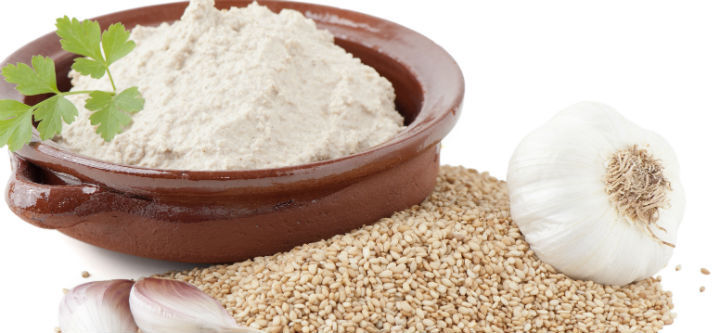 Alternative: tahini ©pepmiba/iStock
Genetically modified food is OK (at last): The debate is over, GM foods are safe, so the 'we don't serve GM foods' tag on the menu will disappear and we can all eat the produce of the farm without any concern. It's worth remembering that GM was developed to increase yield per acre so that more of the world don't go hungry. It also means cheaper fruit and vegetables over the long term.
Meat-free: Not the politically correct 'all meat is murder, feel bad that you were born as an omnivore' rant of the seventies but a balanced approach to having meat free days or even weeks. It isn't that hard and your arteries will love you. British chef Jamie Oliver is on to this now so the television blizzard that will follow will make this an option in lots of staff canteens as well as in hotel restaurants.
Sprouting foods: This process allows seeds to sprout before they are harvested and milled into flours and such. Malted bread has been making use of this for years but we'll see a wider use of sprouts in salads and baked goods than before. Very helpful for coeliac sufferers or anyone going wheat or gluten free as this process helps break down the starch in the plant before we eat it and is easier on the digestive system.
Beyond this look out for edible soil (the real stuff, not a Heston Blumenthal way of making chocolate look like soil), egg white ice creams, chia pods, kale lollies and insect bars. Yes, insects are going to be the superfood of the 2020s – there are an awful lot of them, they are very nutritious and we are going to be nine billion mouths to feed by the middle of the century.
There's a ton of things happening in kitchens that are too numerous to mention but how about alcohol aware ice cubes that flash in your glass if you're drinking too much or too fast? What about smart knives that have a digital display of the bacteria content coming into contact with their surface as well as sugar, vitamins, protein and fat in the food they cut. They also emit negative ions to help keep the food fresh. Other developments include printed Q codes directly onto meat so there is no chance that the food was mislabelled.
The opportunity to live well and stay well is growing exponentially
So cutting-edge firms, how will you embrace that without it becoming the 'dead hand of health and safety'?
Well, before I fulfil that long time mantra of the City, 'Sell in May and go away, don't come back until August Bank Holiday' here are my top tips for living well on the road.
- Reduce travel by use of technology and increase spend per trip for frequent, more than 100 nights away travellers regardless of rank or grade in the firm
- Only use hotels with fitness facilities and that have healthy eating options on all menus
- Start listing and promoting (not enforcing) use of healthy restaurants and menus
- Employ or retain a nutritionist to create menus for regular and frequent business travellers to help them make smart choices
- Make the annual medical twice a year and benchmark BMI, cholesterol and blood pressure. You don't get promoted if they are getting worse
- Pay for gym membership like you fund educational programmes, the expense only gets reimbursed on proof that you've turned up and done the workout
Live well, be happy.