Hilton built an empire on the proposition of 'New York wherever you go'. In other words everything bundled up under one roof: rooms, restaurants, bars, meeting rooms, spa and the inevitable gift shop, all done the way you're used to. You really didn't need to go outside the hotel for anything if you chose not to.
Nowadays that feels more like a gilded prison than a great array of product and service. Half of the fun of going to a great city like London, Paris, or anywhere else is to sample the local cuisine and get immersed in the local culture, not stay within the confines of the hotel all the time. As travellers have become more sophisticated and less nervous about eating and going out, hotel facilities are finding themselves competing with the high street. And the high street is winning. All of which has affected hotel design and development.
Travel managers need to find the balance between what their travellers want and how to maximise hotel rates as these new behaviours and designs come into play. Hotel groups have broken off into several brands that aim to appeal to different traveller types with varying levels of service, atmosphere and facilities. Understanding the differences could help travel managers to seek out the best ones for their travellers.
Nowadays, rooms make about an 80% gross profit margin in most hotels while restaurants generate about 30%. Bedrooms are occupied at more than 70% annually and meeting rooms around 35%. If you and I were building a hotel today for our pension pot, purely for a returns perspective, we would just build a block of bedrooms. Let's call that model Travelodge. It's a very high ratio of revenue-generating floor space to total footprint, very high margin on everything you do (in this case, rooms only), a low room rate, basic design and décor all wrapped up with a low touchpoint service level.
Let's take a short trip up the value chain
If we jazz that model up a notch so that we get a higher room rate the traveller would get a limited service hotel similar to a Hampton by Hilton or a Fairfield Inn. It's the same basic concept but with a combined bar/restaurant/lobby added.
Continued below
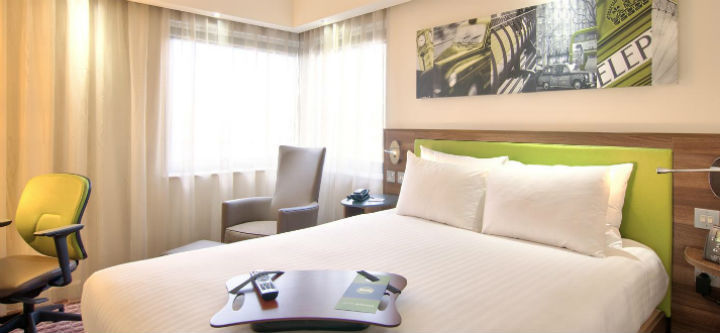 A room at the Hampton by Hilton Amsterdam Schiphol hotel
However, the restaurant is only open for breakfast (about 85% of guests will have breakfast, 20% will have dinner if the hotelier is lucky) to keep the operating cost, and therefore the selling price, nice and low. Having a restaurant open, even just for breakfast, means service personnel and that means a somewhat greater level of service. It's still a pretty utilitarian design and, as the name suggests, a limited service although it will be called anything but limited. It will be defined as a select or focused service by brands (if you want a good euphemism, ask an American).
Okay, let's take it one further. How about a Hilton or Marriott-lite brand; let's call it Hilton Garden Inn or Courtyard by Marriott. The room product in these hotels is very close to that of their parent, core brand but the operation is designed to minimise staffing because staff are expensive.
As it's a pretty decent room rate it will include things like free WiFi and free breakfast (ie breakfast included in room rate) which you would pay extra for in the higher rated, luxury hotels like JW Marriott or Hilton. So the cheaper it gets, the more you get included. Wow, that seems backwards, but it's the way it works at present.
In this hotel type the rooms are not too indistinguishable from their full service cousins but there has been more than a bit of a designer's hand over the entire building. But here the traveller is still carrying their own bag and there's no room service. If a traveller wants food it's a trip to the lobby shop to buy a microwavable meal and a drink or they might head somewhere nearby. The hotel is providing a pretty decent room, a nice lobby with the ability to have breakfast and the option to buy other food and drink in a hotel version of a supermarket, and that's it.
The only way is up: lifestyle
So having journeyed from budget to limited service we find ourselves at lifestyle hotels. It's still a sector that defies a definitive description but lifestyle properties are certainly a design-led sector.
It encompasses modern trends in restaurant and bar although these are frequently outsourced (eg Hoxton in London) and it aims to be different from the established brands. These are non-corporate on appearance even though they are by-and-large owned by big corporations and are full of themes like local, empowering and energetic.
At its entry level the lifestyle segment is a design-led, limited service offering with brands like IHG's Indigo, Marriott's Moxy and Starwood's Aloft. At its top end it is luxury such as the Morgans, W and Design Hotels names. One does get their bags carried at these places, usually by a nice chap wearing a black Armani shirt and trousers. Travellers normally get to choose from a restaurant serving Peruvian or other exotic, somewhat off-the-wall cuisine and will be served by a waiter often with several piercings and in need of a shave.
The style of service at lifestyle hotels strives to be intimate and genuine but can fall into condescending as this is the territory of service without servitude. It works most of the time, but the rate is undifferentiated from a traditional luxury hotel, so you pay top dollar for it but it can be both funky and flunky. It's fair to say these hotels offer service as a product as opposed to service as a culture.
Where next?
The economics of building new hotels is becoming very challenging. The cost of factoring in meeting space that is rarely used, restaurants and bars that face fierce competition and the need to grow average rate ahead of rent or lease increases and wage inflation kills more projects at birth than ever get out of the ground.
The Travelodge block of bedrooms remains fiscally very attractive but travellers continue to demand surroundings in hotels that are equal to or better than what we experience at home. These big-bundled boxes are going to struggle to survive at their current number. They won't disappear but they will become the preserve of big (and expensive) cities and exit provincial, secondary and tertiary locations.
It costs almost as much to refurbish one of these hotels as to build it in the first instance, and the returns are way less attractive than the limited service model. It's more likely that a big full service hotel will be developed into a mix-use development of limited service hotel, residential and some retail so it gets the capital replacement it needs after 15 or 20 years in operation. This is 'adaptive reuse', a phrase you will hear repeatedly in the coming years.
And will we miss those larger hotels? Arguably, no.
As a good chum of mine has a habit of saying to bellmen asking to carry his luggage, "Thank you but I've schlepped this bag for the last 5,000 miles, I can manage then next 200 yards". Anyway, haven't bags with wheels made bellmen more or less redundant?
Do travellers need a hotel restaurant? No, they don't. Going out is part of the experience. There will be destination restaurants in luxury and lifestyle hotels that will compete with standalone restaurants but the 'do everything for everyone, death by buffet' hotel restaurant is dead in the water due to waning consumer demand and the impossibility of overcoming development economics.
A bar, and ideally one which serves limited food, is a different story. A hotel without a bar is a hotel without a heart.
Watch shared space developments and brands like Clink Hostels, Meininger and other new entrants. These might be hostels, as they were previously known, but are very cool and funky and only cost around £25 a bed for the night.
This very low cost option is going to take on a new identity. Think of it this way; you probably wouldn't want to share a bed room with 10, mixed sex strangers sharing three lavatories, right? But would you fly first class to Sydney? If the answer is yes then for 21 hours you'll be sharing a room with 10 mixed sex strangers and three lavatories! For cash-constrained sectors like not-for-profit or the third sector this could be a boon.
Also watch the shared economy move into its next gear as firms like Airbnb get into the corporate space.
And be prepared to carry your own bag.