If you don't regularly have employees travelling to high-risk destinations, do you really need a travel risk management programme? It's something I do get asked… and my answer is always an emphatic yes. Legal responsibilities aside, every organisation, large or small, has a duty of care to protect their employees wherever they may be.
The important thing to remember is that a travel risk management programme doesn't just deal with the major incidents or cover your people in high risk areas. A travel risk management programme will also help you prepare for and mitigate against far more common occurrences such as travel disruptions, road traffic accidents or medical-related incidents. Although these incidents may not hit the headlines, they can (and do) have a significant impact, not just on the individual traveller involved but also on the organisation as a whole.
Before we get into the detail of what a travel risk management programme should include though, it's important to remember that it won't allow you to eliminate risk completely. It will, however, set out the necessary processes, procedures and actions that will allow you to manage it effectively (as one of my earlier articles outlined in more detail) and in doing so, limit the likelihood of any negative impact on either the individual or the organisation.
The core components
When taking buyers through the detail of a travel risk management programme, I find it helps to set it out in a more visual way and making it easier to contextualise.
Pre-trip
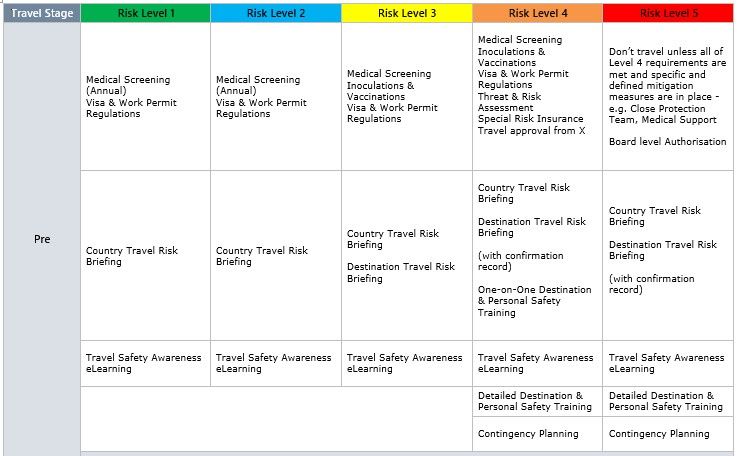
The groundwork for any travel risk management programme needs to be laid well before any trip takes place. Having the right policies and procedures in place and ensuring that they're communicated, understood and adhered to, is crucial.
You then need to ensure that you have a clear and accurate real-time picture of the risks that your people may face. Travel risk assessments are key ie evaluating and documenting potential hazards in a particular area or country including identifying the level of risk and suggesting steps to mitigate and control it. This is something that your in-house security team or travel risk management provider should be doing as standard.
For each of the identified risk levels (level one being low risk, level five being high risk), the following 'pre-travel' steps also need to be taken as an absolute minimum:
Active trip
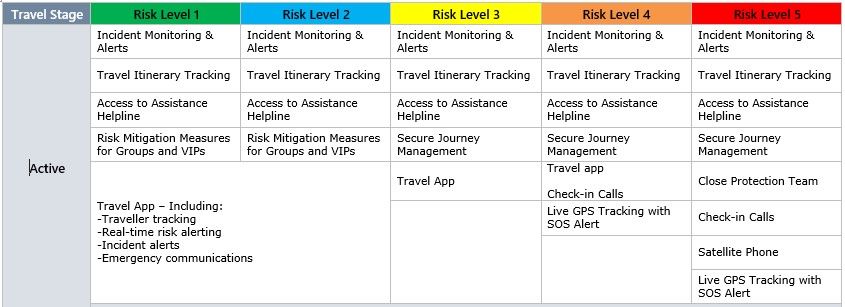
During any active trip, you then need to have the ability to not just locate your travellers at any given time but also communicate with them, alert them to any potential risks and, should the worst happen, be able to request immediate assistance. They in turn, need the ability to easily access advice and assistance, should their individual circumstances necessitate it.
The following shows the recommended minimum requirements, again, for each of the risk levels:
Post-trip
Although it's common to assume that once a trip is completed so are all of the required actions, this isn't the case. After a trip it's important that you also have a mechanism in place to gather feedback from all travellers in order to ensure that your programme and polices are actually working.

Having a programme in place is one thing but ensuring that it's fit for purpose, and continues to be so, is another. Ultimately, how effective is your travel risk management programme? Consider things such as how many incidents have been mapped against it. How quickly did/could you respond to each of those? Is this being measured and recorded? Are there any obvious gaps or areas for improvement?
Also look at your compliance levels. You may have provided your travellers with a tracking and alerting app, for instance, but how many of them actually have it installed and are using it fully?
Obviously, the matrix above is still a very simplified model. There's a need to factor in a number of additional elements, such as:
- Individual traveller circumstances
- The type/nature of your business
- Human behaviour
- Your organisation's attitude to risk
- The unknown!
All this considered, the matrix goes some way to outlining the basic framework that you need to have in place and is good starting point for assessing the travel risk mitigation measures that you should be taking, according to the travel stages and varying destination risk levels.
Key takeaways
It's clear that a sound travel risk management programme goes far beyond considering how to deal with an incident should it happen. For a programme to be truly effective, it needs to fully encompass both proactive and reactive measures and needs to be part of a company-wide approach to risk. It needs to involve numerous internal and external stakeholders who need to be working to the same end — to keep your personnel and your business safe.
To assess whether your own travel risk management programme is fit for purpose, ask the following questions.
- Do we have clearly defined policies and procedures relating to travel (from a health, safety and security perspective) that are not just documented but are communicated and adhered to by all concerned?
- Do we have access to reliable real-time health, safety and security information that can be used to support travel decisions and can be easily communicated to travellers before they embark on any trip?
- Are all of our travellers provided with the necessary pre-travel training and relevant briefings to empower them as individuals?
- Do we have a process for controlling travel to higher-risk regions?
- In the event of a safety, security or health incident, are we able to locate and communicate with travellers and advise/support them accordingly?
- Do we have a robust incident/crisis management plan for dealing with emergencies? And is this regularly tested?
- Do we have total confidence in all parties in our chain (internal and external)?