In 2017 without much fanfare, the Global Business Travel Association (GBTA) released an updated version of the global standard and well known Strategic Meetings Management Program (SMMP) Wheel. As a longtime evangelist for the SMM discipline, the changes are a welcome sign that SMM is maturing and becoming more inclusive of other factors in meetings and event management especially with regards to expanding into event management.
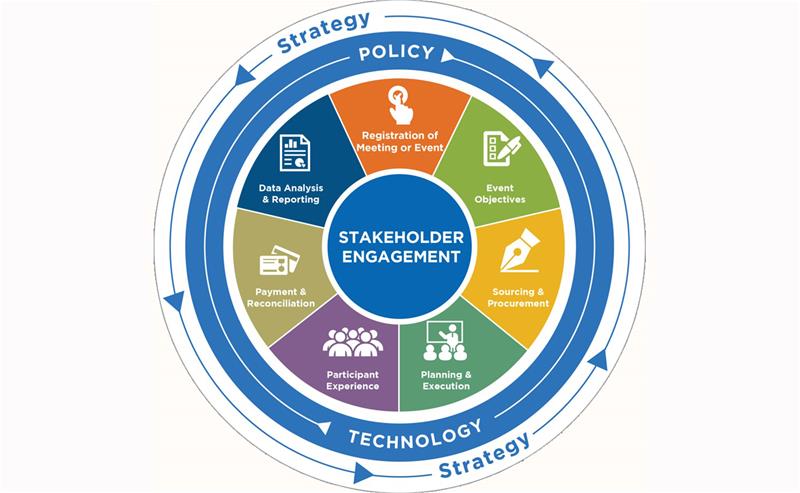
So, what has changed? In case you have yet to see the new SMMP diagram, here it is below.
Previous challenges with marketing
Immediately what has been included now into the SMMP roadmap for consolidation and enterprise management is Event Objectives and Participant Experience. These two new elements for SMMP are targeting the enterprise events vertical by design for maximum inclusion of all corporate meetings and events. SMM leaders have always wanted to include their marketing counterparts in their corporate SMMP. Truthfully, not many companies and SMMP leaders were successful in that endeavour.
Inclusion of corporate events proved to be difficult to "sell" to their marketing counterparts. If you are wondering why, it is because the initial value proposition for SMM was designed with procurement stakeholders in mind using cost savings and cost avoidance as the primary incentive drivers, along with process and supplier consolidation.
Many early SMMP adopters were quickly rebuffed by their marketing counterparts, as marketing events are more focused on experiential quantification and ties into sales and lead generation rather than cost savings. SMMP focused on getting buy-in from the chief procurement officer (CPO) and/or chief finance officer (CFO). In the original design, there was no consideration for the chief marketing officer's (CMO) needs, so SMMP was mostly rejected by corporate marketing stakeholders and, most importantly, event planners.
Adding further complexity into the situation, marketing had almost zero interaction and operational synergies with finance/procurement/administration or wherever the SMM category leader was positioned internally within their company. In very rare cases, like with Cisco Systems, did the SMMP leader report into the marketing department. Needless to say, they have one of the more successful SMMPs and it is no doubt due to the corporate reporting situation, which provides more unity in enterprise decision-making and support because the SMMP is part of the Cisco marketing group.
To add further disincentives for inclusion, SMMP technology platforms were not designed to handle the specific marketing data collection that marketing groups and executives rely on to track campaign information, lead generation, sales conversions, etc. Marketing-designed technologies are often not integrated with SMMP data, so that makes it more challenging to justify any value-added synergies between the SMMP leader and marketing stakeholders.
What the new diagram means now
Fast forward to today and it is gratifying to see that after much lobbying by many SMMP leaders (including yours truly), the diagram now includes marketing objectives and inclusions. In addition, marketing technologies and SMM technologies today can also be integrated to get full purview of corporate spend, activities and sales and marketing lead generation, along with return on engagement (ROE) and return on objectives (ROO).
Let us review the new changes and start to do a deeper dive on the new SMM diagram with the multi-coloured puzzle pieces within the strategy, policy and now technology outer rings.
1. Meetings Registration is now Meetings & Events Registration. It does not seem like a big deal but if you understand the different challenges that are commensurate with meetings vs. events when it comes to registration of attendees, then you understand this is a not an insignificant word inclusion.
2. The new inclusion or change of Event Objectives is now the olive coloured piece. While SMMP was founded with ROI (return on investment), marketing and events are more focused on ROE and ROO. Without this inclusion and update, there was no listing of marketing's objectives within SMMP.
3. Participant Experience was added to encompass why meetings and events take place and what are the areas that resonated with attendees. You cannot declare success in meetings and events execution without measurement of the participant experience.
4. Technology moves from the centre to the outer ring. Technology was always regarded as the primary enabler for a SMMP. While the relevance of technology is still unquestioned, it sits better along with Policy as the Strategy and Policy are the guiding lights for a SMMP and technology enables and automates both.
5. Stakeholder Engagement now resides in the centre of the diagram which was long overdue. One of the most common challenges and deterrents for SMM success has been getting the right level and commitment from ALL the key stakeholders within the company to support and use SMMP globally. Without stakeholder engagement and support, you don't and won't have a relevant and well-functioning SMMP, period.
I am a former NBTA (now GBTA) President from 2001-2003 who instigated the birth of SMMP by creating the Meetings Committee. We developed the programme in 2004 and SMMP was always designed to be a work in progress. I want to extend my congratulations to the current GBTA Meetings Committee for keeping SMMP alive and relevant with these important new changes.
These new changes validate this strategy and, most importantly, keeps SMMP relevant for today's global marketplace needs and for the immediate future.