The current political chaos and pending impeachment of Brazil's President are dominating the headlines and news about the upcoming 2016 Summer Olympic Games. What worries me most about this is that in the midst of all the country's comprehensive logistics planning and construction in order to be ready to host the Summer Olympics, this is distracting us from the potential global pandemic on Brazil's doorstep.
I am talking about the Zika virus and its potential to infect and affect the athletes, business people, meeting and event attendees, tourists and many others currently travelling to Latin America from many countries for the Summer games.
It's frankly not just Brazil which is experiencing this crisis but most or all of Latin America. It has finally made it to the US territories too, with Puerto Rico reporting an alarming number of growing cases of Zika.
According to the International Olympic Committee (IOC), some 500,000 tourists and athletes from 206 countries and territories are expected to travel to Brazil, which is considered the epicenter of the Zika outbreak. This means there is a high risk of the virus being transmitted back to the home countries of these visitors to Brazil and Latin America.
I keep thinking about the series of scenes in the movie Contagion where people are innocently infected and became unknowing carriers for the disease bringing it back to the US and other parts of the world.
An unfamiliar threat
Between 3 and 4 million people are estimated to have contracted Zika virus ailments since infected mosquitoes reached the Americas some nine months ago. Twenty-three countries and territories have reported cases and some 4,000 babies have consequently been born with the skull-misshaping microcephaly, according to the World Health Organisation (WHO).
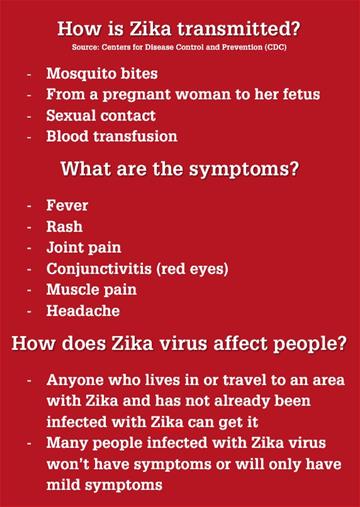 There is still so much that is unknown about this virus and its transmission between adults. Also there is uncertainty on how it affects not just unborn babies, but potentially also the adult hosts.
Add to this the possibility of contracting Zika while visiting other Latin American countries in conjunction with visiting Brazil for the Olympics and it does not take a maths whiz to calculate the odds of contracting the virus at some point during the trip in either pre and/or post-Olympic travel.
US health officials believe that there will not be a vaccine ready for clinical trials until the end of 2016 and it is likely to be several years before a vaccine is widely available. WHO anticipates an 'explosion' of infections in the coming months in the Americas and has expressed concern about the upcoming 2016 Olympics in Rio de Janeiro.
What has also become known recently is that the virus can also be transmitted sexually so men too can be infected and could potentially infect their female partners.
How travel managers should react
What should this mean to travel managers and corporate risk managers?
Here is a suggested checklist of actionable activities in which travel buyers should already be engaged.
- Travel executives need to reach out and collaborate immediately with their risk management counterparts to agree future staff communications and internal coordination of all business travel, meetings and conference leaders.
- They should also establish an on-going reporting cadence as well as a RACI chart (responsibility assignment matrix) for who is responsible, accountable, consulted and informed about the potential exposure of employees to the Zika virus.
- There should be a fully aligned warning communication to employees about the health concerns surrounding Zika virus transmission in the region.
- Managers need to co-ordinate all communications to include travel and meeting management company partners. This should include
- Setting up processes for reporting and pro-active vetting of travel requests
- Making sure the appropriate internal stakeholders are on a master contact list which is sent out regularly, preferably weekly, not monthly
- Creating a Zika FAQ document which specifies your company policies and processes that employees can access for travel to/from Latin America
Managers need to set a specific policy around travel to and from the Latin America region. Travel programme owners should ideally take a lead role since they are responsible for outsourced supplier management for TMCs and MMCs, reporting and stakeholder management. Many travel managers have reported this is already a line item currently mentioned on their monthly dashboard reporting metrics.
Managers should also consult with their human resources and legal departments to determine what insurance coverages could be applied towards any employees affected and any potential legal or duty of care ramifications.
Most importantly managers need to educate themselves and others on the real potential of this pandemic on Brazil's doorstep. Great regularly updated information is available from
The Business Travel Coalition
The WHO
Centers for Disease Control and Prevention (CDC)
Meetings and conventions special section on Zika
This is a serious situation that everyone needs to be prepared for immediately. Ignorance and denial will have catastrophic results especially for future generations to come.
Corporate travel, meetings, human resources and other departments need to be fully aligned and ahead of this potential pandemic crisis or risk potential unwanted future litigation from employees.