 Traveller centricity is the buzzword of the business travel industry but conversations are increasingly turning towards productivity of the traveller and, in parallel, the return (or loss) on investment of a trip. The pre- stage is already largely covered; it should be easy and quick to book travel. But are travellers making the most use of their time, and what happens to productivity and mood when they get back?
It's difficult to measure but we know that data speaks volumes.
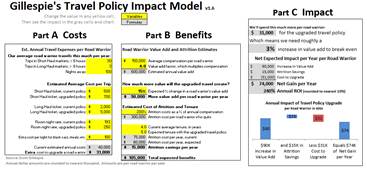
Scott Gillespie has been one of those at the forefront of this topic. At the Business Travel Show pre-show conference last month he presented a need for a bigger goal that looks at total travel costs and effective trips. He puts forward that companies should reduce the amount of travel taken on personal time and allow a better flight class and hotel; "traditional travel" costs might go up but he argues employees will be more productive and have a better business impact, such as more sales. After buyers asked how they could convince senior management he produced a free Excel spreadsheet so those handling travel budgets can work out what impact that extra cost could have — such as the example below.
But add artificial intelligence (AI) and even more data points wrapped up in a searchable, easy reporting dashboard and you can show the value of travel even further. I was genuinely impressed by the analysis tool presented to me by Manchester-based TMC Clarity the following day that did just that. Using AI platform IBM Watson, APIs and data points that are not just about travel, the TMC's new sentiment analysis tool blends information to consider angles such as (but not exclusive to)
- Indicating traveller performance via feedback vs sick days and employee turnover
- Factoring the true cost of travel based on an hourly rate taking travel costs, salary bands, Salesforce feeds, supplier feedback etc into account to work out productivity loss/gain
- Feeding survey results, social media, keywords etc to get a sense of how suppliers are performing
- Using police crime data to show where might not be the best area to walk through or where to avoid booking a hotel
- Historical hotel rates vs spend by city to forecast prices and show optimum booking windows
Speaking in a similar vein to Gillespie, Clarity's CEO Pat McDonagh told me "Business travel has to get deeply strategic and to maximise travel you need to pull data…to assess whether a meeting is a success. We have to justify the existence of a TMC and travel generates business, so we have to identify the behaviours to maximise that…and make it accessible so it directs travel managers to performance."
"Instead of siloed systems there is the capability for an MI strategy that goes through everything encompassing the supplier stream, call stats, sales; all of it," adds Darren Williams, head of MI and data.
Is this tool the start of more contextualised travel programmes and a shift to more strategic travel management?