There are some important differences in the way the business travel industry works in India.
Continuing from my earlier article on Business Travel IQ, which outlined strategies to successfully integrate India into a global travel programme, this piece outlines the primary variances in the dynamics of airline and hotel partners in India that European and global travel managers need to expect and consider.
It highlights some unique business travel practices relating to air and hotel programmes that India-based companies implement.
Industry partners
International airlines
When a travel manager is looking to roll-out a programme into other countries you might generally expect that your global contracts and partner relationships will simply extend. Things work somewhat differently on the ground
In India, outbound international air ticket prices are possibly among the lowest worldwide, especially when using promotional/restricted fares. It's common to find that your global air contracts do not cover the travel of your Indian employees on these special promotional/restricted fares, which are often assigned to a certain airline fare booking class, more commonly referred to as RBDs (reservation booking designator) in India.
Therefore you need to engage your global partners locally to secure local contracts that reflect your commercial leverage. Further, it's probably best to tweak your global contracts to ensure that your local Indian air spend counts towards your global targets and incentives.
It's best to ensure that your global and local airline account managers are working in tandem, so that data is accurately consolidated for your account. It's quite common to find that the transactional data and reporting either does not get captured centrally or it's ignored by your global airline account manager. This is usually because the Indian numbers in dollars/euros adds up to much smaller numbers, due to the exchange rate benefit.
Domestic airlines
The general trend in corporate travel among India-based companies is that most of the transaction volume is for domestic travel, but most of the spend is on international tickets. This means that securing robust domestic airline contracts is critical.
At present in India, there are three primary full service carriers (FSC) - Air India, Jet Airways and Vistara (launched January 2015). These airlines' inventories are fully available on primary global distribution systems (GDS).
On the low-cost airline front (LCC), the primary carriers are Indigo, Spice Jet and Go Air. There are smaller niche low-cost operators like AirAsia and Air Costa, but these have a very limited niche sector presence.LCCs have a significant share of the business travel market in terms of passenger numbers when it comes to domestic air travel; within India.
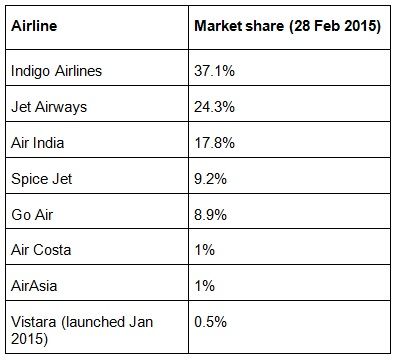
Source: Director General of Civil Aviation, India
LCCs in India are not bookable on the GDS so a TMC must set up an independent and direct API integration or book direct. Further, LCC integrations can be an issue with some self-booking tools in the market and this must be confirmed accurately to prevent surprises at a later stage.
Corporate deal programmes are common with both full service carriers and LCCs and are usually set on a corporate rate basis level. This is determined by the flight distance tier applicable.
The standard distance tiers for corporate rate programmes are
0-750 km 750-1000 km 1000-1400 km 1400 km+
The primary basic fare is fixed which includes the fuel surcharge. Ticketing and government taxes are additional and generally add 20% of the basic fare component to the overall cost.
In addition, for bookings on non-corporate rate levels (ie retail/web fares), the airlines generally offer a fixed or variable discount based on the class of travel. Productivity-linked bonuses (PLB), where corporates get a discount or additional value after accruing a certain volume of tickets, with an airline, are rare.
It's important to get complete clarity on the conditions attached, as each airline has a different nomenclature and conditions for inclusions/exclusions and charges.
Recently Indian LCCs changed their cancellation policies on non-corporate rate levels. This has resulted in a significant rise in the cancellation fee, sometimes going as high as 20% -or more of the total ticket price.
There are recurring instances where the pricing of LCCs are higher than FSC airlines. This is apparent in corporate rate programmes as well as in retail fares. This is largely due to the dominant market share that some LCC airlines have in India. When considered with the ancillaries that a business traveller pays for, the full service carrier's fare may today prove a more attractive proposition. Further, the loading of ancillary charges, increased cancellation penalties and layered pricing models places a question on the economic value of LCCs in corporate rate programmes. This requires a careful assessment, when contracting, to take a positive business call.
Hotels and corporate apartments
International hotel bookings - per diems as common practice
Common practice, especially with the IT/ITES/BPO corporate segment, is to give the employees a fixed per diem towards their hotel stay. Per diems are a daily allowance for expenses given to an employee when they are travelling for work, giving the individual a specific amount of money per day to cover living costs. The employee is at liberty when they reach the international destination to stay where they wish.
The company may not require invoices to support the stay expenses. This is implemented with a view to cap the hotel costs and encourage employees to be resourceful. Some companies even regard this as an employee incentive.
Others may offer their employees a grade-based room rate band within which the employee books the hotel, generally using the listed global hotel partners. Bookings are generally done direct with the preferred hotels by the employee or through the travel administration team.
Basically these approaches present a veritable nightmare of challenges from a data consolidation, reporting and duty of care perspective.
 Per diems mean the traveller decides where they stay. ©jenifoto/iStock
Booking hotels direct is also quite common with Indian travellers when they are taking an international trip and this should be considered when implementing a travel policy for Indian employees. International hotel bookings are generally governed by a separate set of policies which are widely different by the individual companies. While most multi-national companies have global hotel partners, these may or may not have been loaded on the Indian TMC's GDS access. Hotel programmes are usually not part of the TMC's remit in India.
An important challenge for global travel managers is to get their heads around the policy parameters set within their Indian operations as well as question approaches to 'cost minimisation'. Ensure a solid and consistent framework where the policies are enforced with a view to optimise the travel programme, with limited or nil local deviations.
Corporate serviced apartments and guesthouses
Corporate serviced apartments, or guesthouses as they are more commonly known in India, constitute a very large part of both the domestic and international accommodation category.
The use of international serviced apartments is generally a function of the policy of per diem entitlement that was mentioned earlier. Generally this is applied to those at the junior executive level and is largely operated through a peer network of recommendations, depending on the policy implemented for reimbursement of the per diem. There is a glaring absence of duty of care regulations with this policy, which must be understood.
The domestic corporate guesthouse market has exploded in the past several years and every company has a different approach to this segment. Some large companies have in-house apartments which they lease long term and use exclusively. Others commit a certain number of room nights and take on an allocation of flats within a block of apartments - the management of the apartment being done by the service provider.
Frankly, there is a question mark of the viability and value that these apartments offer. Over the last five years there has been a significant growth in the quality and number of budget hotels. Brands like Ginger (a brand of the Taj Hotels), Red Fox, Formule 1 and other international budget hotel brands are increasingly visible. They offer consistency and a good geographical footprint. Standalone serviced apartment vendors can be good but there is inconsistency in service delivery and formats. A large part of the serviced apartment business in India are not bookable on the GDS and largely managed individually - this poses challenges of security, reliability and consistency.
The biggest challenge in the serviced apartment industry is the absolute lack of integrated property management and reservation technology. They generally offer either a call-to-book facility for the individual locations or at best a central reservation office where a booking request is taken. The agent then manually checks availability and confirms back to the employee or travel team. The process becomes excessively manual, complex and totally inefficient. Again the range of exposure to duty of care liabilities, are very real.
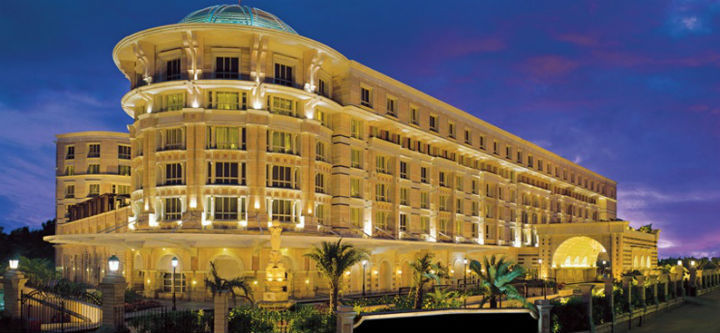 ITC hotels is one of several establish India brands
Domestic hotels
The hotel industry in India is quite mature with all the big international chains represented as well as some excellent local hotel brands.
Some of the top India hotel chains include Taj Hotels, which has the largest market share, ITC, Oberoi's, Park Hotels, Lemon Tree and Fortune. Hotels from two- and three-star categories onwards are generally bookable on GDS platforms and there are several local hotel aggregators and online travel agencies (OTAs) that offer a further range of budget hotels.
It's very common for both domestic and international hotel chains to offer corporate rate programmes. The important difference can be that while the premier hotel chains will offer these for bookings through the GDS platform, many may actually expect you to book direct. Booking direct for domestic hotels is a common and accepted phenomenon across all market segments.
This is largely based on
- A historical lack of engagement of the resident TMC in the domestic hotel booking process
- A strong desire by corporate travel managers to control and directly book hotels
- A specific sales approach taken by hotels to secure direct booking through a central reservation office or at the hotel direct
- A demand from the corporate travellers who prefer making a booking direct
In addition, corporate rate loading on the GDS platforms can be challenging at times for the domestic hotels. One of the main reasons is that the hotels want to reduce the GDS booking charges, which can constitute to more than 5-10% of their realised net room rate.
Welcome to incredible India!
Getting a structured air and hotel programme in place is possibly the most important step in securing a successful programme in India. Given the variations in approaches between different countries and cultures, a best practice approach would be to recognise the local differences and work towards getting consistency to secure the primary program objectives. Global travel managers cannot assume a seamless replication and transition of the global programme and contracts without recognising local nuances.