Corporate travel and entertainment (T&E) programmes have grown in size and sophistication over the decades. Companies now spend an average of up to 12% (2017 Certify Annual Expense Management Trends and Outlook Report) of their entire budget on T&E, and many have implemented truly global payment programmes, despite local and regional fragmentation. But the greatest progress may lie ahead, as innovative technologies, policies and partnerships lead to significant new gains for both companies and business travellers.
Embracing the digital agenda
As cutting-edge payment options begin to disrupt the consumer world, the way forward for programmes begins to emerge: both companies and providers seeking to optimise must begin thinking in terms of leveraging new technologies, challenge existing preconceptions and be prepared to rethink the connectivity that is supporting their model.
Different industry participants have begun to embrace the digital agenda with varying levels of enthusiasm and success. Understandably, most assume that their interests are best served by extending their reach or increasing customer touch-points. The expectation of being able to make bookings, payments and expense submissions on the move aligns with the rise of mobile apps from travel management companies (TMC) and other providers.
But this has been at the risk of fragmentation and sometimes confusion for end-users. There is a significant opportunity to integrate much more deeply across the booking, payment and accounting chain to provide a far greater level of automation, control and convenience. Partnerships will be instrumental, of which some compelling examples have been seen. However, there is still an absence of consensus on which roles different participants will play.
 Moreover, too often, T&E programmes are unduly constrained by corporate policies that have barely changed in a decade or more. A stranded traveller, for example, needing to re-book a flight and a hotel at short notice can be unnecessarily frustrated in their endeavours by the policy and operational demands of a traditional model. This is a symptom of legacy thinking around policy, but also innate limitations in booking and payment processes that have yet to fully realise the potential that technology has to offer.
Data is key
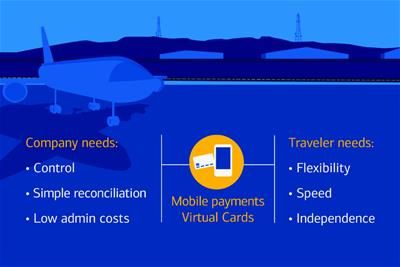
In an ideal world, the competing, and sometimes conflicting, needs of the corporate and its travellers must be balanced. The company wants control, simple reconciliation and low administration overheads. The traveller, on the other hand, increasingly demands flexibility, speed and independence.
Key to reconciling these priorities lies in the way we leverage data. There are remarkable parallels, for example, between the mechanisms payments providers use to prevent fraud and how corporates monitor and enforce their travel policy. Yet too often the real-life experience has been a struggle to achieve compatibility between the two, let alone realising meaningful synergies.
Much can be done to address this by simply revisiting existing policies and factoring in a risk-based approach. Yet the dawn of the digital age offers new options. The ability to integrate powerful data such as real-time schedules, weather conditions, business enterprise data and geolocation data — to name just a few — present completely new possibilities for far more sophisticated solutions for booking and reconciliation.
Integration as the norm
Smart companies are increasingly requesting the integration of their enterprise resource planning (ERP), expense management and even human resource (HR) systems. Sourcing platforms and TMC solutions are frequently added to the mix too.
Realising the potential of data, however, will require broader perspectives on integration. Further exploration of Big Data and analytics could deliver process optimisation for a far wider range of functions, from accounts payable and receivable, treasury and finance, to sales and marketing, customer relationship management (CRM) and HR. More than ever, T&E programmes will be a people business.
The dawn of the era of application programming interfaces (APIs) begins to make such complex integrations a reality. And now, whether as a result of innovation or regulation, payment providers are entering the game. With the right payments partner sitting in the chain, capable of integrating at different steps, the consolidation of real-time and historical data across the enterprise offers a level of efficiency and insight that has never been seen before in this space.
Payments are coming of age
The fundamental components of realising an optimal payment process are largely in place. Technologies such as biometric authentication, near field communication (NFC) and sophisticated rules engines were confined to research and development departments just a few years ago and yet today are a reality on the high street.
The obvious starting point for any discussion on the future of payments is mobile payment. Having gained ground by offering real-time, accessible, convenient and secure transactions in the consumer space, acceptance and deployment will now conceivably overtake traditional payment methods. T&E payments will inevitably follow the same trend.
More of a rising star in the corporate world is the virtual card. Virtual cards can be used in either de-centralised or centralised buying modes. They can be fully integrated into a booking engine, or standalone as a simple on-demand or batch processing tool. Virtual card technology also allows corporates to pre-define their risk appetite, per user and even per transaction, opening the door to sophisticated logic around policy administration to grant flexibility and convenience but with full corporate control.
Card-based payments may become interoperable with different payment methods and form factors. Compelling concepts emerge in the intersection between mobile and virtual cards. The prospect of employees armed with mobile payment devices that may, at any time, be populated with a one-off virtual card enabling the traveller to make a controlled payment real-time is a powerful one.
Thinking about the future
As the digital agenda gathers pace, the conversation inevitably turns to futuristic concepts such as artificial intelligence (AI) and blockchain.
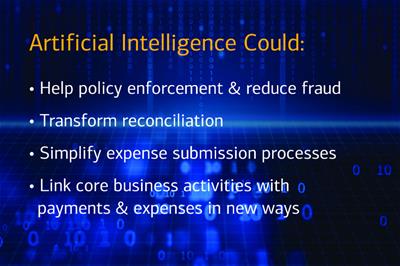 AI could have a major role to play in policy enforcement and fraud prevention but could also help to transform reconciliation. For the traveller, it could be used to ease expense submissions, using data harvested from multiple internal and external sources. Removing the chore of doing expenses after a long trip would be a popular outcome! But with such powerful possibilities of combining enterprise data with AI, there is also no reason why the booking process itself cannot be transformed or - even - eliminated.
The value and application of that other great technology hope, blockchain, may not be quite so tangible for the business traveller. But as payment mechanisms evolve, this technology may pick up the heavy-lifting on delivering such features as control and reconciliation. Blockchain has the potential to underpin a further evolution in payments that stretches beyond what most can conceive of today, but data and integration will remain critical to its success.
By leveraging data and new technologies, travel and entertainment payments have the potential to create enormous benefits for corporates. But keeping convenience and relevance for the business traveller front of mind will be key for corporates and providers to find the way.