The future is predicted in science fiction novels and we are living in a time where many of those predictions are coming to fruition. Driverless cars and the technology behind them have been foretold and are here now. Currently, driverless cars are being tested by Uber in Pittsburgh and San Francisco and GM in Detroit and Scottsdale to name a few. In Singapore NuTonomy has launched a fleet of self-driving taxis that are in use and soon the testing will go to London. Google already has two million miles logged on public roads.
But it doesn't come without its challenges. For example, California has revoked the registration of Uber's self-driving cars until the company properly registers them as others do. The reason Uber does not want to register its cars is because it doesn't publically report accidents or any instances where drivers have to take over. That keeps the statistics confidential and away from public knowledge, which will be helpful when it is time to market driverless cars.
The current belief is that in five to 20 years we will have driverless cars out of the testing cycle and operational. My guess is that we are five years away from them in service but not fully executed. I will expand a little more later.
Let talk curves
Technology curves: We are consistently improving and creating new technology. The current estimate of five to 20 years for driverless cars to become the norm is based on today's technology but what if there is a break-through that accelerates the process? These timelines could be reduced with more players in the game and more resources set aside to get the cars out there sooner.
Distribution curve: Let's look at Uber which is not a car company but claims to be a tech company with a large footprint in connecting the passenger to car/driver. Many think that it will dominate the driverless car market with its current business plan, but will it?
This needs to be looked at differently from another angle: what about BMW, Ford, GM and all the other original manufacturers? Most of them are getting into the autonomous car business. Maybe they might just go directly to passenger; after all some autonomous cars will be sold to the average household but most will be in fleets as less people will own cars. Car manufacturers will want to hold on to their current market share and have a piece of the automated pie. Their design approach is currently considered to be slower, as they believe in a phase or level system which would be slower to market, but that could change.
Also, now that Apple and Google, which are already in technology and information business, have jumped in the automated car business, why do they or the manufacturers need or want to pay a transportation network company (TNC) a royalty for the connection?
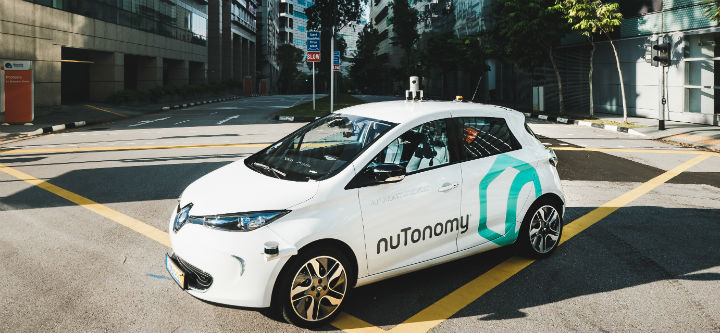 NuTonomy has been testing in Singapore
One of the other issues with TNCs is profitability, or lack of it. It is not unusual for a start-up to lose money, however you cannot keep losing money indefinitely. According to Bloomberg, Uber is approaching at least a $3 billion loss this year. At some point it wants to dominate the market and will raise pricing to cover costs and produce a return for investors. But how long can you hold your breath underwater until you drown? Uber, Lyft and other TNCs have to be aware of this cliff; will they fall off of it? My experience shows me that in ground transportation there is always competition and what drives market share is quality and price and/or good value.
Trustability curve: This is going to be a factor. We all use technology and we have seen it breakdown. We also know that hackers can disrupt a process, such as the US election, and that is an increasing issue for all technology. Imagine a car, or worse a truck, travelling 65 miles an hour being controlled by the "dark side"; the thought is a scary one.
On the other hand, currently 1.3 million people are killed annually in a motor vehicle and that is without robots driving. Robots don't drink and do drugs, they don't drive tired or impaired in any way. There will however have to be mass marketing explaining to the travelling public how and why this new technology is not susceptible to breaking down or being hacked in order for them to accept this new way of travelling.
Testing times: liability and regulation
Corporations and their travelling employees should not be part of the testing. There should be a policy that forbids employees from using a driverless car being tested. Companies are still dealing with the duty of care issue of using TNCs and that liability has not changed here. The TNCs have not been forced by legislation, like the chauffeur industry is, to conduct FBI finger print background checks or drug alcohol testing and I do not see them doing so anytime soon. The longer they can avoid the testing (by the way it cost money and you lose drivers, lots of drivers) the closer they come to autonomous cars and then they don't have the driver 'problem' anymore. Companies must remember they have the liability for any traveller using a TNC unless they tell their employees not to.
Regulations are going to be a part of the development and operational process. Unfortunately this is controlled by many different entities. The devolvement of the driverless technology is dependent on testing on existing roads not just test tracks. The legal body governing the test area has laws in place and/or will have to pass laws that allow testing. For example, vehicles that are sold and tested in the EU states require EC type approval. The detail of the laws can actually pertain to specific parts of the car such as the steering wheel. In the US, it is by state and/or local municipality.
The point I am trying to make here is the laws restricting testing are highly complicated legally and by geographical area globally. Then there will be the laws on operating autonomous vehicles, which will have similar issues. Some of the laws and the jurisdiction have yet to be determined. It's complicated.
The wider impact
Let's have fun and speculate here: imagine there's no car to worry about and you won't need a parking space anymore. If you work in or travel to any major city, which more and more people are doing, this will be a much needed positive effect as, in theory, autonomous vehicles will result in much less congestion. You could schedule one with entertainment, movies, refreshments and food or a business unit equipped with the necessary office amenities to do your job. You could work, workout or even dine on your way to next location. The interior and or exterior would most likely look nothing like a car as we know it today.
There is a danger of job losses; that is a lot drivers out of work. That dilemma will exist in the future with all automation. Hopefully what is lost in one area will be gained in another.
This I do know: it will be here sooner than later. From what I see now there will be many different companies wrestling for market share in the automated vehicle market. There is a lot of technology that needs to be developed and implemented, not just in the vehicles but investment in infrastructure on the roads and bridges these vehicles will operate on. There are laws that need to be passed for testing, what is tested and different laws for operational usage. There will be a need to have a system to coordinate between the different companies operating driverless vehicles, different vehicle types and other forms of transportation. The impact will be on all forms of transportation, from the obvious taxis, chauffeur driven vehicles and TNCs to rental car companies and trucking industry.
Basically, anywhere humans now drive a moving vehicle will be impacted. It is important to note however, there will always be the need and want to drive or have human drivers. I predict chauffeur driven vehicles will not be all driverless vehicles. The human touch is needed and wanted; a well-trained chauffeur will still be in demand. That Sunday drive with my hands on the wheel and my music on will be a reason to keep the steering wheel.
In my last article on technology in the ground transportation industry I used the elephants leaving Ringling Brothers and Barnum & Bailey's Circus as a metaphor. I also said I was sad to see the elephants go but I understood it from an animal rights point of view. It has now been announced that after 146 years "The Greatest Show on Earth" will no longer exist. The loss of the elephants dropped sales to a point they had to close the whole circus. That is a consequence of modernisation and improvement I guess but it is both sad and alarming to me. I wonder what will happen here, after all, most science fiction movies and novels end with the robots taking over, or at least trying to.