The US car rental market is feeling the slowdown in the ground transportation industry, coupled with the poor used car markets. It is not alone, the chauffeur driven industry is also feeling the slowdown.
My prediction is that to combat this the rental car companies will be spending, or should be spending, their money on improving the functionality of their technology related to 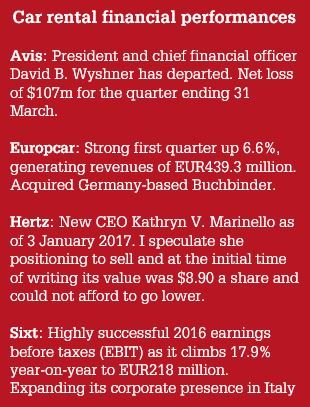 mobility. This space will be dramatically changing in the next several years. Hertz has been through a difficult few years and the new CEO has a big job ahead, which will be one to watch. The TNCs (Uber, Lyft etc) are taking some business away and have changed how all ground transportation companies are looking at their technology and should be planning on how driverless cars will change the world.
One of my previous articles on the battle for market share in the automated car revolution made the case that Uber or Lyft may own the space, but also may not. Uber is having many internal and external problems coupled with massive losses resulting in a sweep of the executive group and pressure from the investors who have pushed CEO Travis Kalanick out.
The rental car companies could emerge as the leaders in the AI fleet distribution world. They currently have assets to manage fleet, which is no easy task. Currently the TNCs mainly rely on the fleet of individuals and the vehicle can be up to 15 years old. Rental car company fleets are usually two years or less.
The other big benefit for the rental car companies is they currently manage millions of vehicles and have locations strategically positioned to service effectively millions of customers each year. As an example, EHI, with its National, Alamo and Enterprise brands, has 9,600 neighbourhood and airport locations worldwide. If, or should I say when, they are fleeted with autonomous vehicles, they will be positioned to service any customer's driverless car needs.
After the initial draft of this article Hertz, Avis and Europcar made announcements in this area that came to my attention.
- Hertz announced that Apple is leasing a small fleet of SUVs from Donlen to test its self-driving technology which sent the Hertz stock upward to what is quoted in the box
- Avis Budget Group has signed an agreement with Waymo's autonomous vehicle fleet and early rider programme which is a public trial of self-driving cars in Phoenix. Avis will offer automotive services and secure parking for its fleet
- Europcar Group announced a 20% share in carsharing service SnappCar.
This is a first step in the rapidly changing ground transportation world and in line with my speculation about driverless cars. The fact that while I was writing this article there was an introduction of autonomous vehicles at Hertz and Avis is an example that this world is changing at a very fast pace.
Where does this leave the used car market, which is a major factor in car rental firms' profitability?
The major car manufacturers (OEMs) are showing record-high inventory levels and trending even higher for 2017, according to Morgan Stanley. The OEMs are reducing production in some models and selling less fleet to car rental companies at preferred pricing.
This translates to lower new car prices and favourable lending and lease rates. Car rental companies need to be able to sell their older fleet at a profit. If volume is slowing down, that can result in over-fleeting. Then there is the regular fleet being move to the used car market as the fleet ages. The result means there are too many used cars, and an inability to turn a profit or even breakeven on the fleet.
With new car prices and favourable financial terms, car rental companies might have to take a loss on their fleet sales. As stated earlier, Hertz has had several years of poor earnings and Avis had a tough first quarter. EHI is private and its earnings are hard to get but I believe they also are experiencing a slow down over the last several years of growth and they are definitely not immune to the difficulty of the used car market. In fact, they are the largest buyers of automobiles in the world and would also feel this unfortunate negative economic impact of the used car market.
One of the reasons is because maintenance goes up as the cars gets older and the resale value of the vehicle is best at that point. This business is very capital-intensive as new fleet is replaced annually. In the future how effectively will rental car companies be able to sell their vehicles or will there be a new model that does not exist today? Currently the used car market is soft and could remain soft in the future. Many think that autonomous vehicles are less than five years away. How do you sell your fleet if people are not buying as many cars?
What this could mean for corporate pricing
It has been at least a decade since corporate pricing has increased. I reported in my 2014 article that prices needed to rise for Hertz, which it attempted then went the opposite direction. Unfortunately that is being reflected in its losses.
The company who could, and or must, lead is EHI. It has a much stronger financial balance sheet than all other rental car companies and it will be hit hardest by the used car market slowdown.
The other question is, how long can corporate pricing go without an increase? Here is food for thought - if just one of the one of the big three (Hertz, Avis and EHI) decides that they will not try and raise pricing, then it won't happen. This is what has happened for over the last 10 years. If one of the suppliers starts to raise pricing and one of the others is protective and is predatory then pricing remains flat or goes lower.
The problem is that all of them have not raised pricing in many years and very few of the sales people know how to do get a price increase effectively; they haven't had to. If one company attempts to raise prices and their sales people do not have the ability or the loyalty of the corporate client to do that difficult task, they will fail. It would logically seem that with just three majors controlling the US market, they have an oligopoly and a price increase would be not that hard to pull off. But so far it has been very hard, as market share gains have driven this industry.
The other hurdle that rental car companies have is the connection to the customer
Today they all have a large reservation centres that are costly. They all have apps but only a small percentage of bookings go through them. Rental car companies will need to move more customers to making the reservation on their apps to reduce the cost of the reservation. They will also need to vastly to improve the functionality of the apps to be more TNC-like as AI cars are introduced into the fleet.
Avis has a new app and it has new and exciting functionality. You can reserve and control the car from the beginning of the process to the end. It shows a photo of the traveller's actual car and the options to either change to a car in the same class and shows available upgrades with the cost alongside. Users can lock and unlock the car from their phone, there is an unmanned return process and the rental agreement and insurance card are available for viewing in the app.
At this time this is available at more than 100 locations of the airports. As new fleet is added the mobility percentage will increase as will the locations it is offered in.
Hertz has the 'Ultimate Choice' where the traveller chooses the vehicle that is right for them instead of being allocated one. Gold Plus rewards members go straight to the 'zone' that corresponds with the car that is reserved where they have access to a select group of cars with enhanced features. At this time it is at many major US airports and expanding to more US airports soon. This seems very much like National's Emerald Aisle.
Meanwhile Enterprise has introduced LaunchPad where customers are greeted by an employee with a tablet which has the reservation on file and then takes the customer to the car. That allows the employees to get out from behind the counter and interact with the customer more efficiently. This is launched in the US and being launched in Europe this year.
National also has an app where you can make, modify, extend and cancel reservations. At non-Emerald Aisle locations travellers can choose their car. Within the app they can track future and current itineraries and access roadside assistance as well as manage their Emerald club profile and check out to expedite the transaction.
This is just a start for the car rental industry and the ground transportation industry as a whole. It will be exciting and interesting to see what happens next.