Back in May I wrote an Expert piece asking travel managers to think about an answer to the question "what's next?" The piece was aimed at challenging the business travel community to think about what they wanted next in their careers so they could clearly articulate this to mentors, leaders and sponsors. It appears to have resonated; I had feedback from both buyers and suppliers from around the world that the piece had kick started some personal action. Great.
So now can I provide the next challenge? What's next for your travel programme? Do you have a well-defined business plan that takes into account the micro environment (what's happening inside your company) and the macro environment (what's happening outside your company)?
I feel privileged to have a front row seat observing the changes unfold across this industry. There's three prominent changes I've spotted in 2016.
1. Consumer
We're no longer building travel programmes for travellers; we're building for consumers. Each of us is a consumer first and foremost. Every day we purchase goods, whether it's a double macchiato with extra froth in Café Nero, a gift on Amazon with guaranteed delivery the next day or a restaurant meal delivered to our homes. Each of these experiences (and many more) are defining us as consumers and I like to describe this new consumer behaviour as "know me, be where I am and tell me only what I need to know". But we then bring those new expectations into the workplace and our travel experience doesn't quite cut it.
2. Content
Content has always been king in any travel programme but in the past year we have seen this importance rise rapidly. The "stop clicking around and book direct" impact was in fact a side effect of the hoteliers trying to regain some dominance over online travel agencies (OTAs) yet somehow it felt a direct hit to business travel.
With airline margins at the biggest they have ever been in 2016, 4.9% according to IATA, airlines are looking for ways to sustain profitability. They have worked out they can make good money from following the low-cost carrier (LCC) model of upselling and it is now forecast airlines will turnover $60bn from ancillary revenue in 2016, about 8% of total airline revenue. How did they discover this? Hint: The top five most profitable airlines in the world are all LCCs!
3. Control
I spend a lot of time with travel buyers. When we discuss the above the immediate concern is that of control. They ask questions such as
- How am I going to meet this new consumer like expectation?
- How do I control my costs if suppliers are going to upsell?
- How do I get my travellers to come back into my programme and stay compliant?
My answer is to get inside the mind of the consumer and the supplier. Ask great questions, listen intently and then build a plan.
Every travel programme is unique, or at least it should be. What drives your company will be different to what drives the next. Each of your travellers (or consumers) will have different needs and expectations. Importantly, your suppliers will each have a unique distribution/content strategy too. My proposal to you is to take a fresh look.
My front row seat tells me suppliers are desperate to learn from the retail industry.
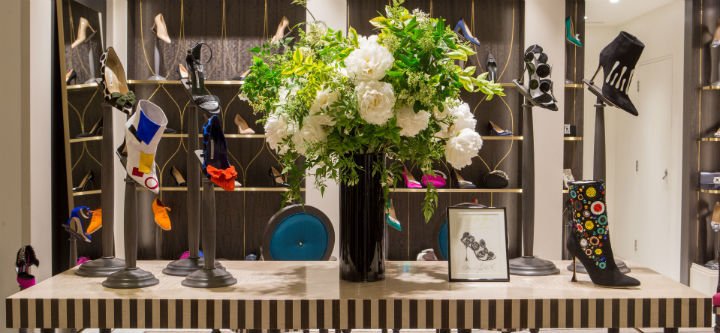 Fashion brands like Manolo Blahnik can retain their brand's look even when retailing in stores like Selfridges ©Selfridges
They are looking at how the best retailers ensure brand consistency across multiple channels. They want to learn how a luxury brand ensures the "path to purchase", as retailers put it, is exactly as they want it to be to ensure the luxury price tag is preserved, whether that's in-store, online or via a reseller.
Think of how a brand like Mulberry sells its handbags in-store, online and via department stores. A handbag purchase is a lower cost purchase than a business class long-haul ticket and yet the airlines don't have the same brand consistency and protection across all the different channels like luxury fashion brands do. Airlines only get to control their own website, often called brand.com. This is driving the airlines to think about their distribution strategies and how they can become better retailers, as are the hotels.
At a recent IATA event, many airlines shared their distribution/retailing strategies and how the New Distribution Capability (NDC) will help enable this. Each of the major travel technology providers (sometimes called GDSes) has a merchandising platform to help support this new era. Let's be clear this is not a strategy to cut out the middle man (ie TMCs) - the airlines want to get to the point where they can better retail to all consumers no matter whether they book on brand.com or via an agency, OTA etc.
Why does this matter to a travel buyer? Your traveller (consumer) expectations are increasing and your supplier (retailer) strategies are changing. You need to assess what changes you need to make in your travel programme to benefit from the new future.
TMCs have a great opportunity here as they can reinvent themselves from just offering a service to book an airline ticket (sorry TMCs but many of you are just too air focused) to becoming a retailer of travel. A retailer for a complete business trip. Maybe even the department store for business travel?
Have this conversation with your TMC and your suppliers. See what they think so you can judge for yourself if you need to create a new future for your travellers (consumers) and your organisation. But remember: ask great questions, listen intently and then build a plan.
If I were a betting woman I'd put money on an "omni-channel retailing model" being the future managed travel model. It looks something like this.
Continued below
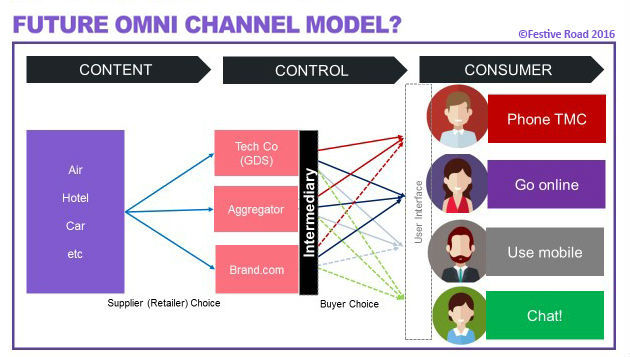
You'll see this model gives choice on both the buy and supply side. It gives the supplier (retailer) channel choice and the buyer a traveller (consumer) choice. The supplier selects the channels they believe provides the greatest returns, brand consistency, customer loyalty etc and the buyer selects the intermediary that can provide access to multiple content channels in a consistent way, allowing an overlay of degrees of control.
Don't misunderstand this visual as a huge shift away from the well-known GDSes. Those value chain stakeholders have shifted their offering to answer these consumer-like demands and suppliers' need of improved retailing. A lot of work has been happening behind the scenes. Ask your TMC to show you their agent desktop technology and you'll see the shift from the green screen cryptic era to one that empowers the agent in the same way a consumer is empowered in a brand.com/OTA world. These are all recent developments so if your TMC hasn't moved on yet, ask them when they'll be on the latest version and when you can see it. I was impressed and I'm sure you will be too.
I've already prompted a number of readers to create a personal career plan or a development plan. My call to you now is to think about what's next for your travel programme? Do you need to think more like a department store and support your traveller (consumer) retailing habits and also become a reseller of choice to the supplier (retailer)? My final advice is: don't let others create the future for your travel programme — create your own path.