Two key themes hit me as I walked the Business Travel show floor this year. Firstly, just how busy all of the stands were — does that mean business travel is back? It certainly felt so.
Secondly how so many of the stands from technology to TMC, in fact players across the whole value chain, were focused on personalisation. Not overt personalisation, there were no stands emblazoned with "personalisation, the next big thing", but references to channel agnostic content, consumer-like booking tools, changing the face of retailing, control vs enabling and the list goes on.
This got me thinking. These issues are swirling around corporate travel right now, why?
B2B2C vs B2C
This big shift is driven by the fact we live in a B2B2C world vs a B2C world. This difference had never hit me before but its key. Why?
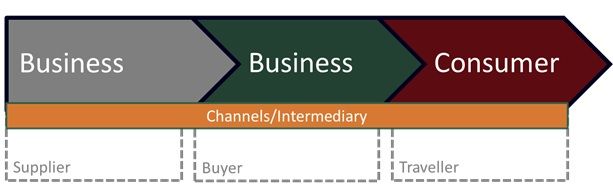
This diagram helps visualise the business interaction flow in business travel in a B2B2C world. An example would be the B (Business) is the supplier; an airline looking to sell a seat.The second B (Business) is the company negotiating and booking the seat. Finally, the C (Consumer) is the traveller who actually flies in the seat.
There are many other industries that operate in this way and each experiences the same challenges that we do in business travel, yet we think we're unique!
- Financial services companies that sell through brokers or a financial planner
- Technology companies that sell to and through an integrator or channel partner
- Food products companies that sell to restaurants
With this in mind I researched the concerns of other industries operating in a B2B2C habitat and found these discussion topics on forums/at events
- How do we (the supplier) keep up with changing consumer expectations when we only have limited direct contact with the end consumers?
- How do we align agents and brokers in order to deliver a consistent brand experience that drives growth?
- How do we overcome complex, legacy distribution channels in order and reinvent the customer experience in a cost effective way?
The language may be slightly different but any one of these examples could have been a business travel debate!
The additional businesses
The added complexity in business travel are the extra "Bs". We also have global distribution systems (GDS), travel management companies (TMCs) and technology providers who are also entwined in the B2B2C model. As you see this isn't straightforward.
So if I had a product to sell how would I want to sell it? B2C can limit your audience, think of what companies like Not on the High St, Etsy and even Amazon have done providing a valuable channel to increase sales. A small company focused on selling direct can rapidly increase their market size by selling via a third party.
Of course the majority of companies we're dealing with are large established players who have had a multi-channel sales strategy in place for years. A hotel for instance will get business direct via their website (direct channel) and business via OTAs (online travel agencies), TMCs and many other intermediaries (indirect channel). Some may say it's more profitable to run a direct channel business but others say the cost of acquiring and servicing that direct customer is far in excess of paying a fee/commission to an intermediary.
Why is this even important?
My days in procurement taught me that as a buyer it's crucial that you understand the supply marketplace. You need to understand your own company, the travellers and the demand they create for travel but of equal importance is an understanding of the supplier business model as this can affect everything from the price you pay to the risk of supply interruption and more.
For example, knowing an airline has huge pension/union issues means you're contracting a supplier that may have to deal with worker negotiations/strikes.
If I were back in a buyer role now I would be paying special attention to the differences between B2C and B2B2C and what benefits some form of crossover of the two may bring. For instance, I learned recently that every flight booking made through a TMC or OTA is faceless to the airline. At the time of pricing and offering a seat (aka retailing) the consumer/passenger is generic. Imagine this happening every time you tried shopping on Amazon! I like that Amazon knows me and personalises my shopping experience — it makes life easy.
Back to the airline example the supplier cannot build a relationship, apply offers that may interest the passenger, build a history to enable better future servicing etc. You may be thinking, isn't that what an airline loyalty programme does? Yes, it does but that information is not linked at the point of offer/pricing.
You may have read about something called "NDC" (New Distribution Capability). For me this is so much more than distribution. It's moving travel out of the dark ages and into a more Amazon-like age whereby the supplier can properly 'retail' its offer. If I'd just invested millions in my state-of-the-art flying product you can bet, I'd want to show it in all its glory through an enhanced retailing experience. I have chosen an airline example but this exact same issue is happening for hotel suppliers (free Wi-Fi if you book direct anyone?), car rental providers, etc.
So what?
This is all great but why as a buyer should you this be on your radar? Now I sit outside of the buyer role I can clearly see the opportunity presenting itself here. Is it time to rip up the B2B2C rule book and embrace a B2C model in a "managed" programme? What does "travel management" even mean anymore? Is it the booking or the traveller or the trip you're trying to manage any way?
I would encourage all buyers to get a single blank sheet of paper and write down what's important for their company and their travellers. Then think how to deliver to those priorities. Maybe the traditional way is the right way but maybe it's time to embrace a new way and turn the "I have to manage every single booking for duty of care reasons" excuse on its head.
I should be clear here I am not saying this is the end of TMC or GDS, far from it. Instead I am saying they have an important role to play in helping push us all forwards. Whatever decisions the travel buyer makes following the blank sheet of paper exercise, I predict that we will see more B2C moves in the coming year and the progressive thinkers are making it happen for them not to them.