The International Air Transport Association (IATA)
has urged governments to make decisions based on data to manage the risks of
Covid-19 when reopening borders to international travel.
“Data can and should drive policies on restarting global travel that manage Covid-19 risks to protect populations, revive livelihoods and boost economies. We call on the G7 governments meeting later this month to agree on the use of data to safely plan and coordinate the return of the freedom to travel which is so important to people, livelihoods and businesses,” said Willie Walsh, IATA’s director general.
The airline body said that there was a growing body
of evidence to suggest that vaccination protects travellers from serious
illness and death, and carries a low risk of introducing the virus into
destination countries, including research from Germany’s Robert Koch Institute, the European Centre for Disease Control and Prevention interim
guidance on the benefits of full vaccination and Canada’s Testing and Screening
Expert Advisory Panel recommendations.
IATA also questioned the need for universal
quarantine, saying that for arrivals in the UK between 25 February and 5 May
2021, 365,895 tests were conducted on arriving passengers, all of whom had
tested negative before departure. Of these, only 2.2 per cent tested positive during
quarantine of which around half were from “red list” countries.
“Many governments continue to require universal
quarantine—either hotel-managed or self-managed. This impedes the freedom of
movement, discourages international travel and destroys employment in the
travel and tourism sector. Data from the UK tells us that we can and must do
better. Almost 98 per cent of those detained because of universal quarantine measures
tested negative for the virus. We now have more than a year of global data that
can help governments make more targeted decisions on international travel,”
said Walsh.
IATA has also pointed to research by Airbus which showed that
even without taking into account the effects of vaccination, air travel between
Europe and the US would only add less than one imported case per 100,000
population to the local incidence in the US over the course of two weeks.
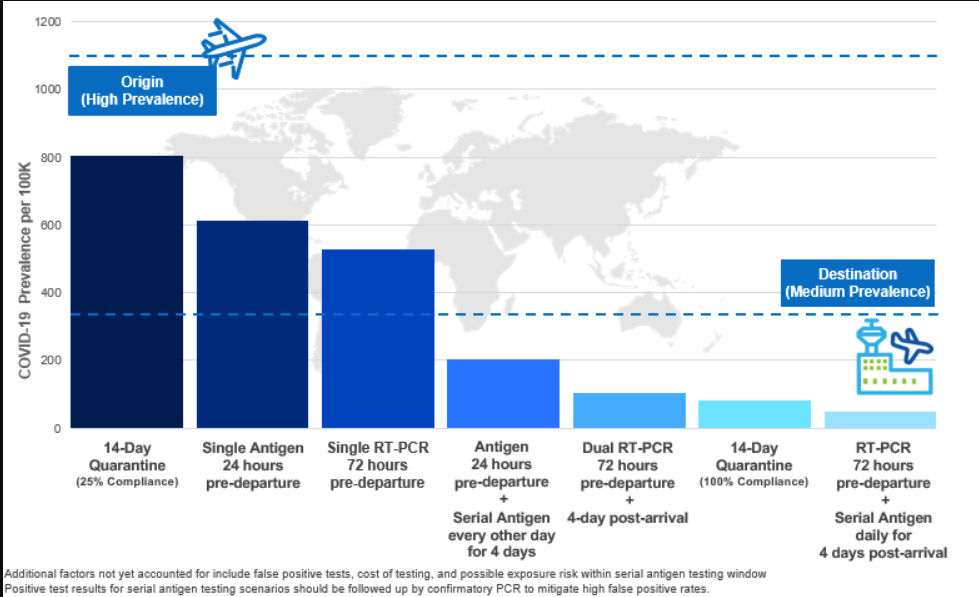
It added that Boeing has modelled various testing
strategies and found that an RT-PCR test 72 hours before departure coupled with
daily antigen tests for four days after arrival was a better way to stop the
spread of Covid than a 14-day quarantine.
Professor David Heymann of the London School of
Hygiene and Tropical Medicine, said, “Government policies are naturally risk
averse. By contrast, the private sector has great experience in managing risks
every day to deliver its products and services. Covid-19 now appears to be
becoming endemic. This means that Covid-19 is not likely to disappear anytime
soon, so governments and industry must work together to rebuild global
connectivity while managing the associated risks.
“The first step is for governments to evaluate the
threshold of risk of virus introduction that they can effectively manage. Then
they need to identify with industry feasible strategies to enable an increase
in international travel without exceeding those thresholds. Airbus, Boeing and
IATA have demonstrated some possible solutions. Now we need more intense and
transparent dialogue between governments and the airline industry to move from
models to policy and ultimately facilitate international travel.”