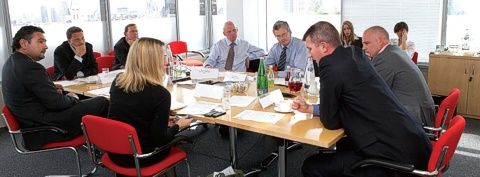
Two leading travel buyers, two major suppliers, the executive director of the Institute of Travel Management and representatives of Carlson Wagonlit Travel sat down to discuss the findings of CWT's latest White Paper about optimising travel policy and compliance
The participants
Gerry Flanagan, global travel manager, Shell
Carlos Carbonnel Bamford, manager global corporate sales, British Airways
Helen Cahill, marketing director, CWT
Paul Tilstone, executive director, Institute of Travel Management
Russell Green, director business travel sales, InterContinental Hotel Group
Paul Boyle, director of account management UK, CWT
Jeremy Broadgate, category director, business travel and payment cards, OGC Buying Solutions
Mike Toynbee, editor, Buying Business Travel
Paul Boyle: "The findings were based on research among 80 clients and what this White Paper on travel policy and compliance means is, we no longer need to talk anecdotally, but now have facts and figures to back it up."
Jeremy Broadgate: "We have all known about this for a long time, but it is good to have real examples that have come from outside your own organisation. I am currently working in a very procurement-driven organisation, and what they tend to fail to recognise is that most savings generated in business travel come from the behaviour of the individual. If you don't have a policy in place, people don't know what is expected of them. And if you don't monitor people's behavior against the policy, and then fail to enforce the policy, you've got no chance. The only savings you'll ever generate will be down to the goodwill and the conscience of the individual, which is not going to amount to much across the board. In most organisations people want to do the right thing, but there will always be some whose attitude will be, 'It's not my money, they can afford it.'"
Gerry Flanagan: "We would use this to our advantage to lever internal behaviour. With a global agent now in position we are seeing greater clarity of data in our own performance. If there is anything missing from the report, it is probably the overlay of the online booking tool. That is a key policy issue as we have yet to mandate online self-booking tool usage."
Paul Tilstone: "For the travel manager of a smaller organisation, I can see this document will be genuinely useful because it shows them the way forward in dealing with problems with which they might not have too much experience. For an organisation like Shell, it is more a case of demonstrating to internal stakeholders there is a general problem, not one limited to Shell, and that they are really not doing too badly."

Carlos Carbonnel Bamford: "If a corporate mandates, you are definitely going to get efficiencies, but it depends very much on the corporate - some companies simply don't have that mandating culture. If you take restricted fares, they can save you money. But if the nature of your business is that you are booking more at the last minute and you need to change your tickets regularly because you are client-driven, that is going to cost you more than buying a negotiated fare because of change fees, upgrading to the highest class, and more transaction fees to the TMC. I think there are caveats to many of these findings."
Boyle: "You have to accept it is very general - we make no excuses for that because we have looked at the average and then at benchmarking against best practice."
Helen Cahill: "What can you do to incentivise people?"
Tilstone: "One technology company provides a cap per trip. Where travellers source the trip is entirely up to them; there is a TMC in place and if they manage to get the trip under the cap, then the excess flows to the next trip. At some point they can probably upgrade from Premium Economy to Business Class. That is the carrot - they don't have much of a policy, but it goes right back to internal culture."
Broadgate: "Most organisations find it difficult to reward people for what amounts to doing their job. I have worked with organisations that have said if you set people a budget and they come in under that budget, then you share the savings with them. But the lawyers then got nervous, saying that if these people travelled regularly and were injured because they were travelling in an inappropriate method, staying in back street hotels, where there was no security, and in areas where nobody knew where they were, potentially you could be in trouble for endangering them.
Tilstone: "Policy has to be one or the other, not something in between. It is mandated, you book it this way, and if you don't, you don't get reimbursed."
Flanagan: "This is one of the issues, perhaps relating to culture. For us, key to success is a productive conversation between the agent and our travellers, perhaps engineering managers, who may feel it doesn't matter what it costs to get them wherever because of the value they are adding. It is a problem and perhaps we need to give the agent more confidence that they are going to get our support when they step into that situation to enforce it."
Tilstone: "Isn't this where a self-booking tool works really well?"

Boyle: "It does because then you get the visual guilt. It is a great way of driving conformity."
Toynbee: "According the White Paper, improving policy and compliance can produce average savings of 20 per cent. But people are busy and often don't get round to making their travel arrangements until the last minute. How do you deal with that situation?
Flanagan: "We have been carrying those messages into business leadership meetings for some time.We've moved our performance along and certainly publishing data is part of that. We have not yet gone the whole way of generating internal league tables as that may not be in keeping with our culture. The message is understood by the businesses and there is recognition of the cost of a ticket change that might be incurred."
Carbonnel Bamford: "If a corporate can change behaviour either by booking earlier or to book their meetings - often they are internal - around certain flights, it will get them cheaper fares. If the type of business won't permit that, or they can't drive that compliance, they will end up paying higher fares."
Green: "I would love corporate travellers to move their hotel booking patterns away from Tuesday and Wednesday night, but business travel is what it is. Book on a Monday, Thursday or a Friday and you will get some fantastic rates."
Toynbee: "Where would you say are the biggest inefficiencies in current travel policies?"
Tilstone: "The biggest weakness has been that an efficient policy needs to be updated regularly. However, there is a fine line of updating the policy on such a frequent basis that people don't know what it is because of constant change."
Broadgate: "The worst thing you can do is write the policy, lock it in a drawer and never tell anyone that it exists. If it is not relevant people will ignore it. There are basic elements you would want in there around preferred suppliers or using approved booking channels to ensure you capture all your data so that you can track all your people and fulfil your responsibilities to your workforce to make sure they are all safe. Beyond that it is mostly about communication."

Tilstone: "Is it not the policy, but the way in which we procure travel? There are so many points of interface that it is incredibly difficult to manage, which is why we have the burgeoning policy. With everything else, such as IT, everyone knows they go to the IT department, which then procures it on their behalf."
Cahill: "It is the attitude towards travel. People don't challenge the decisions of the IT department because they sort out the office equipment. But when it comes to their own comfort, people have much more of a say. It becomes an emotional issue."
Broadgate: "It's also to do with enforcement. When you put your expense claim in for whatever today's outlandish equivalent of Concorde is, then whoever is responsible for signing off the expenses, needs to have the backbone to deal with the situation in the same way as someone going off and buying a laptop because they like the look of it. There's no real difference."
Flanagan: "Some travellers may treat it very subjectively, for example if they are travelling in their own time, in the evenings or at weekends."
Broadgate: "That's why people are loathe to enforce policy as severely as with transgressions such as someone going out and buying their own laptop. It's not difficult to see why someone wants to stay in a particular hotel as opposed to the one he or she is supposed to be staying in under the terms of the travel policy. But sign it off once and it opens the door to further abuse."
Flanagan: "There are also challenges in where the policy comes from within the organisation. There is a solid link to the employee value proposition: whereas if it is coming from the CP director or the finance director it might have a different emphasis as it is published."
Green: "There will always be the rogue traveller, but it's surely the 80:20 rule. Unfortunately, when someone finds a fare that's cheaper than the one they got through the TMC, it has such an undermining influence."
Flanagan: "On the non-compliance issue, I was encouraged by our governance body that their names, too, should be included in the non-compliance list. Does it apply to everyone or does it not? That visible leadership came through strongly within the organisation."
Toynbee: "The White Paper suggests average savings of 50 per cent are achievable by using preferred suppliers. What do suppliers expect to get from such deals and how closely are they monitored?"
Carbonnel Bamford: "In the UK we deal on volume and in the rest of the world it's market share. If a customer commits to us and we know they have all the right policies in place in order to deliver, they will get a preferred rate. We sit down with our customers about once a quarter to review it, or once a month with some of our major clients."
Green: "I want to help if I can to improve compliance, so that my preferred deals materialise and everyone is sweet, instead of it not happening, when off come the gloves and it is all confrontational. Procurement isn't about confrontation, it is a win-win for both parties. I don't put a highly skilled account director against a corporation that isn't able to drive what my hotels and I are looking for. We all have some fantastic relationships in this industry, but relationship will only take you so far. You have to make a commercial decision as to whether the reciprocity is there."
Toynbee: "What are the points of differentiation?"
Green: "Corporate social responsibility is a big opportunity because you can demonstrate a point of difference. I want you to choose our hotels because we do better than the next best alternative in terms of making your travellers safe and secure in an environment they enjoy."
Boyle: "We have noticed a huge increase among the international hotel chains that people are using because of the CSR aspect."
Green: "Corporate social responsibility is actually a business decision because if you do it right, you get more business. If it is price alone, it is the lowest common denominator and anyone can play that card."
Flanagan: "Hotels are one of the harder areas in which to manage compliance. Something that works against us in an empowered organisation is the company credit card. The difficulty for us is that our internal customers feel they are doing the right thing. Typically, 'I am going to Kazakstan and the safest thing for me to do is to call my local host's secretary and book a hotel they are familiar with.' Moving that mindset is a challenge, but it is happening."
Broadgate: "The big headache at the moment in the public sector is how you address sustainability as an issue within travel policy. What the industry needs to agree is what is the standard measure."
Tilstone: "The only thing you can do at the moment is make some broad statement within a travel policy so that the traveller can interpret that at the booking stage. To say that taking the train from London to Manchester creates less emissions than taking a flight is not always the case. It depends whether you are measuring the occupancy on that train against the aircraft, and how you get to the airport or train station."
Broadgate: "The new corporate manslaughter legislation has put compliance back on a lot more agendas at a far senior level. On its own it has not made people comply with policy, but it has made them go back and have a look at it, which is never a bad thing. It is about risk management."
Boyle: "One of the biggest challenges we have - and I have just come from the operational side - is what is the level of expectation of policing the policy. Difficulties can arise when the traveller doesn't like what they are being told. Self-booking tools eliminate this problem. The good thing about the procurement side is that it is more black and white, allowing us to say you can't do something, with the option of referring it."
Broadgate: "Policing policy also fails when there is a sterile organisation out there that will abdicate its responsibility for looking after its own budget, with the attitude: 'Well, you're our travel management company, you do it.' That's when things get ugly, particularly for the 18-year-old agent at the end of the phone."
| THE KEY FINDINGS |
Companies can save on average 20 per cent of total travel spend by optimising travel policy and compliance. While travel managers are increasingly focused on improving compliance, they should also look critically at their policy. Savings come from making improvements in the following five key areas:- Advance air booking, with discounts sometimes exceeding 50 per cent of ticket price
- Restricted air fares can bring savings compared to fully flexible fares, even when the cost of changes or cancellations is taken into account
- Preferred suppliers, when used consistently, represent lower overall costs than a mix of suppliers that are used on a "best price" basis
- Travel comfort has a major impact on costs - companies can benefit from aligning their travel policy with standards in their sector
- Preferred booking channels (on- and offline booking through the travel management company) bring tangible benefits, including lower prices, increased use of preferred suppliers, and enhanced service and security.
|
EIGHT KEYS TO SUCCESS
- Engaging management throughout the organisation
- Providing travellers with clear, comprehensive guidelines
- Standardising the policy regionally or globally
- Promoting compliance through communications and training
- Driving compliance through point-of-sale measures
- Tracking progress and taking corrective action
- Benchmarking industry performance
- Leveraging travel management expertise