Are airline hubs in decline, as one industry leader predicts, or will they continue to flourish as regional travellers, in particular, attempt to avoid Heathrow and Gatwick? Simon Warburton reports
Rather like Mark Twain's quote about reports of his death having been greatly exaggerated, the forecasted demise of the hub-and-spoke system might also be seen as a little premature.
Yet that was the prediction by one leading industry figure engaged in a little crystal ball gazing at October's Association of Corporate Travel Executives' educational forum in Rome. Martin Cowley, head of Sabre Travel Network for the EMEA region, maintained that "the consolidation of small operators, inefficient operators or those with high operating costs will result in a more balanced airline industry, where capacity reflects demand, with more passenger-friendly schedules and choices. Airlines that favour the hub-and-spoke system will be consigned to the history books."
The fact is that the legacy carriers have relied heavily on feeder services into their main hubs for traffic on their more lucrative long-haul routes, and long-suffering regional travellers have been happy to avoid the horrors of Heathrow in favour of some more user-friendly Continental gateways. Then there's the all-important frequent flyer miles that often accrue when flying with one carrier rather than another. Heathrow, of course, is arguably the most disliked airport in Europe and the disastrous opening of Terminal 5 earlier this year did little to enhance its tarnished reputation - corporate travel buyers and travellers are all too painfully aware of the initial T5 queues, cancelled flights, bags in Milan and so on. Although anecdotal evidence suggests the new terminal is finally delivering what it promised, passengers tend to view Heathrow as shorthand for everything that's wrong with UK infrastructure, and many use the European alternatives to bypass it.
There are numerous direct services from UK regional airports to European hubs, and the emergence of low-cost carriers at what were previously considered the mainline scheduled airports of Edinburgh and Manchester, means that passengers now have more choice. But low-cost carriers are famously point-to-point and have little interest in ensuring that passengers - or their luggage - make connecting flights. Any connecting service has the potential to go wrong. Late incoming flights, bad weather and stacking all add to a sense of uncertainty.
Lufthansa's UK general manager, Marianne Sammann, notes, however, that UK regional hub connections to Germany, both for point-to-point and onward, is up by six per cent in the past year. "We've had enormous success with our passengers who want to fly direct from Birmingham, Bristol and Manchester and connect with [a possible] 207 destinations from Frankfurt and Munich, and not have to put up with Heathrow," she says.
Bizarrely, Lufthansa is seeing UK customers willing to travel to Germany to then overfly Britain to the US. "If you count [the time] going to Heathrow, or hopping on one of our regional flights, you make up easily what you backtrack," points out Sammann, adding that the German carrier offers 10 destinations in the US.
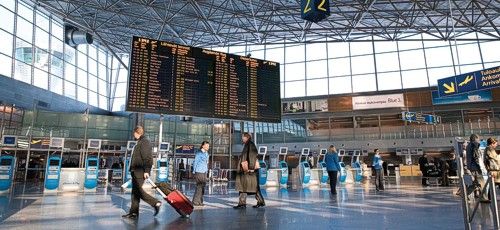
Scandinavian airports and Helsinki, in particular, work well for UK and European travellers with onward destinations. Business Class passengers flying Finnair and continuing to the Far East, for example, can use the short connecting time in the airline's Business lounge, located immediately opposite the international departures gate. Furthermore, the Finnish carrier highlights the fact that it's far quicker to the Far East transiting via Helsinki Vantaa, given its northerly location.
While this clearly doesn't work for someone in London with direct flights with Korean Air to Seoul, for a passenger in Manchester or Lyon, with no direct service, rather than flying to London or Paris, it may well make sense to fly Finnair via Helsinki, with all the assurances of through-baggage and the knowledge that the minimum connecting time (MCT) will happen.
And unlike Heathrow, still debating whether a third runway is a possibility, Frankfurt has advanced plans for a fourth to cope with an estimated increase of 34 million passengers by 2020 - up from the current 54 million a year. As well as the new runway, a third passenger terminal is also in the pipeline, and the airport is well prepared for the Airbus A380.
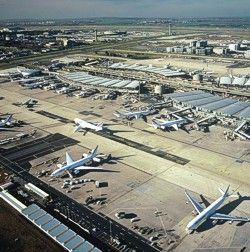
Paris Charles de Gaulle already has four runways, eight terminals and three control towers. This is an airport that can cope with expansion and expects to handle up to 66 million passengers by 2010. When was the last time anyone stacked over Charles de Gaulle? Almost never. Furthermore, Air France has 51 services a day to Paris CDG from nine UK airports.
New, as the airport gears up for the A380, is CDG's satellite lounge in Terminal 2E, capable of handling 8.5 million passengers a year, with improved connection times. The satellite can accommodate six super-jumbos simultaneously, with Aeroports de Paris claiming that the maximum capacity of 26 aircraft at any one time will ease connectivity.
Amsterdam's Schiphol is the other major European hub, with KLM and its subsidiaries/partner airlines operating up to 72 flights a day from 14 UK airports.

The origin of the hub-and-spoke system was the US, where major population centres, catering for large aircraft, are linked to smaller cities. The sheer size of North America and its transport sophistication has meant that hubbing is a readily-accepted concept, and it is here that Sabre's Martin Cowley sees the change taking place. "The knock-on effects of recent airline consolidation and, in some cases, the failure of airlines altogether, is the closure of hubs across the States and the negative impact this will have on the 'hub-and-spoke' business model," he says.
"With continuing capacity reductions, airlines operating hub-and-spoke models will inevitably need to reconstruct their business model to be more competitive with the low-cost carriers, resulting in consolidation and the elimination of hubs."
Cowley emphasises, however, that the hub-and-spoke model is not to be confused with premium network carriers, such as Emirates, Cathay Pacific Airways and Singapore Airlines which serve one hub - in their home market - not multiple hubs.
"They link long-haul markets with what are essentially one or non-stop services catering to the needs of the premium traveller. They optimise range and payload of long-haul aircraft and invest in premium services and products," he says. "This is very different from the multiple hub-and-spoke operations of the US domestic carriers. The introduction of the A380 will enhance this premium service and optimise this one/non-stop approach."
In Europe, airlines will continue to operate with a dual strategy by launching or acquiring a low-cost carrier equivalent, and redesigning their core network operation to compete effectively with other low-cost operators in the market, he concludes.
On the other side of the Atlantic, the current economic conditions are sweeping away the cosy status quo enjoyed by the majors, such as Delta Air Lines (Atlanta, Cincinnati, New York), American Airlines (Dallas, Chicago O'Hare), Continental Airlines (New York) and US Airways (Pittsburgh, Charlotte) among others, which have long formed the backdrop to the US aviation landscape. The first mega-merger, between Delta and Northwest, looks set - pilot unions notwithstanding - to go ahead, while others have been mooted.
Amid the maelstrom of activity among carriers are the manufacturers. On the one hand there's Airbus, which believes its ultra-large A380 means delivering vast numbers of passengers to point-to-point hubs; on the other hand, there's Boeing, whose philosophy is reliant more on direct services using smaller aircraft, such as its 787. The irony, of course, is that both companies also produce a range of other aircraft to cope with both philosophies.
Delta is confident that its passengers use the UK regions to connect to the US. "As well as Gatwick and Heathrow, we operate non-stop services from Manchester and Edinburgh, as well as Dublin and Shannon in Ireland, to our hubs in the US, which means that our regional originating passengers do not have to transit," says Delta staff vice president sales EMEA, Frank Jahangir. "Passengers can fly non-stop to our hubs in New York JFK, Atlanta , Cincinnati and Salt Lake City."
Delta, however, is in no mood to criticise Heathrow - it has finally secured access to the airport in tandem with SkyTeam partner Air France. "London Heathrow to New York JFK is the world's most important business travel market and the airport also offers a wide selection of flights available to cities around the world," says Jahangir.
The merger with Northwest will, ironically, strengthen Delta's hub capability. From Atlanta, for example, there are approximately 1,000 daily departures to 223 destinations; from Cincinnati, around 300 departures every day to 96 cities; and from New York JFK 191 daily services to 87 destinations.
One key organisation within Europe that has taken a long, hard look at the hubbing principle is the European Regions Airline Association (ERA), whose members have little connection possibilities at Heathrow, but which highlights London City Airport as a template for its mid-sized aircraft.
"London City works because of the substantial size of the point-to-point market," ERA director air transport policy Andy Clarke says. "There are a handful of other airports, such as Bromma in Stockholm, but it isn't anything like as successful as London City. Regional airports need access to hub airports - if you provide a service to Frankfurt or Amsterdam, you get connectivity. You don't mind necessarily what the connections are, as long as there is connectivity. Billund [Denmark], for example, has connections to or from other hubs such as Frankfurt and Brussels."
The current buzzword around the aviation industry is 'intermodal'. The UK Conservative Party is also making noises about aligning rail with air - although widespread reports indicate it may scrap any third Heathrow runway as a result.
It's one thing providing the surface transport, quite another to ensure seamless ticketing and, to that end, the European Commission (EC) recently launched a Continent-wide survey to gauge the feasibility of providing the passenger with just one through-service.
"The integrated ticketing implies the integration at information level [schedule and price] and at reservation level [access to the inventories of available places and issuance of ticket]", says a statement from the EC.
The concept exists in rail form through Eurostar's integrated ticketing scheme that links 138 UK towns and cities to Brussels, Paris and other destinations in Belgium and France, while TGV-Air, AIRail (Germany) and Flugzug (Switzerland) have variations on the theme.
But ERA's Andy Clarke also cautions against too much EC direction concerning integrated ticketing: "Where there is a need, the market will ensure these products are in place - it does not need a heavy-handed approach," he insists.
A classic example of an intermodal approach is Frankfurt. Since 1999, air travellers can access the Long-Distance Train Station with high-speed Deutsche Bahn ICE rail services.
As Lufthansa's Marianne Sammann explains. "We grounded one of our flights, replacing it with a Frankfurt-Cologne train service with through ticketing. This was possible because of the suitability of the railway station at Frankfurt and the short distance from airside to train."
Rail travel time between Frankfurt and Cologne is a mere 57 minutes, and to Stuttgart, 73 minutes. Lufthansa maintains that it is on such short sectors that passengers prefer the rail option. But for longer journeys, such as Frankfurt to Brussels or Amsterdam, many travellers express a preference to fly.
Minimum Connecting Time (MCT)
Vienna:
An MCT of 30min (25min for Star Alliance carriers) makes the Austrian capital one of Europe's best airports through its 'Via Vienna' service. Austrian Airlines has built its reputation on linking Western and Eastern Europe with a genuinely efficient system.
Paris Charles de Gaulle:
An MCT of 90min (Official Airline Guide) shows just how enormous CDG has become - three main terminals with several satellite buildings make for quite a complex transfer but the inauguration of the CDGVAL driverless train is a vast improvement. Connections using the free service are between all terminals, TGV, RER stations and car parks.
Frankfurt:
Passengers using Frankfurt's AIRail Terminal can check-in up to 45min before departure. The integrated AIRail Terminal is located between Frankfurt's Long-distance Train Station and Terminal 1.
Helsinki Vaanta:
Vaanta is one of Europe's easiest and fastest hubs. Finnair gives the following MCTs: domestic-domestic, 20min; domestic-international, 30min; international-domestic, 40min; and to and from a leisure flight, 75min.
Detroit and Minneapolis St Paul:
Part of Northwest Airlines' hub strategy for some considerable time. It will be interesting to see how its merger with Delta will affect the carrier's hubbing strategy. MCT's for Detroit: domestic-domestic, 30min; domestic -international, 40min; international-domestic, 75min; and international-international, 90min.
Europe transfer
Check whether the flight is a Schengen or non-Schengen destination. Schengen countries do not require passport checks and include Belgium, France, Germany, Luxembourg, the Netherlands, Italy, Portugal, Spain, Greece, Austria, Denmark, Finland, Iceland, Norway, Sweden, Cyprus, Czech Republic, Estonia, Hungary, Latvia, Lithuania, Malta, Poland, Slovakia, Slovenia and Switzerland.