Around the world entrepreneurs and freelancers are meeting up at co-working spaces with people from across the globe. They are a part of a bigger trend and these people are often called digital nomads.
I consider myself a part of this trend. I have worked and lived in five different countries, all short term and quickly moving on to the next place. These kinds of people are defining a new way of business travel. They don't just go to a place for a few days for a conference or for meetings, instead they normally stay more than one month.
When deciding on where to go, digital nomads look at the same things as other travellers such as price, culture, weather etc., but they also look for places to work from and the presence of like-minded people. This is something business travel buyers and managers should be aware of, because this is likely not just a trend for a young professionals, but a change in how we work and travel in a bigger scale. The digital nomad trend will become mainstream.
There have always been people who have lived, worked and travelled like this. But right now, we are seeing that this trend is becoming more and more popular and there is no reason to think that it will slow down. Via Google Trends it is possible to see that the interest has been growing over the last few years:
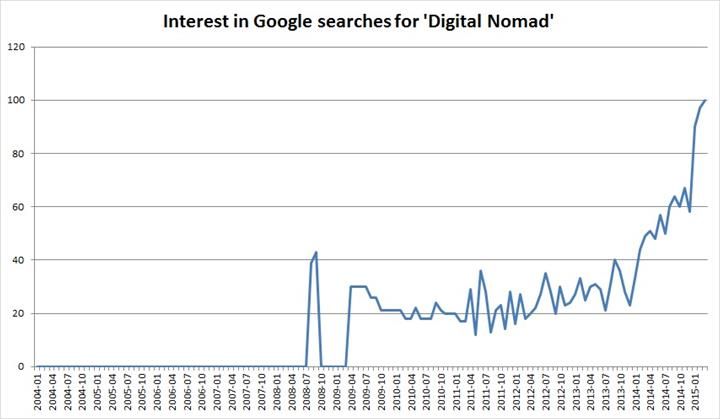
Some of the big media outlets have also started covering the trend, including Mashable and Forbes. People living as digital nomads are often referred to as a trend, but maybe that is not the right word. Trends have a tendency to have a peak of interest at some point, and after that the interest decreases again.
But this could be more than a trend; it could be a bigger change in how we live and work. It would make sense, when you look at history and Maslow's pyramid of needs. Over time we have gone from working just to survive to working for improving our self-esteem as well (aiming for jobs with a big paycheck, a lot of prestige and a nice car). Now more and more people are moving the next step up - they want to work and live with meaning. For a lot of people this means working on their own terms, freedom and the possibility of explore the world at the same time.
With more than one in three people in the US now working as freelancers, we are seeing a change in how we work, which is here is to stay. Everything points in the direction of this to become mainstream and not just a trend.
What does this means for business travel
In short, this is a new way of business travel that is completely different from typical business travel. When a trend is becoming mainstream a lot of possibilities will arise; this especially applies for suppliers, like hotels, travel agencies and destinations.
This kind of company in the travel industry could target this growing market in different ways. Hotels often have a bunch of meeting rooms. These could be used for co-working spaces, targeting people who want to work while travelling.
Travel agencies could also specialise in this. More and more companies are building remote teams with employees spread over different locations. Often these companies want to get their employees together for a retreat/work week once or twice per year. A travel agency could specialise in that.
Destinations could position themselves as a go-to place for digital nomads, by building co-working and co-living spaces, arranging meet-ups etc. The community is still small and people tend to go where other digital nomads are going. In the future there will be some entrepreneur/freelancer/digital nomad hubs around the world, now is the time to do the positioning in this field.
The effect for business travel buyers and managers
If this really goes from trend to mainstream, change will also be seen in regular, bigger companies.
More and more people are freelancing, but that also means that more and more companies are hiring freelancers. This could easily expand to companies hiring nomadic people for jobs, where locations don't matter. In the future the job of travel buyers and managers could also include booking and managing co-working places.
The trend is growing and this also means that a lot of people will quit their jobs to pursue a different lifestyle. Companies could attract and retain the absolute best people, by offering them 'digital nomad programmes', where their employees could travel a part of the year, while they work their normal hours. This could be for some weeks every year that the employee could travel, but it could also be an organised programme, where apartments and workspaces are provided and/or organised by the company.
If a company already allows employees to work from home, this could be a great and cheap way to really offer them an incentive to work for them.
More and more start-ups are building their teams remotely. They believe that the best people are not necessarily living within a commute-friendly distance from their office and therefore they hire people from all over the world. This is a trend that is just starting, but more and more companies like this are becoming bigger and bigger. This is a trend within the trend. This opens up for making services directly targeted companies like this. At some point, when they grow, they would need to hire a company, a freelancer or an employee to manage all of their travelling activities.
For companies hiring people on a location independent basis, offering different variations of 'nomad programmes' or having their complete team working remotely focusing on questions about tax and the legal side of it will also be a challenge. When something changes in our society, regulations are often a step behind, so some resources would be have to be put into solving these matters.
Conclusion
Let's sum all of this up:
- Digital nomads are a trend, where entrepreneurs and freelancer are moving around and working from different locations.
- This is business travel, but very different from the traditional business travel (meetings, conferences etc.)
- The trend is growing and everything points in the direction that it could become mainstream.
- Bigger companies will also be hit by this trend sooner or later, offering more freedom to their employees and/or hiring people remotely.
- This trend is a different kind of business travel that opens for a lot of possibilities within the travel industry.
- This could mean a lot of change for business travel buyers and managers.