Another Business Travel iQ expert — Andrew Solum — previously posed the question:' Have loyalty programmes become a victim of their own success'? to which the answer was broadly yes. Andrew quoted some horror stories about how previously loyal customers had gone from being brand ambassadors to brand terrorists and with some cause.
Twenty years or so ago when I was living in Atlanta, from where there was one British Airways flight a day back to the UK (and lots of Delta flights), I was standing in the check-in line at first class as a gold card holder, not a first class passenger. The check-in staff were dealing with an obviously irate passenger for whom things were not going well, who came out with possibly the best on- line comeback ever when he said, at about 150 decibels, "Look, I understand that you're going to treat me like (bad word here, best described as decaying faecal matter), but would you just stop telling me how important I am to you while you're doing it"!
And therein lies the conundrum, loyalty should not really require anything more than great product & service to engender it, but we have built a whole industry around buying customer loyalty and that is in the process of change. There is now strong evidence to suggest that we are moving from an age where firms want only to retain loyal customers to one in which they will be more interested in attracting each other's disloyal customers.
The elephant in the room — switching is worth more than loyalty
US companies spend $50 million on loyalty programmes alone (McKinsey: Dec 2011, Shaukat & Auerbach). That's a lot of money essentially to build the exit barriers, raise the switching costs for your most loyal customers to remain loyal to you but the other side of the coin is that the switching economy is becoming truly huge. Accenture estimate that there is £5.9 trillion 'in play' as digitally enabled, socially connected, 'always on' consumers choose to switch their service and product suppliers (Accenture: 2014, Wollan, Palmer, Jain). The game is changing and loyalty is becoming a busted flush. Why?
- Firms don't really value loyalty, they value spend. A 100% loyal customer using a short-haul, low-yield route is not of much value to the airline and will be treated as such. A mostly disloyal customer on long-haul, high-yield routes will be slavered over. What providers really want is to retain high profitability, large spend customers and existing loyalty schemes are too much of a shotgun approach to do that well.
- Loyalty is a lifetime proposition or it isn't loyalty. People have career paths and they sometimes go up and sometimes down. So how does an elite tier customer feel when the 'you didn't make the cut' message comes because their job has changed and how likely are they to remain loyal to the same provider when they return to the high profitability customer that programmes really target at the next job change?
- We're all digital customers now. Even if we don't book online, we research online, make comparisons online, swap experiences online and the ability of providers to keep customers loyal in the face of almost perfect knowledge about alternatives and an ever-present enticement to switch brands is much diminished from even ten years ago.
- Competitive equality legislation is forcing firms to lower switching costs; look at utilities, wireless phone and cable services. Will it stop there? Doubt it. The economics of loyalty are all about switching costs and as these come down thanks to the growth of online and level playing field legislation it becomes relatively more profitable to win new customers with growth potential than to retain existing plateaued out customers who have to be rewarded for their loyalty — turning the accepted wisdom on its head.
- The discounters in retail food and airlines are by and large more profitable than the high-service, non-discount (usually with loyalty programmes) providers. A study in the USA showed that retailers with loyalty programmes posted a 2.28% comparable sales increase whilst those without posted 4.26% over the same period (McKinsey: Dec 2011, Shaukat & Auerbach). Now there may be many contributory reasons for this but whatever you think this is a red flag; it's different by sector but the inescapable conclusion must be that
Loyalty isn't working
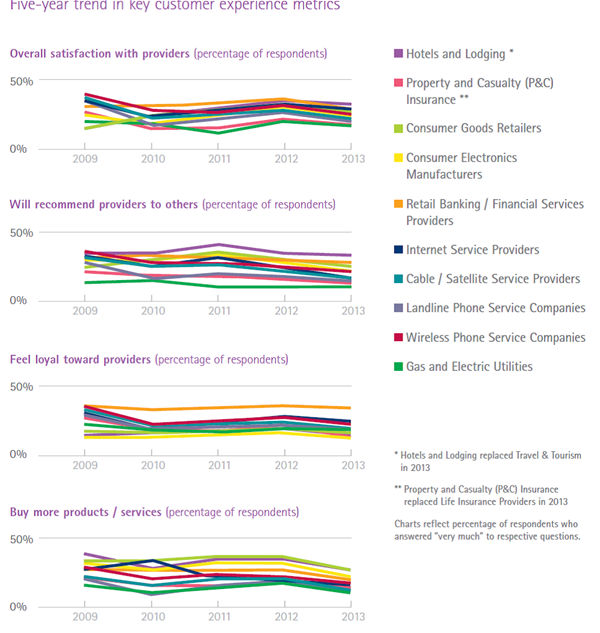 Reproduced by kind permission of Accenture
Overall satisfaction is highest in retail banking and financial services (wow) and lowest in utilities; wireless and cable which have been hammered for poor practice in pricing and preventing a functioning, competitive market. Hotels and lodging are in the top quartile and top of the pile in willingness to recommend. When it comes to 'feel loyal towards providers', well we don't. Everybody — except financial services again, piles into a compressed downward trend.
We are not loyal customers. We're learning that companies are not really loyal to us, that disloyalty pays and that loyalty programmes aren't always all that they're cracked up to be.
So here's my prediction and remember in ten years' time, you heard it here first!
Loyalty schemes as we know them will not exist by 2025
- The switching economy will become the new normal. As exit barriers come down so the economics of the acquisition cost. Customer value will turn on its head. Winning new customers with a large growth curve versus retaining those who expect ever greater incentives to maintain existing levels of spend will become more attractive to firms.
- Food retailers, utility and fuel providers will exit paid loyalty first, other sectors will follow.
- Travel will be amongst the last to exit and hotels the last of the last as the economics of loyalty to the large management companies (as opposed to the managed and franchised hotels under their brands) is very lucrative to them and one of the few things they can control 100%.
- The rise of the self-employed entrepreneur and contractor will hasten the demise of reward schemes as rewarding consumers with their own money — as opposed to transferring corporate funds to private funds, which is what current schemes do when they pay with points earned from the company's dollar — is a zero-sum game.
- Loyalty will go back to differentiating between reward and recognition with reward becoming a lowest common denominator offering that will pay a price in return for permission to market to the individual.
- All other aspects of retention will move to an unpublished, surprise and delight model rather than a formulaic scheme as CRM combines with big data to enable the market segment of one
SWWC (so what who cares?)
Well you should. This is a sea change in consumer attitude and supplier behaviour. It's happening over such an extended period that it's hard to see the wood for the trees but it's happening nonetheless and smart firms will harness that change and get ahead of it. Here are some thoughts on how to do that, from the incremental to the radical to the nuclear
- Negotiate for recognition benefits — upgrades, removal of restrictions, etc. in your programmes based on total company spend rather than individual spend— you probably already do.
- Build a rates/fares matrix of suppliers offering reward points versus those that don't and see if the difference is worth doing something about in the next RFP round.
- Reduce class of travel/accommodation entitlement by one level and encourage travellers to use their points to upgrade (will make you more popular on the executive floor than the shop floor).
- Eliminate category procurement entirely and replace it with monthly best deal guidance; go right back to per diem allowances and make the always on traveller responsible for their own procurement
What we're seeing in purchasing habits in food retail, consumers now shopping across multiple brands to which they are equally loyal — or disloyal, is going to become the new normal in travel and hospitality. The always on-the-move traveller will have vast amounts of information at his or her command which they will use both to inform their own buying choice and to influence others. We will all become each other's trusted voice.
On the supply side this means that the economics of paying for retention as opposed to paying for switching is moving inexorably towards the latter. Paid for loyalty schemes against that backdrop are going to wither on the vine.
The question is how are you going to harness the age of disloyalty to your advantage?