Business Travel iQ
Boeing has new luggage bins on offer for its 737s. They can hold 50% more carry-on items and sacrifice merely two inches in head space for passengers.
But will this really benefit airlines, travellers and the environment?
Carry-on baggage used to be mostly handbags, briefcases and items for the person in a hurry who didn't want to wait for the luggage carousel to deposit their overnight case.
Then two things happened — low-cost carriers began disaggregating fares and introducing charges for services that used to be included in the fare, namely checked baggage, and the oil price started rising. The more weight there is on a plane, the more fuel that is used so carriers were keen to limit weight — and charging for baggage seemed one way to do this.
There was, of course, the inevitable consumer backlash so one-by-one carriers announced that passengers wouldn't be charged for carry-on baggage. The inevitable consequence was that carry-on bags changed from the laptop and a small holdall to the entire wardrobe for a two-week holiday in Tenerife.
Continued below
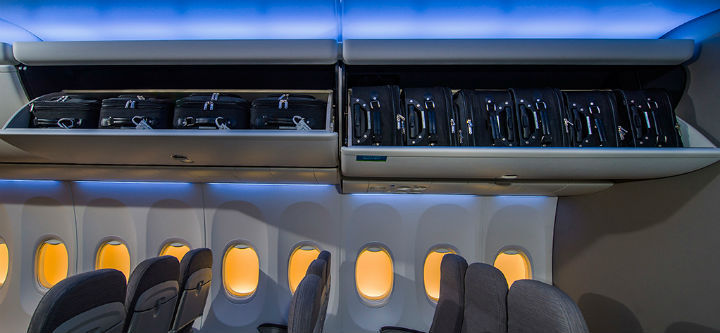 The difference in the two overhead bins. Credit: Boeing/Jim Anderson
Increasing the amount of baggage that an aircraft can carry will increase the weight of the plane and therefore the amount of fuel per kilometre required.
So for the carrier the result is less money from checked baggage fees and greater cost from lowered fuel efficiency. The need to burn more fuel per kilometre means more emissions.
And for the traveller, leisure or business, front or back of cabin, the result is two inches less head space — maybe not an issue for an eight-year-old child but it is for a 6'4" business traveller.
And it looks like a space issue that won't be resolved by moving your travellers to the front of the plane.
Maybe the carriers should consider charging by total weight rather than by number of items in the hold.