T&E report management company Certify produces quarterly reports tracking traveller trends and benchmarking spending. This week it released its findings based on figures for the last quarter of 2017 and they make very interesting reading indeed for both ground transport suppliers and corporate travel managers.
As the chart shows, quarterly data for 2017, when compared with 2016 data, shows an accelerating trend for ride-hailing services such as Uber (52 to 56%) and Lyft (4 to 12%) to increase their market share in terms of number of transactions to the cost of the more traditional sectors of taxis which fell from 11 to 7% and car rental (33 to 25%).
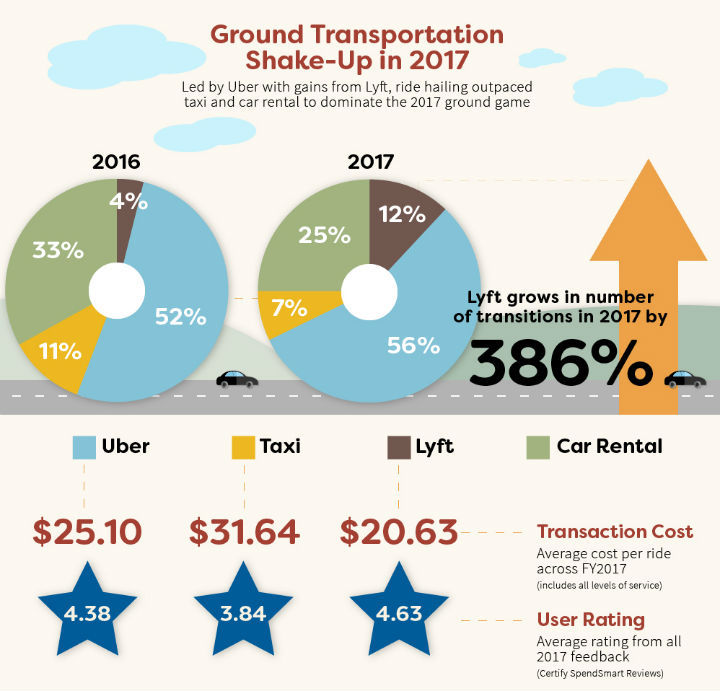
You would admittedly expect more taxi and ride-hailing transactions than those for car rental — after all, it's not unusual to book four rides a day whereas a week's car rental would count as only one transaction. But the rate of growth is still impressive.
More of Uber's receipts — 9%, to be precise — are processed than those of any other T&E supplier. Starbucks, in second place, lagged by six percentage points despite also being a high-transaction, low transaction value business.
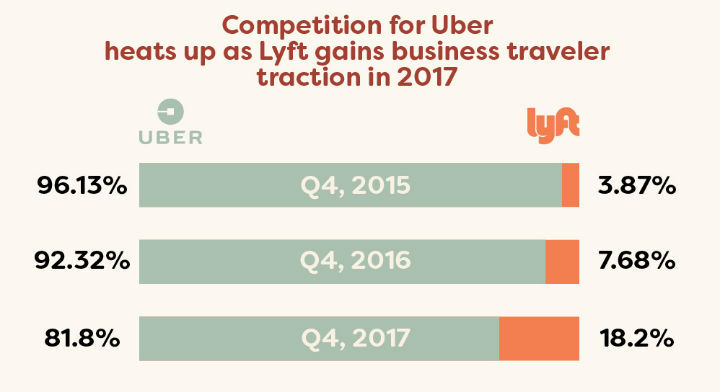
Certify attributes Uber and Lyft's success to "industry disruption and change in business traveller preference". As the chart below shows by demonstrating Lyft's increasing market share to the cost of Uber, the shift is to the genre rather than one specific company. Sharing economy ride-hailing companies in the US are making big inroads in corporate programmes.
Taxis and car rental are used for different objectives so logic might suggest that the reason for the dip in both is the growing popularity of ride-hailing. This probably points to changing taste — why would one stand in the street looking for a taxi to hail when you can order one that will be with you in minutes from your smartphone? And there's also the matter of cost. They tend to be cheaper than traditional taxis.
Lest one think that it's just a fad for sharing economy businesses, Certify reminds readers that although Airbnb bookings have nearly doubled every year for each of the past three, they still represent only 0.5% of expensed lodging bookings — a big gap from the 68% share, admittedly for a lower value, higher volume product, enjoyed by Lyft and Uber.
There has been a big rush over the past couple of years to incorporate ground transport into managed travel programmes.
This could very well be the time to negotiate a deal — the prices of some established players could be quite competitive.