Trying to establish integration when it comes to travel technology is one of the biggest challenges facing the industry. Together with HRG, we invited a number of experts to share their thoughts on the subject. Mike Toynbee reports
Soundbites ...
"The challenge is how to get the supply side of the industry to put together a decent, robust level of connectivity. Something that is robust enough to service the corporate model."
Bill Brindle,business technology and distribution director, HRG

"Facebook and Twitter, for the generation that is coming into the business, will become business tools as well as networking tools."
Mark Avery, head of business services,PricewaterhouseCoopers

"The barrier is not always about technology, it is about establishing firm relationships."
Neil Sunners, group vice president for product and services, Travelport

"Together with fragmentation, the challenges will be control, governance, security risk ... if we can create an environment that allows our clients and partners to work together, and we can manage data from that, we are then in a better position."
Stewart Harvey,client management director, HRG

"There is no equivalent of interline agreements between the rail carriers to sell customers tickets all the way through."
Paul Bustin, executive director of Travel Assets, Groundscope
Let's be honest. Technology is not a subject in which many of us have much interest, let alone understand. The complexities of what goes on behind the scenes are as baffling to most people as what's under the bonnet of their car these days.
Yet we are all dependent on technology and, in travel, more so than most. And we take it very much for granted, just as we do when we turn the ignition key of the car. Few of us have even the vaguest comprehension of the technological wizardry involved in simply buying an air or rail ticket, or the distribution and payment systems that entails.
It is little wonder, therefore, that so much time, effort and money is expended on developing new technologies and systems that will deliver savings and efficiencies.
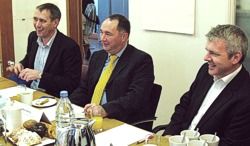
But the corporate travel industry is facing huge challenges, not least on the technology front. It was with this in mind that a number of experts, representing various interested parties - a leading travel management company (TMC), a global distribution system (GDS), a specialist in ground travel management technology and, of course, a buyer - sat down to discuss the issues and to examine where we go from here.
Not least of these challenges is the need for industry-wide standardisation as it becomes more fragmented, highlighted by David Radcliffe, HRG's chief executive, at a technology seminar last year at Microsoft's Thames Valley Campus. "On the one hand, technology is a great differentiator [between TMCs] but, on the other hand, there is so much disparity within the industry," he said.
The problem is that there are no defined standards for the corporate travel industry in terms of technology. According to Bill Brindle, HRG's business technology and distribution director, the emphasis is on satisfying an ever increasing demand, largely driven by the leisure market. "Corporate technology tends to be overshadowed by the leisure side of the business, due to its sheer size and volume," he said.
However, it is generally recognised the corporate client tends to be more sophisticated than the leisure customer, and requires not only more online content, but more robust systems to handle their business.
As Stewart Harvey, client management director for HRG, pointed out: "Unlike the leisure type of business, the corporate travel booker can be handling bookings for a number of travellers and will, therefore, be hitting a phone or a site a dozen or more times a day, every day."
From a user's perspective, Mark Avery, head of business services at PricewaterhouseCoopers (PwC), maintained that both the global distribution systems and the online tools used are, indeed, robust. "It is a bit like picking up the telephone - you expect it to work. People fail the systems but rarely do the systems fail the people."
The concern, however, particularly on the part of the technology experts, is the pace of change and the increased burdens on the systems. There is a huge number of transactions being produced now as people increasingly search, before they book, in their efforts to find the cheapest deal.
According to Neil Sunners, group vice president for product and services, Travelport, the number of GDS transactions is spiralling upwards as both leisure and corporate travellers search for lower prices. "The pressure on the systems is enormous - we are seeing record peak activities."
What's more, that demand is not going to go away, said Avery. "It is going to get worse. How do you turn that round to deliver the information so that people can look and not book?"
He adds that what the customer - the traveller or the booker - wants is an end-to-end process, from making a reservation, based on all that content available, through to how they actually travel, receive the goods, pay for it and finally expense it. "It is actually trying to link up all the pieces in the chain. The difficulty today is that all that required content isn't there. It is tough to obtain because it is so disparate and fragmented."
One of the problems, it appears, is the speed with which airlines are changing their products, particularly in terms of value-added content, outside the normal distribution channels. "You end up with fragmentation, whereby the carriers make the content immediately available on their own sites and we are not able to access it through the traditional source," said Brindle. "Clients want more services from us these days - much of it off GDS," he added.
Neil Sunners acknowledged that the GDS are required to think more about the traveller's needs, "so that the tools we provide to customers are more able to meet those needs". He said that the strength of the GDS was in providing quantative information - the number of seats on an aircraft, for example - but there was also need for qualative-type information, such as seat comfort or the experience within a hotel, which is visual, or 'soft' information that, in itself, did no represent something that could be sold to users. "That is the area we are beginning to look into and develop solutions for," he said.
Added Paul Bustin, executive director of Travel Assets, Groundscope: "It has to be packaged and delivered in a way that makes sense. It is as much video content as anything else."
Stewart Harvey suggested there was much duplication of effort and energy in the search for solutions. "Sometimes the focus on costs looks at one part of a process in isolation, whereas the need is an expanded process, from itinerary planning, trip authorisation, actual transportation, accommodation and then expenses. For me there is a need to enable the provision of that service, requiring some form of synthesis all the way through. At the moment, a number of things are getting in the way of that, and not necessarily technological. Very often they are driven by commercial considerations or legacy behaviour."
Sunners added: "I see and understand the need - we are in business to provide a single interface through a myriad of suppliers of different types. But things are moving so fast, the challenge for us is to keep pace because, as large as we are, everyone has a budget. We have to pick our priorities."
Aggregating content - air, hotels, rail, car rental, airport parking and the rest - appears to be the end game.
"From a customer point of view, we don't care how it's done - what is important to our users [travellers] is that we can give them all that content," said Mark Avery, adding that perhaps this comment was a little unfair, "because, as an informed customer, we know how difficult it is to achieve".
Many of the problems, if would seem, revolve around the commercial model for travel distribution. "How much is that model, which has been in existence for many years, hindering that process or development change?" asked Avery. "It goes back to the core - the airlines, the hotels, the GDSs, through to the TMC and, finally, to the customer. Ultimately, those fees are being paid for by us and our travellers.

"As far as I am concerned, that model is, and has been, potentially broken for a long time in terms of the way the money flows around those organisations. Fragmentation will continue for as long as the commercial model remains in place as it is."
"Everything points to greater fragmentation," said Paul Bustin. "I can't see one commercial entity that has the significant edge within the market to be able to assert itself and, therefore, create sufficient momentum towards standards. I see this as a trend in the opposite direction."
He highlighted the problem with rail travel, which has been the fastest area of growth for HRG in recent months. "We are building a new solution just as fast we can, but it will probably take us 12 months to get five suppliers on it, because again there is no common approach," he said.
Drawing comparisons with the airline network, which he described as mature, he said there wasn't the same global integration of networks for rail: "Selling a ticket from London to Gare du Nord was straightforward enough, but if the need was to travel beyond that point, today's systems wouldn't find it because all the routing tables and information wasn't currently stored in a GDS-type system. There is no equivalent of interline agreements between the rail operators to sell customers tickets all the way through the journey. Trying to work with all the rail companies together is an absolute nightmare".
Yet that was the only solution as far as Bill Brindle was concerned. Although HRG worked successfully with thetrainline.com in the UK, handling many thousands of bookings a week, in Europe it is still a question of how it all comes together.
"Rail platform service integration is something which has been on everyone's minds for years because of the volumes involved. The only way we can achieve it is to bring all the rail suppliers together, the users and the technology teams that can make it all happen." He said there were currently three long-term projects under way, each funded by the main GDSs.
Mark Avery pointed out that PwC had seen a 100 per cent increase in rail bookings via HRG and online in recent months, with the average ticket price down by 38 per cent against the same period last year. "People are changing their behaviour by coming online. The economics is driving some of that change," he said.
That behavioural change was as a result of people being able to approach and plan itineraries, suggested Stewart Harvey. "At the back end, once you have the processing in place, you gather data which goes back to management, who can then take a decision and establish a policy. As a result, you get this continuous cycle of getting better and smarter decisions."
All of which is driven by technology. We might not understand what goes on behind the scenes, but you can be certain that without it, everything would grind to a halt.