London City Airport has seen some big changes in recent years. Gary Noakes explores what the airport has to offer
Twenty-two years ago when it opened, the steel and glass building of London City Airport resembled a spaceship that had landed in a war zone, but it - and the area around it - has come a long way since.
Built over the old King George V dry dock and now boasting a New York service among its 30-plus destinations, the airport is the favoured choice of anyone flying into London with need of a quick route to the nearby financial districts of Canary Wharf and the City.
It has come a long way since 1982, when a test flight by Brymon Airways saw a small propeller aircraft land in nearby Heron Quays, putting the case for an airport in London's then-mainly derelict and bankrupt Docklands.
Some of the financial institutions that later relocated to Canary Wharf and fed the growth of London City have recently gone bankrupt themselves, but the airport, just three miles away, is still managing fine without them.
As it beds in the new British Airways flights to JFK, the airport is facing several significant changes. Firstly, there is the possibility of extending its range of short-haul destinations beyond its current, roughly two-hour limit. It is also pondering the opportunities that the 2012 Olympics will bring and enjoying the fact that, after years of muffled enthusiasm, BA is finally taking London City seriously.
The airport's traditional model has been to offer frequent flights to Europe's business capitals. "In some ways, we might have thought that was our lot in life," said Richard Gooding, the airport's managing director. "Two or three years ago we would have said that two-to two-and-a-half hours' flying time was our sphere of influence."
That changed this autumn with the launch of the New York route. For these flights, BA has become the first to operate the Airbus A318 into the airport, the largest aircraft to appear there. The A318 typically holds about 109 passengers, but BA has put only 32 seats on the aircraft, marketing it as a special version of its Club World product. The A318 can cross the Atlantic using a full-length runway, but with London City's shorter runway, needs a refueling stop in Shannon on the outbound leg.
Gooding is already thinking about where else the A318 can fly. It has a range of about four hours using London City's runway and he is excited about the possible spin-offs from BA's new project.
"If New York works and the A318 is seen as successful, what else could it do? If it can go long range, it can get to Moscow, three-and-half hours away, or Athens, three hours away. It opens up some interesting new markets for us."
Another spin-off from the New York flight may be an increase in the number of transfer passengers. Currently, these make up only three to four per cent of the airport's customers who arrive on another flight - however a canny five per cent walk through the front door to transfer in Europe and avoid Heathrow, mainly when flying eastwards.
Gooding refers to the New York flight as his "green shoots of recovery", hoping that the hype that surrounds it will bring back a few of the passengers lost in the recession. "I'm not going to pretend it hasn't been a difficult year for us," he said. Last year, the airport attracted a record 3.27 million passengers, a number Gooding admits it will not match this year given the belt-tightening among financial institutions.
The airport, however, can convincingly argue that there are better times ahead, chiefly in the shape of the 2012 Olympics, which will take place just two miles away.
Gooding believes the legacy the Games will leave is more important to the airport than the fortnight of the actual event itself. "We'll definitely see a downturn in our business then. The business community will disappear during the Games because all the transport and hotels will be full and if you are here, you'll stay and watch it."
What will benefit the airport is the improved transport links that the Olympics will bring. The Docklands Light Railway - which, in 2005, was extended to within a minute's walk of the check-in area, putting the City 22 minutes away - will then also link it directly to Stratford International and the Olympic Park, which, after the Games, will become a big new residential area.
"It gives a huge kick-start to this side of London, which is where our market is," said Gooding. "If nobody ever came from west London to use the airport, there is still more than enough demand from the east."
The experience of the airport since the DLR arrived on its doorstep four years ago gives grounds for optimism, as it literally put it on London's Tube map. Now, more than half the airport's passengers use it - a good thing seeing as the roads surrounding it would be unable to cope with current numbers.
It may have been the DLR's arrival that prompted BA to look seriously at London City. BA had previously allowed VLM, a tiny airline based in Antwerp, to take pole position there while it concentrated its efforts on Heathrow and developing Terminal 5.
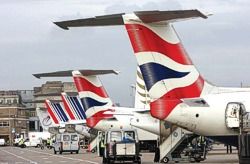
In late 2007, Air France/KLM bought VLM, adding it to its other subsidiary, Dublin's CityJet, which also specialises in operating from London City. The VLM name has now disappeared in favour of CityJet and, together, the three brands are heavily dominant at the airport, having 42 per cent of slots and 36 per cent of passengers. BA is the second-biggest carrier with, in August, 19 per cent of slots and 26 per cent of passengers.
BA's CityFlyer subsidiary, which operates the London City flights, has reacted to CityJet with an investment in 11 new Embraer aircraft with a list price of US$376 million. The 76- and 98-seat twin jets, which offer two abreast seating, will all be delivered by June next year. They underline BA's commitment to the airport, as they do not fit its operations anywhere else.
The 76-seat Embraer 170, the first of which arrived in September, consumes 55 per cent less fuel than the four-engine type that it replaces. It and the larger 190 can fly slightly further than BA's existing London City fleet, giving the airline opportunities to serve new cities once the economy picks up. BA is remaining tight-lipped, but adds that with a little modification the Embraer can reach places like Moscow.
"There are a lot of potential routes on the drawing board," said Peter Simpson, CityFlyer's managing director. "We currently have nine routes - I can see a genuine opportunity for at least another five, but we will do that carefully."
Simpson said business travellers would enjoy the new aircraft, which have not been seen at London City before: "From a passenger perspective it is a much better seating configuration. There is greater capacity in the baggage bins for the significant amount of carry-on luggage that London City passengers have."
The new aircraft may give London City an altogether different dimension as well. It is without doubt a business-focused airport, and, partly because of this, closes for 24 hours from Saturday lunchtime, as Saturday afternoon and Sunday morning are not traditionally the times for business travel. Few carriers at London City have made serious attempts to attract leisure travellers during the non-peak hours, although Swiss International Air Lines (SWISS) has been successful in serving the winter sports market.
BA CityFlyer's Simpson is, however, acutely aware that he has a fleet of brand new, expensive aircraft that are under-utilised at weekends and during the August business travel lull.
Simpson's 190s can comfortably reach Majorca and he has said he will "put a toe in the water" next year by launching flights to destinations such as the Balearics. This is a radical move, but it does not mean that business travellers will be tripping over the bucket-and-spade brigade at London City during the week. It will, however, provide more opportunities to spend those BA Miles if it is your local airport.
Meanwhile, BA's main rival is spending £4m on an advertising campaign. Among CityJet's targets are Heathrow passengers, with a heavy presence on the M4 reminding travellers into London of comparative journey times to the City and an alternative to motorway traffic jams.
A dogfight between BA and the new CityJet dedicated brand can only be good for London City as it seeks to regain lost passengers. Part of its past problem was that promotion was left to a disparate number of smaller brands. Behind CityJet and BA, SWISS has a respectable 21 per cent of London City's passengers.
Next is Lufthansa, with only seven per cent and after this, no one even reaches three per cent.
CityJet is spending £4m on marketing after research showed there was still a lack of awareness about London City.
"What astounded me was the blank faces when we asked about the airport," said CityJet marketing manager Colin Lewis. "It's still not on the menu for the wider market in London, and outbound travel is not as strong as inbound. People either don't know about it, or they do know it and they love it. The more we talk about it, the more people will get it."
CityJet, which introduced Nantes this year, will not be launching any more routes for a while, but despite the recession, this year has also seen Aer Arann introducing Isle of Man; SunAir, a BA franchise, adding Billund; Air Southwest with Newquay and Plymouth; and, most recently, BA's New York service.
This winter will also see the return of the Alitalia brand to London City after an absence of almost a decade. This follows the merger with Air One, which currently flies to Milan from London City. Its aircraft will gradually adopt the Alitalia livery over the next few months.
Further ahead, there will doubtless be more developments once the economy improves. In October 2008, the airport gained planning permission to increase aircraft movements from 80,000 a year to 120,000. This translates to around 5.5m passengers, although actual capacity as the airport exists today is probably only 4-4.5m. Expanding beyond this may mean construction of more parking bays allowing aircraft to be shuffled along the tarmac more efficiently. This means less delays on the ground and, consequently, in the air. Last year, four extra bays were added, leading to a jump in on-time performance from 58 per cent to 74 per cent.
However, while one can talk about statistics and how efficient London City is, there is another selling point. Catch a flight into it when an easterly wind is blowing and you will approach low over central London, taking in fabulous views as you do a U-turn somewhere around Westminster. Here, even the most blasé banker would find it difficult to resist a peek out of the window and, perhaps for a moment, forget all about the economy's woes.
Destinations from London City Airport this winter
Amsterdam |
British Airways, CityJet |
Antwerp |
CityJet |
Basel |
SWISS |
Billund |
SunAir operating as BA |
Copenhagen |
SAS |
Dublin |
CityJet |
Dundee |
CityJet |
Düsseldorf |
Lufthansa |
Edinburgh |
CityJet, BA |
Eindhoven |
CityJet |
Frankfurt |
Lufthansa, BA |
Geneva |
SWISS |
Glasgow |
BA |
Isle of Man |
Aer Arann |
Jersey |
CityJet |
Luxembourg |
CityJet, Luxair |
Madrid |
BA |
Milan Linate |
Air One (Alitalia) |
Munich |
Lufthansa |
Nantes |
CityJet |
New York |
BA |
Newquay |
Air Southwest |
Nice |
BA, CityJet |
Paris |
CityJet |
Plymouth |
Air Southwest |
Rotterdam |
CityJet |
Strasbourg |
CityJet |
Zurich |
BA, SWISS |
On the ground
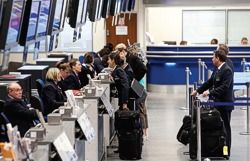
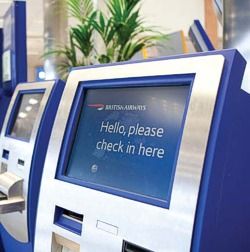
London City Airport's boast when the DLR opened four years ago was that check-in was 90 paces from the DLR station. These days it is arguably even closer, as the airport's growth has meant that remote kiosks have had to be located in the gangway leading to the station.
Despite expansion, the airport still boasts a minimum 30-minute check-in with hold baggage or 20 minutes with hand luggage. The only potential peak-time bottlenecks are at security and, on the inbound journey, at passport control.
Early next year, work will begin to expand the security search area, plus another extension of the departure lounge. The downside to this is that once complete in autumn 2010, car hire booths will be relocated outside the terminal building and the restaurant will be smaller.
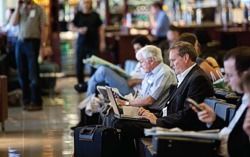
This will be the third phase of rebuilding in recent months. Last year work finished on a £50 million redevelopment, the largest capital project since the airport opened. As well as four extra parking stands, the departure lounge was extended, absorbing what were meeting rooms. In March, another £1.5m was spent on refurbishment of the main departure area, including the installation of laptop power points.
Airport managing director Richard Gooding said he was also working to get immigration queues down but admitted that this was a difficult thing to achieve given the heightened border security nowadays.