Bob Papworth hears how travel management company HRG pulled out the stops to aid its clients during January’s big freeze
FOR THE 15-YEAR-OLD Papworth twins, the morning of January 18, 2013, was an occasion of almost-unalloyed joy. School was cancelled, mock GCSEs had been postponed, and the garden was ankle-deep in stuff just begging to be thrown at the slip-sliding passers-by.
Inevitably, they had to endure the curmudgeonly paternal exhortations to keep the noisedown because “these Buying Business Travel features don’t write themselves, you know” – but, leaving aside me and my aversion to anything cold and wet that doesn’t contain vodka, this promised to turn into the best Friday ever.
To read this article on your tablet, phone or desktop, download the Buying Business Travel app from the Apple or Android Store. To get a preview, click here
Of course, being a mere 15, and yet to inherit their father’s deeply-ingrained disillusionment with life in general and adverse weather conditions in particular, they considered not for one moment the plight of those who were, on that same morning, thinking unkind thoughts about a transport system that grinds to halt every time it clouds over a bit.
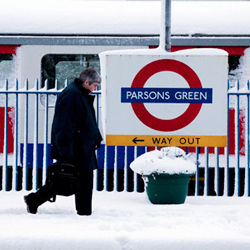
And they (the unkind thought-thinkers, that is) were legion. More than 800 flights out of Heathrow had to be cancelled that weekend and, at various times, Cardiff, Bristol, Southampton, Birmingham and London City were shut down.
Southern and South West Trains revised their timetables, and Greater Anglia and Eurostar, among others, also cancelled services. A section of the M4 in Wales was completely closed for a while, and many A-roads were rendered impassable.
For professional services and accountancy firm Pricewaterhouse Coopers (PWC), with some 7,500 frequent flyers and more than 11,000 regular rail users, it could have been a nightmare. Obviously they weren’t all on the move that weekend, but those that were very quickly found themselves stranded in places they did not want – or need – to be.
“Clearly, when there is snow, it affects different parts of the country at different times and to different extents,” says PWC’s business travel manager Will Hasler. “It can be fine in Birmingham but awful in London, and the guy in Birmingham doesn’t know that.
“Here in the UK, our top route is Belfast-London, and if there’s a problem at one end the traveller at the other end probably isn’t aware of it. And that’s when he gets on the phone…”
And how. PWC uses travel management company HRG’s 24-hour emergency service, where call volumes that weekend were up 850 per cent. “There are normally 52 people on the 24-hour team, and we brought in an additional 20 people, as well as having other staff working late into the evenings and over the entire weekend – and, to be honest, I think that still wasn’t enough,” says Shetal Raval, HRG’s international head of operations.
“We put in two calls a day to the senior management team to make sure we had the right number of staff in the right places but – although I haven’t told anyone here yet – I think, going forward, that is something we are going to have to look at. I believe we did very well, but that’s not enough. We have had a lot of compliments from our clients, but we can always do better.”
BIG IMPROVEMENTS
Over at PWC, Hasler says: “We won’t have a de-briefing session for something like this – although we would for a major incident like the 7/7 London bombings or the ash-cloud – but I know HRG does.”
He adds: “In the eight-and-a-half years that I have been here, I’ve seen some big improvements. They’ve got a lot better at getting people in to man the phones, and their telephony has improved dramatically – if one centre starts to get over-loaded, they can divert calls to another office where the call volum
es are not so great.”
For Raval, there is still more to be done. “We try to learn from every incident, and this time it’s a question of how we can keep people updated.
“With bad weather, we do at least get some prior warning, so we were able to plan our resources to a certain extent, and we know the people who are going to be impacted immediately. That’s how we prioritise, insofar as we can – somebody who is supposed to be leaving in ten minutes’ time takes priority over someone who isn’t travelling for another three days.”
GRADING RISK
Because crisis management is in essence a reactive process, there is still no easy way of grading the risk factors involved. Is a lone woman traveller, stranded on a station platform, more or less important than a senior management figure, stuck in Paris, overdue for an urgent meeting back in London?
“One thing we don’t do is prioritise travellers by seniority,” says Hasler. “We try to deal with everyone in turn. Where we can, we push out advance warnings and give general advice on potential travel hazards. We tell people that the weather is going to be bad tomorrow so, ifthey can, avoid travel – and that works pretty well.”
And if they can’t avoid travel, and get stuck, the recovery position is generally welcomed. “I only hear of the extreme cases,” says Hasler. “I have maybe five or ten emails saying how wonderful it all was, but you’ll always get one or two that say the whole experience was dreadful.”
It wasn’t that wonderful for the HRG team either, but on the Monday evening, after the weekend’s snowy travails, they had cause to celebrate. In recognition of both her career-long contribution, and more immediate crisis management during recent events such as Hurricane Sandy, Shetal Raval received the David Brown Outstanding Achievement accolade at this year’s BBT’s Business Travel Awards.
Your correspondent’s offspring were less happy. The rapid thaw meant the Papworth twins were, toenormous paternal relief, back at school…
COPING WITH CRISIS

HRG’s Shetal Raval offers some best-practice guidelines for disruption management
• CORPORATES SHOULD WORK WITH THEIR TMC to develop contingency plans. After the crises of recent years, more and more companies are putting procedures in place to be carried out in the event of travel disruptions. A good TMC can help establish a strong crisis management strategy.
• TRAVEL MANAGERS SHOULD ensure that all employees comply with travel policy. In order to be sure that every traveller is accounted for and can be contacted in case of an emergency, companies should insist that all travel must be booked using the company’s reservation system.
• TRAVEL MANAGERS SHOULD ALSO subscribe to email travel alerts, which can provide quick warning of danger or disruption affecting destinations around the world, especially important if a company has many travellers spread out in various countries.
• INSIST ON SPECIALIST TRAINING for employees travelling to high-risk destinations. Pre-trip guidance should cover safety, communication and health issues. In some cases, it may be necessary to provide security experts with itinerary details in order to ascertain specific threats.
• ONCE THE DISRUPTION OR RISK is assessed, restrict bookings to the impacted destination. Using the company’s approved reservation system, make sure additional travellers are not planning – and booking – travel to destinations that they may not be able to reach.
• AND, OF COURSE, companies should avail themselves of TMCs’ traveller tracking systems – not just to establish where employees are at any given moment, but to find out where they will be in the near future.