There has been much hype about the opening this week of what is billed as "the first [new rail link] from a major British city [to London] in more than 100 years".
Chiltern Railways and Network Rail have spent £320 million to open a new line between Oxford and London Marylebone, with journey times of 46 minutes, with new stations on the route at Oxford Parkway (on the outskirts of the city close to the A34 and A40) and Bicester. The route offers an alternative to those travelling on existing services via Reading and Paddington.
Chiltern says that the new service is expected to generate an additional quarter of a million rail journeys every year.
Network Rail has put up the bulk of the investment and will levy a facility charge on Chiltern and successive franchisees.
To mark the launch and the potential of more journeys on the UK's rail network we thought we would look this week at how passenger journeys have been growing over the past three decades.
The chart below shows the total number of franchised rail journeys.
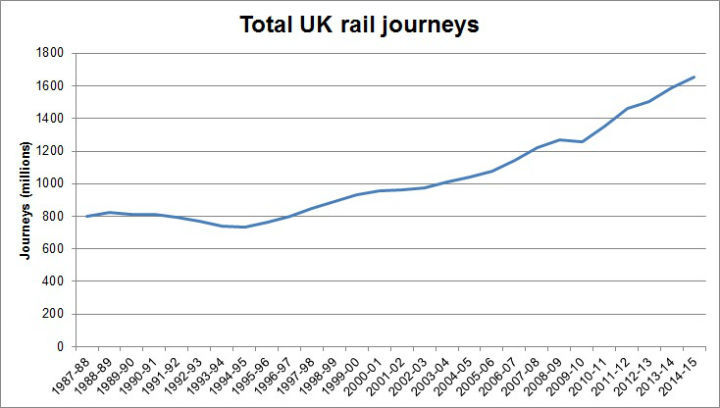
It shows that the number of journeys has doubled in the past 25 years. One obvious point to note is the privatisation of British Rail in 1993, when the number of journeys took off.
The mix of fares has diversified over this period with many more advance purchase tickets now available than in the past.
However, adding extra capacity to the rail network is challenging and expensive. If journeys increase without corresponding growth in infrastructure, fares are likely to be forced upwards despite their regulation; the fares paid by business travellers are usually those that are unregulated.