Only six months ago, business travel was looking buoyant. The GBTA forecast annual growth in 2018 at 7.1% at its August convention. It is important, however, to note that that figure was consolidated across all regions and is a value, ie spend, figure rather than a volume, ie quantity, spend.
More recent research from the Business Travel Show is gloomier. This annual survey of European travel buyers has found that only 33% of respondents say they will have bigger travel budgets in 2019 in comparison with 2018 compared with the 40% which said so when asked about 2018 in contrast to 2017. At the same time, 33% of respondents said they would have more trips to manage in comparison against 40% who said they would have more a year earlier.
Only one-third of respondents saying more to both spend and volume means two-thirds believe there will either be no change or even lower spend and/or volume.
Fewer trips among European organisations could have to do with all sorts of positive reasons such as employee welfare or using travel alternatives for internal meetings.
It could also, as in 2009, have to do with company caution and a slowdown in growth.
UK GDP figures released this week would support the latter.
A fortnight ago we reported a research report which found that UK company heads believed the number of business trips would fall. Last week we highlighted a UK purchasing managers survey which found that British companies were stockpiling in advance of Brexit.
Stockpiling in fact has been given as one of the possible reasons why last week's UK's ONS (Office for National Statistics) quarterly report found that UK GDP had slowed to 0.2% in the last quarter or 1.4% on an annual basis, the lowest rate since 2012.
Research from PwC's most recent Global Economy Watch (see below) shows rates of change in GDP, growth, everywhere except for India (7.6%), China (6.3%) and Indonesia (5.2%) are forecast to be under 4%. The figure for the Eurozone is 1.8%.
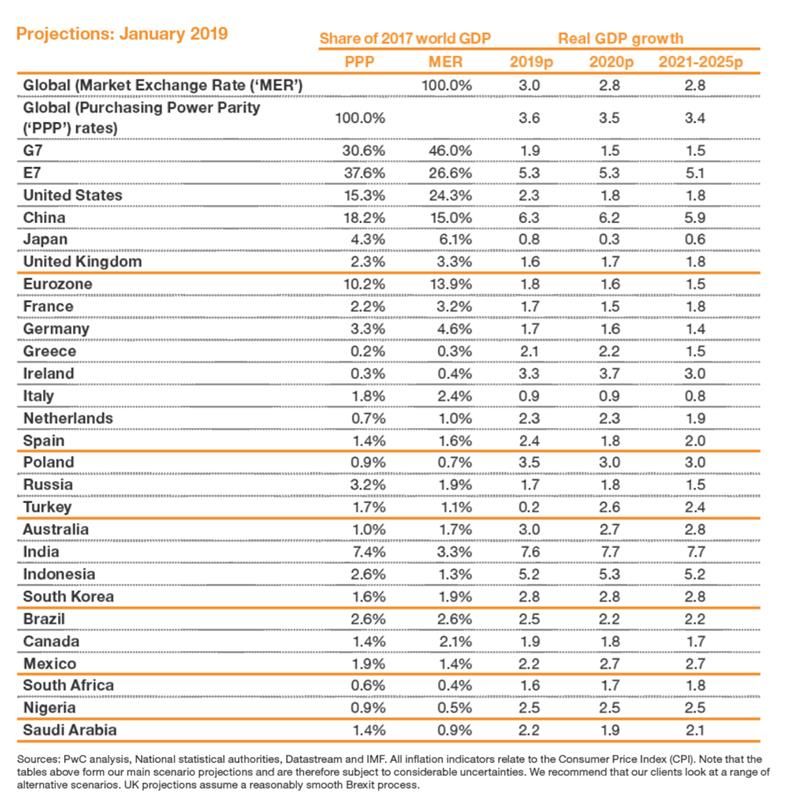
Everything is pointing towards less business travel in the year ahead.
Those who negotiate room rates or air fares on a volume basis should take heed and check their supplier contracts T&Cs. If volumes are not met, are there financial consequences? Are there consequences if the TMC is not given the forecast number of transactions? Do your internal forecasts take account of what some describe as scaremongering, others genuine economic slowdown?
Contingency planning is not just for other people.