Online travel agents (OTAs) continue to take market share from other channels, according to a new report from the European Commission.
The European Commission has released the report to look at the activities of the OTAs and whether changes to rate parity clauses in their contracts with hotels made in 2015 have made any difference to the competitive landscape.
The chart below shows how share among different booking channels has changed in the period 2013 to 2016. The figures relate to the period before many of the major chains started focusing efforts on incentivising direct bookings through their own websites.
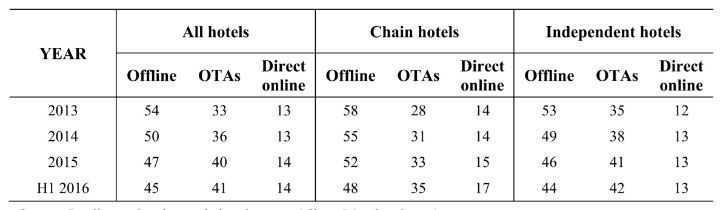
The report is based on studies carried out in 2016 by 11 EU competition authorities in Belgium, the Czech Republic, France, Germany, Hungary, Ireland, Italy, the Netherlands, Sweden and the UK as well as the Commission's competition directorate. It involved 16,000 hotels completing a questionnaire on their OTA activities between 2013 and 2016, with most focus on the period after changes to rate parity clauses were introduced in 2015 by the major OTAs. The researchers also gathered room rate information from both the OTAs themselves and metasearch engines.
In 2015, the OTAs moved from so-called 'wide' parity clauses to narrow ones. Wide clauses oblige hotels to give OTAs the lowest prices and best availability relative to all other sales channels; narrow clauses allow the hotel to offer lower room prices and better room availability on other OTAs and on offline sales channels, but allow the OTA to stop the hotel from publishing lower room prices on the hotel's own website.
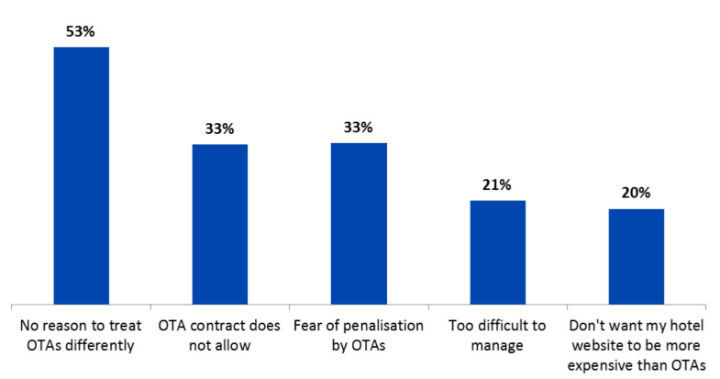
Some 79% of hotels reported that they had not price-differentiated between OTAs and other channels since the narrow clauses were introduced.
The reasons that hotels have not price differentiated since the change were given as shown in the chart below:
Source: European CommissionHowever, the researchers found that that switch to narrow clauses had increased room price differentiation of more than 5% in eight of the ten markets under scrutiny. To observe this, the researchers looked at a control group of hotels in Canada, where no change to parity rules has occurred.
It is important to view this result with caution. The research team found that in around half of the cases where price differentiation was evident, there was a difference in room type or booking conditions. This is because the introduction of narrow parity clauses has increased the ability of hotels to differentiate product between OTAs as well as rate.
Across the ten Member states included in the study, 40% of hotels said that since the switch to narrow parity clauses, they had undercut their OTA partners by publishing lower rates on their own websites and 57% of these hotels did so most of the time.
The survey also found that since the change, 69% of hotels have not started to offer different levels of room availability between the different OTAs. Most believed there was no good reason to do so. 30% of hotels said they now offer rooms on their own websites even when showing no availability on the OTAs; large chains generally did not do this, saying they saw no reason to do so and that they feared penalisation by the OTAs if they did.
Some 90% of hotels that responded to the survey said that there had been no change in the basic commission rate charged to them by OTAs in the period from July 2015 to June 2016.