IAG has made its third offer for Aer Lingus – now up to €2.50 in cash and a €0.05 dividend per share. The offer is conditional upon agreement from Aer Lingus's shareholders - Ryanair with 29.9%, the Irish government with 25.1% and, indeed, Etihad with 4.1% - but it's likely to be accepted.
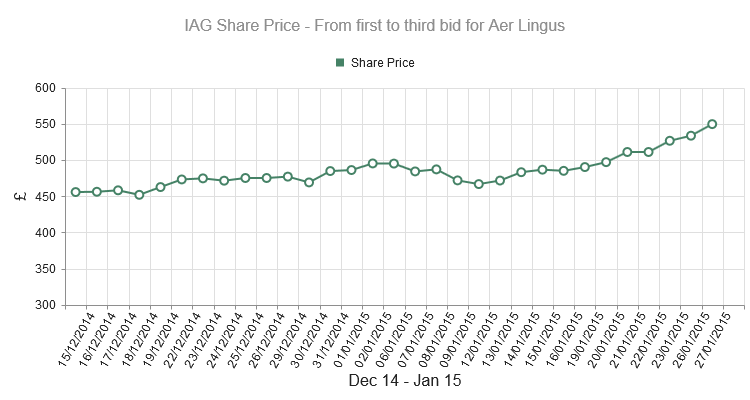
Investors clearly believe that the move will add value to IAG shares. Shares have gained one-third in the past 12 months and 20% since its initial bid.
The airline is in much better financial shape than when CEO Christoph Mueller, now set to move to Asia to run Malaysian Airlines, took over in 2009. It has gone from having losses of approximately €150m a year to profits of about €40 million. However, it is probably more Mueller's restructuring than the balance sheet which has made Aer Lingus such a valuable potential acquisition for IAG.
When Mueller arrived Aer Lingus was headed towards becoming a low-cost carrier, competing head on with its main shareholder, Ryanair. Indeed Ryanair has been unsuccessful in three attempts to buy Aer Lingus because the EC believed a takeover would impede competition and hurt the Irish consumer.
Mueller instead has moved Aer Lingus to a more hybrid model with service levels more in the British Airways and Iberia league than in the O'Leary style.
Groups in Ireland are seeking reassurances about a continuity of service, not just to Dublin but to the regions such as Cork and Shannon where a lot of international companies are now located. They need the connectivity. In Ireland Aer Lingus is recognised as an important support to the economy.
IAG says it will preserve the Aer Lingus brand and connectivity but it is widely assumed that it wants the carrier for its Heathrow slots – it has the fourth highest number of slots after BA, Lufthansa and Virgin.
The Aer Lingus routes between the UK and Ireland are profitable, but observers fear that because long-haul services are even more profitable, slots could systematically be transferred into the more lucrative North Atlantic routes with Aer Lingus joining the American, Iberia and British Airways joint venture.
This is possible but more long-haul routes are unlikely to hurt either Ireland's tourism trade, its connectivity for business travellers or its potential for attracting more international business to the Emerald Isle.
We read in one of our expert insights by Barbro Köhler that travel buyers do care about national carriers such as SAS in Scandinavia but that they cannot rest on their laurels in the face of high quality competition. In today's market-driven world national carriers have no God-given right to exist (unless you live in a dictatorship) and, realistically, consolidation is sometimes the only way to survive. Are cross-border groups inevitable and should we celebrate their Europeanness instead? Or, if fares rise as a consequence, should we as buyers be battling to prevent such mergers at all costs.