Britain's Ministry of Defence (MOD) is traditionally considered to be Europe's biggest spender on business travel.
Each year, the UK Government requires departments to publish details of their efforts towards becoming more sustainable in an annual report.
While some countries may think the very idea of asking the military to report on its carbon footprint is odd, the annual sustainability report contains some fascinating insights.
The main thrust of the report is the mandatory carbon emissions reporting that government departments have to do.
The MOD's carbon emissions from various modes of transport over the past five years are shown below.
Continued below
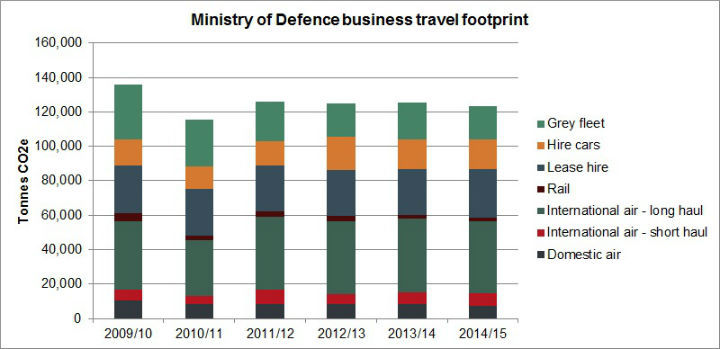
This has to be seen against the backdrop of MOD travel policy which "discourages unnecessary business travel and encourages personnel to use video teleconferencing and or telephone conferencing wherever practicable. If travel is necessary, the cheapest/most cost effective available means should be used."
There has been much focus in recent years in the public sector on reducing the amount of domestic air travel, with a target of 20% cuts on 2009/10 levels.
In 2009/10, the MOD bought 66,274 domestic air tickets and reduced this to 53,110 in 2010/11. However, the number of domestic tickets in 2014/15 was 64,910. The MOD says that the increase is mainly due to organisational changes resulting from army rebasing and ship-building programmes in Scotland.
It says, "92% of our domestic air travel is to Scotland and Northern Ireland where it remains value for money taking account of both the ticket cost, and the consequent costs of accommodation, subsistence and time. Air travel represents a return journey that can be completed in one day, compared to a rail, or car journey which would lead into overnight stays."
So what does the department spend on business travel? The report also gives financial indicators including expenditure on official business travel. This is shown in the chart below and shows that following a reduction in 2009/10, spend has remained fairly constant.
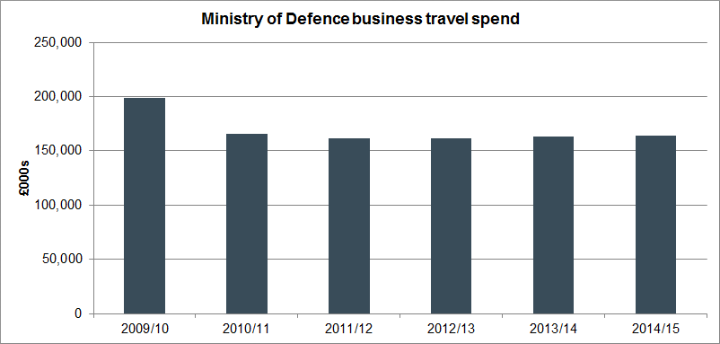
Note that both the emissions and spend figures do not relate to business travel undertaken by contractors working on behalf of the MOD nor to military operations. The emissions data for flights only relates to commercial scheduled flights, not to military or charter flights for troop movements.