From June, Marriott International implemented a changed cancellation policy at hotels in the United States, Canada, Caribbean and Latin America meaning that guests would need to cancel their room reservation 48-hours prior to arrival in order to avoid a fee.
Hilton has now followed suit and plans to implement 48-hour cancellation penalties in the Americas from the end of July. IHG has also announced a change to its policy, implementing a 24-hour threshold for many of it hotels.
Will it have much effect on corporates? Consolidation in the sector means that just these three changes will mean a significant proportion of corporate business will now be affected. However, corporates may not feel the pinch.
Research by hotel rebooking platform TripBAM on the potential effect of the new cancellation policies are shown in the chart below. The company says that if these cancellations each resulted in a fee the average cost would be US$179 per occurrence.
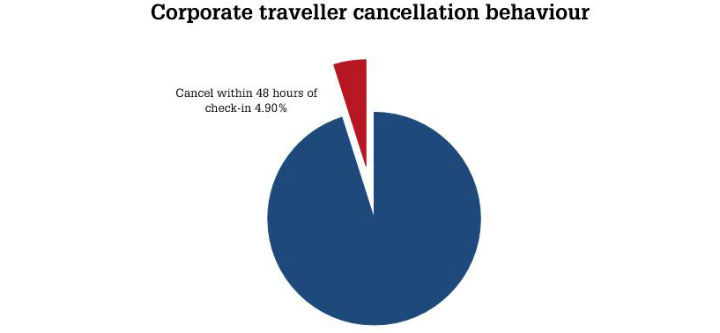 Source: TripBAM
It is useful to look at what hoteliers actually make from cancellation fees.
The chart below shows research by CBRE Hotels in America on the proportion of revenue made from cancellation fees and attrition fees (where a conference attracts fewer hotel room bookings than planned).
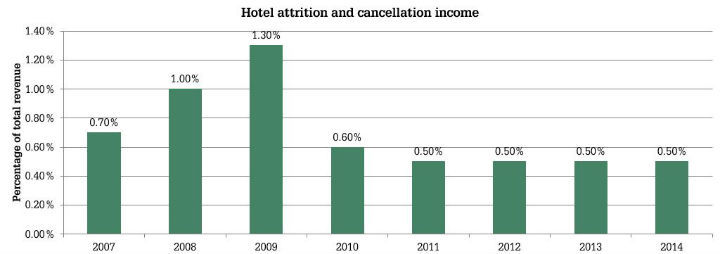 Source: CBRE Hotels Americas
The low numbers here make it seem as though it should not be a key focus for hoteliers. However, what is relevant is that this income largely goes straight to the bottom line since the variable costs barely change and so extending a cancellation policy seems like an easy win.
If it is not revenue generation, why are hotel groups playing with cancellation fees?
One argument is that they are trying to thwart recent business travel start-ups such as TripBAM and Yapta from doing what they do — cancelling and rebooking hotel reservations at a lower price — which directly hits the hoteliers' bottom lines. It is our belief that they are more likely to be targeting leisure travellers booking through online travel agents and Booking.com in particular.
Research in 2016 by Mirai showed that cancellations on Booking.com were more than twice as high as on the hotel's own website.
This is not the first time hotels have implemented cancellation fees. Some hotels in key destinations already have cancellation periods of 72 hours while hotel groups started rolling out 24-hour policies in 2015. However, many corporate buyers were able to negotiate an exclusion from these policies.
Will he same happen this time?
Speaking in a BTiQ webinar in late July Areka Consulting's Kate Watson said that there was no guarantee that buyers would be able to negotiate exemptions from such cancellation fees as some have been able to do in the past with 24-hour cancellation fees. Buyers will have to look carefully at the hotels they use the most and negotiate hard.