The views of several senior figures at one session of CAPA's Airline Leader Summit in Dublin last week was an object lesson of why all buyers and sellers need to understand each other's business models.
Travelport's Ian Heywood, Cartrawler's Bobby Healy and SAP's Paul Pessutti addressed the value and challenges surrounding data in current alternative distribution systems.
Heywood believes that airline distribution is evolving from the ATPCO system where all carriers file content and fares to be distributed via GDS to one dominated by APIs; he sees a world not of individual direct connects on different platforms but a more collaborative, less fragmented venture involving more carriers and distributors, buyers as well as suppliers.
Ah, you might say, that's NDC but Heywood reminded us that, as yet, the airlines adopting NDC represented only a small percentage of all carriers.
Healy thinks Google Flight Search is the biggest threat to travel distribution which could potentially become a monopoly, hold data and charge high fees.
SAP's Pessutti agrees with Healy that maintaining control over one's data was vital for any business but emphasised that its value came not from possession but from analysing it and applying its insights. He contends that buyers of air increasingly want not just the flight itself represented by the fare but a more retail-like experience with add-ons appropriate for the traveller and the trip.
The three emphasised different needs and benefits of data but they agreed that recognising where its value lay in achieving business objectives was vital. And they all believe that the market wants a distribution system that includes merchandising or retailing elements. For buyers the result is the ability to purchase simply a product closer to what they wish to buy. The bonus is the data that they could obtain to enable them to purchase more wisely.
But distribution systems come with different costs. Healy quoted that the average airline profit per booking was $21 while Amadeus's average profit per booking is less than $3. However, Google receives $16 per Flight Search booking, says Healy. He advised carriers not to be distracted by GDS fees when Google's fees were rising by 15-20% a year.
Lest you think that Flight Search is only for leisure, think of how many business travellers are in unmanaged programmes and use a browser to book their own tickets. Try it. If you Google Lufthansa, the first result is a sponsored Lufthansa link, which Google gets paid for. The second on the list is www.google.co.uk/flights.
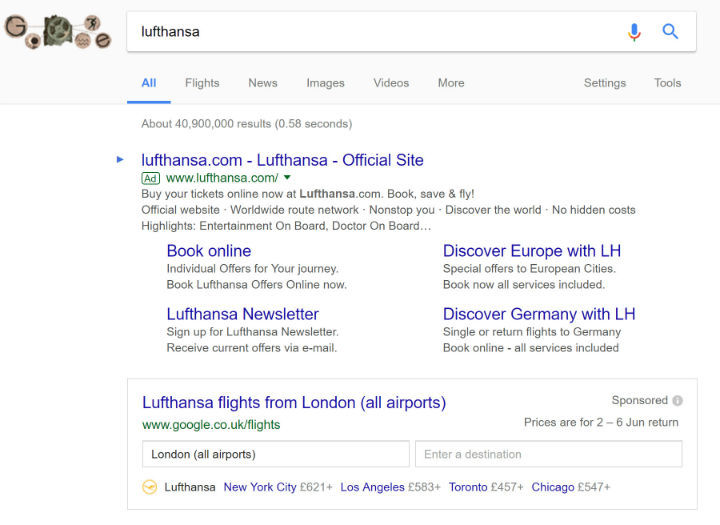
Lufthansa and Delta might have yielded to the power of Google but other carriers such as American are resisting, keeping hold of their data and still delivering a service to customers and profits to their owners. Will the fees charged by carriers on Google Search become relatively more expensive?
Data is so valuable.