The annual CarTrawler Yearbook of Ancillary Revenue was released recently and not surprisingly showed another giant leap. Last year total revenue from ancillaries for the top 10 carriers in terms of revenue generation was just short of US$26 million (see table). In 2008 the top 10 carriers combined reaped only a bit more than $8 million.
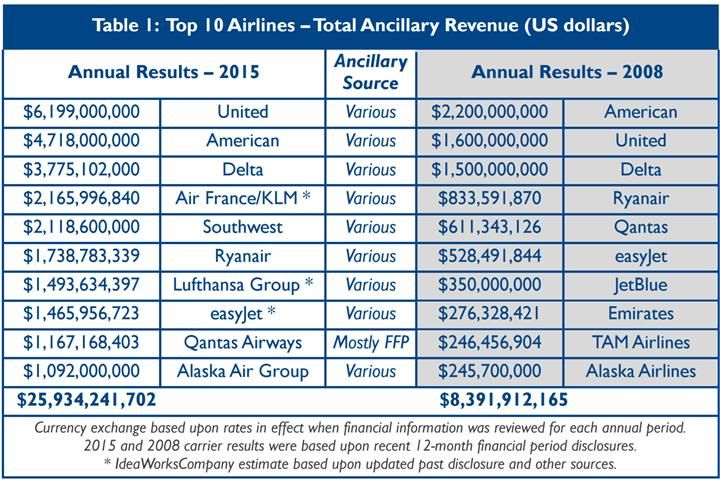
These figures are unremarkable; they are what was expected. Readers might instead take note that in 2008, the first year of the surveys, only two European carriers — Ryanair and easyJet — made the "top 10". Seven years later, the table shows Air France KLM and Lufthansa Group firmly embedded in the top 10 at numbers 4 and 7 respectively alongside perpetual ancillary kings, Ryanair (6) and easyJet (8).
The traditional carriers, however, are still nowhere close to the low-cost carriers when you measure this income stream as a percentage of total revenue. Ancillaries represent a major chunk of Ryanair (24%) and easyJet (20%) total revenue. They are less so for AirFrance KLM (7.5%) and Lufthansa Group (5.5%) but they are growing in importance for these legacy, network carriers.
And the growth has as much to do with business passengers as with low-cost leisure travellers.
Air France KLM recently launched its Perform 2020 strategy which includes plans for more ancillaries, some of which such as extra leg room, baggage pick-up for flights from Charles de Gaulle and Orly and lounge access, are aimed straight at the business traveller.
And Lufthansa's introduction of DCC (Distribution Cost Charge) will undoubtedly swell its ancillary revenues.
CarTrawler's figures do not reflect a full year of DCC (it was only announced in June 2015 and introduced in September of that year) but what they show is how important ancillary revenue (including that from branded fares — Light, Classic, Flex and Business) are to the future viability of Europe's airlines.
Lufthansa introduced its DCC to all bookings made via the GDS to cut its distribution costs. This acts as an incentive to use the carriers' own sites. The more that Lufthansa carriers can entice passengers to book direct, the more it will be able to collect data about its customers and the more it can target them to sell its extras, not just indirectly by its agents as a result of marketing, but directly by actual transactions on its own sites.
The advent of low-cost carriers conditioned everyone from back-packers to briefcase carriers to be price-led when making booking decisions. It has meant that carriers have unbundled their offering to drive basic fares down and seen their bookings and revenues soar.
Lufthansa has done more than unbundle the product. It has unbundled the fare and made distribution an 'extra'. That will drive more travellers, leisure and business, to book directly and that means a greater likelihood for ancillary bookings — and revenues.