As we wrote in our analysis last week, the United Kingdom's 'Brexit' vote is likely to have some unforeseen consequences on air travel and travel costs.
In the wake of the UK's decision to leave the Union, business confidence has taken a huge hit. Research by YouGov and the Centre for Economics and Business Research (CEBR) shows that companies believe the UK economy will now contract and, while they are confident about the ability of their own companies to expand following the vote, are considerably less certain of that fact.
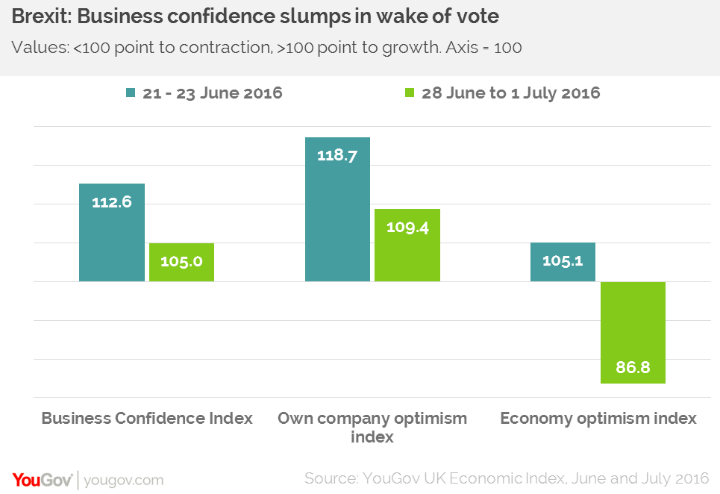
Scott Corfe, CEBR's director says: "So far the only evidence we have for how the economy is in the wake of the Brexit vote comes from the markets which are showing a mixed picture. These figures show what is happening on the ground and they suggest a significant shock reaction. Not only are businesses feeling much more pessimistic in general about the state of the economy, but their own expectations for domestic sales, exports and investments over the next 12 months have gone off a cliff. Hopefully this is a short term panic reaction and confidence will edge up again once the dust settles."
The Lloyds Bank business confidence barometer has also slumped following the vote. Its index fell from 32 to just six in one of the sharpest monthly declines ever observed and is now on a four-year low.
Falling business confidence is often accompanied by falling levels of business investment, as companies try to keep cash on their balance sheets. Business travel is often frozen or cut in such circumstances.
There is also another effect of falling confidence — businesses become more conservative with their suppliers, choosing to remain with incumbents rather than going out to tender, which is often a costly matter and can introduce enormous uncertainty at a time when businesses need to focus on remaining competitive.
Yet for some companies this is an ideal moment to re-examine existing relationships. Take the relationship with your TMC, for example. With business confidence shaky, this may be a good time to renegotiate with your incumbent TMC or to go to the market when prices may be keener and rival TMCs willing to do more to win your business.