A new study commissioned by airports association ACI Europe looks at the drivers of changes in air fares. The report, produced by global consultancy ICF, looks at numerous factors to see how they affect fares, including airport charges, seasonality, fuel costs, time and date of flight and competition.
Taking the last of these, it would seem obvious that increased competition for something would push prices down. There is a view in the aviation world that the arrival of low-cost carriers in the mid-1990s has done much to reduce fares. But is it really the case?
Our charts this week look at competition on routes within Europe and from Europe to the rest of the world.
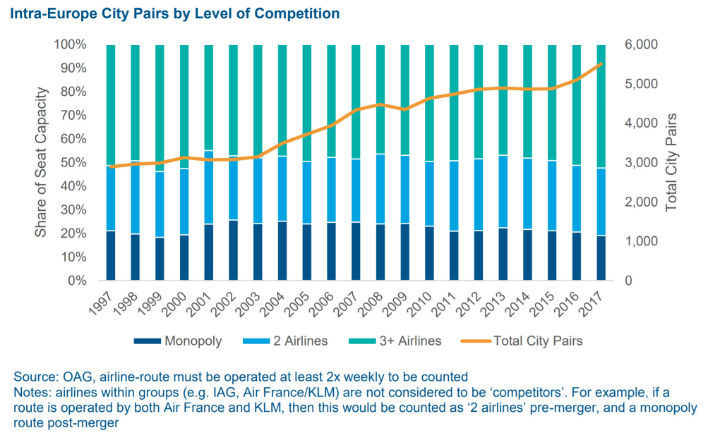
This chart looks at how competition on city pairs within Europe has changed in the past two decades. The number of city pairs has almost doubled over this period but the proportion of these routes which are operated by a single carrier has remained largely unchanged.
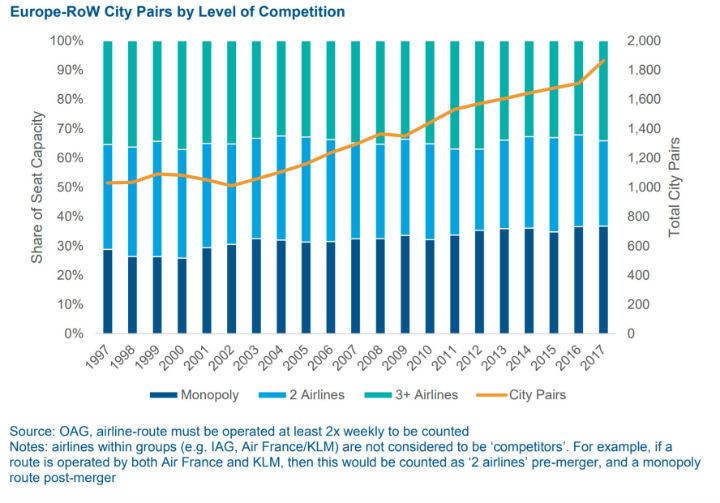
Looking at routes to the rest of the world, the number of city pairs has increased again, although not to the same extent as routes within Europe. Here, though, the number of monopoly routes has increased over the period under scrutiny.
The report goes on to show the effect of competition, where it exists, on fares. For the intra-European case study, fares on a non-competitive route are 70% higher than those on competitive routes. For trips from London to the west coast of America, fares on the non-competitive routes were, on average, 25% higher.
It seems clear that while low-cost carriers have changed the market, carriers are cherry-picking the routes they serve to keep competition at a minimum and fares at a premium.
Dr Michael Kerkloh, president of ACI Europe and CEO of Munich Airport said, "The ICF Study spells it out very clearly that the underlying demand and the level of competition between airlines on any given air route are the key determinants of air fares. This means that airlines will always aim to exercise their pricing power irrespective of the underlying costs of providing the service."