International Airlines Group (IAG) has announced that it has carried a record number of passengers in 2016 - more than 100 million.
In total, the group, which incorporates Aer Lingus, British Airways, Iberia and Vueling, carried 100,675,056 passengers, up by 14 per cent compared to 2015.
The figures have been helped by the acquisition of Aer Lingus but it is worth drilling down into the headline numbers to see what is happening.
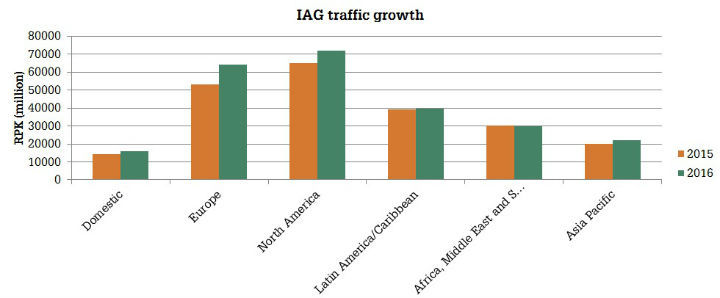
The chart above shows the breakdown in traffic on a geographical basis. The strongest growth has been in intra-European traffic, where traffic has grown by more than 20%. Even with the Aer Lingus figures stripped out, growth has been healthy, at nearly 9%. Most other markets have also seen good growth, except for Africa, the Middle East and South Asia, here traffic has fallen. This is almost certainly due to intense competition from Gulf carriers.
We can also look at the split of traffic between the various carriers in the group which is shown below.
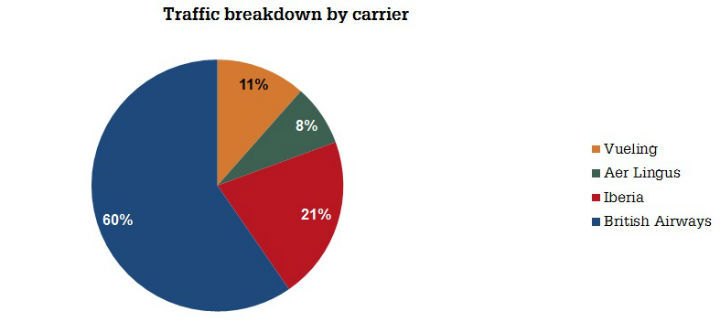
British Airways is by far the biggest member of the group in terms of traffic
However it is also worth looking at where growth is coming from. Traffic at low-cost Vueling grew by 13.2% year on year, compared with just 2.2% at British Airways. At Aer Lingus, growth was 9.5%.
Low-cost is clearly interesting for the group. Just before Christmas the airline announced the summer launch of a "next generation" long-haul operation based in Barcelona using two A330s to fly to, potentially, Los Angeles, San Francisco, Buenos Aires, Santiago de Chile, Havana and Tokyo.
The recent long-haul success of Norwegian has clearly won some admirers.