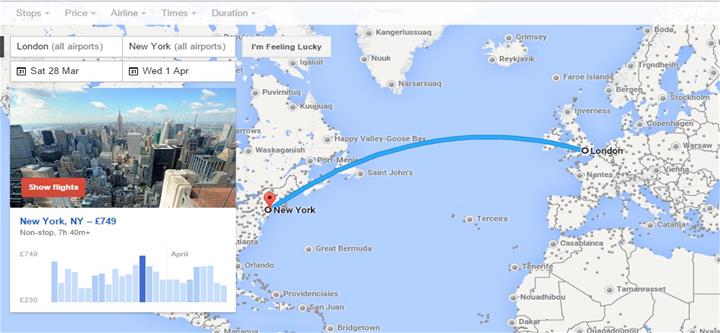
This week Google announced detail of some new enhancements to its Flight Search tool.
The internet giant's flight search engine has all the content search functions of other metasearch sites (i.e. those that seek fares from a multitude of other sites) plus a few other appealing features such as a 'Tips' bar which shows options for saving fares such as travelling out and back a few days earlier or flying to a nearby airport. The Google Now app can alert you if the fare for a journey searched and saved but not booked, falls lower. In brief the site is now starting to show the potential for Google in the travel market which everyone has been anticipating since its purchase of flight information software company ITA in 2010.
This tool, which ostensibly helps users find cheaper holidays, may not look immediately relevant to corporate travel management. But it is.
Everything about Google Flight Search looks aimed at the budget-conscious student gap year or family holiday as it is very easy with various filters and maps to find lower price routes or times to consider as competitive alternatives. There the comparison with low-cost carriers or OTAs should end because Flight Search is only an information site. It does not offer booking or fulfilment.
However, seeking value for money is not confined only to private travel. Value for money is the mantra of most corporate travel departments.
At first glance, Google Flight Search looks suited only to leisure travellers – after all, there's a map that shows you fares to different airports in the regions and tips usually advise to fly at another time.
Options to save money by swapping schedules or airports are not traditional business travel tactics because business travellers have to go to the destination of the meeting and arrive in time for the scheduled meeting.
Well, yes and no . . . That used to be the perceived wisdom but since the global economic downturn there has been a huge emphasis on identifying the reason for travel including distinguishing internal and external meetings to determine which are essential and can't be moved, such as client meetings, and which can. Moreover, in the drive to cut costs more and more travel programmes are making use of connecting flights rather than relying only on direct, non-stop services.
Travel programmes are increasingly affected by a trend for travellers to book their own travel – Travel Management 2.0. Many of these people are now doing their homework on OTAs.
As Google makes Flight and Hotel Search more user friendly, is it only a matter of time before it adds the ability to book and there's a new player in the corporate travel equation?