Rail transport has grown at different rates since it was first launched as a means of passenger transport in the 19th century.
Many factors have since affected the growth of rail – willingness of governments to invest in infrastructure, the willingness of passengers to pay appropriate fares, the physical difficulty in building rail tracks and the willingness of populations to put up with the disruption of tracks being laid.
Take Austria and Greece for example. Greece is 60% bigger in area than Austria but much of this is in the form of islands, In addition, the Greek infrastructure grew slowly and only with private foreign investment. In Austria, railways were state funded from the late 19th century and expansion was rapid. The Austrian rail network sees 10 times more traffic than that of Greece.
Looking at international rail traffic is fascinating too. While Germany has the highest level of passenger traffic at a national level, it lags behind France for international traffic. As you might expect, countries that are more central to Europe and are passed through by those on the extremities will have more international traffic.
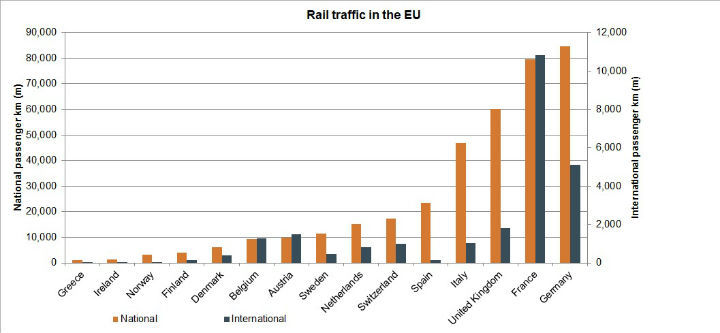 Source: Eurostat, figures for 2013 except Belgium (2011) and Netherlands (2008), the most recent publicly available