What makes an airline a flag-carrier?
Does it mean that it is completely owned by the state, such as
Etihad and Emirates? Or that it used to be owned (or majority owned) by the
government, such as Air France or British Airways?
Or is it just enough to have a flag on your tailfin like
Lufthansa-owned Swiss?
The definition of the term flag-carrier is coming under focus
after Virgin Atlantic launched a campaign, with its own website, in September to be recognised as Britain’s “second
flag-carrier” and be granted favoured access to the new slots that will become
available when—or should that be if?—Heathrow’s third runway is built.
At the launch of the campaign,
Virgin Atlantic CEO Shai Weiss said, “Heathrow has been dominated by one airline group
for far too long. The third runway is a once-in-a-lifetime opportunity to
change the status quo and create a second flag carrier. This would lower fares
and give real choice to passengers, as well giving Britain a real opportunity
to boost its trade and investment links around the world. Changing the way
take-off and landing slots are allocated for this unique and vital increase in
capacity at the nation’s hub airport will create the right conditions for
competition and innovation to thrive.”
The airline argues that BA’s parent IAG dominates at Heathrow
and the situation has been getting worse. A report commissioned by the airline
says that 39 percent of all routes from Heathrow—55 percent of all
short-haul routes—are served only by IAG and its joint venture partners.
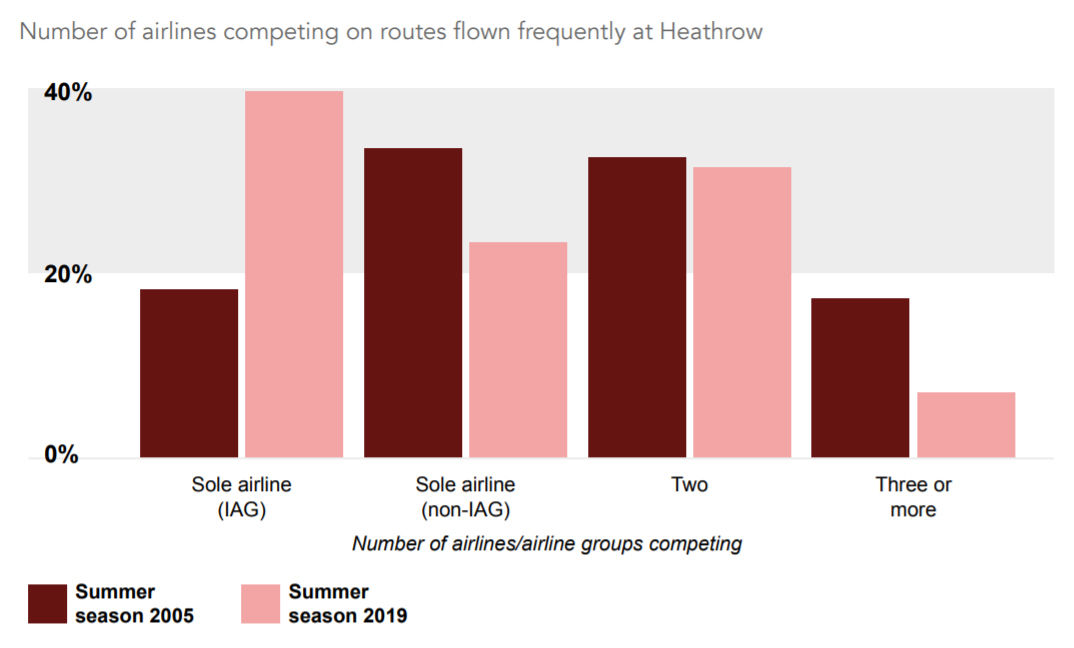 Source: Virgin Atlantic. Note: Excludes services with fewer than 40 flights in a season
The BTA has leant its support to the campaign this week.
CEO Clive Wratten said, “We recognise and support the benefits a
second flag carrier would bring to the UK economy—not only the increase in
competition but also the expansion of new routes from Heathrow, a hub that is
seeing, albeit slowly, its plans for extension draw nearer. As and when the
ambition for airport expansion is realised, the need to fulfil the additional
slots presents an opportunity to carriers and the corporate travel sector.
Which is why we are backing Virgin Atlantic’s campaign to gather support from
the public in a bid to become recognised as the nation’s second flag carrier.
“Allowing significant slot access at Heathrow to a second
British airline should be greeted by all airlines, travel management companies
and corporate travellers with enthusiasm, as it presents a very real
opportunity to access potential new markets further afield whilst at the same
time benefiting from competitive fares.”
British Airways can lay claim to being a flag
carrier, of sorts. It was once owned by the state. It has a flag on its tailfin
and is the UK’s dominant carrier, particularly at Heathrow Airport.
But what of Virgin Atlantic?
What about ownership? Virgin Atlantic has
never been state-owned. Today it is 49 percent owned by Delta, 31 percent by
Air France KLM and 20 percent by the Virgin Group. Not particularly British then.
Its decision to be part of the Connect Airways
consortium which acquired Flybe in early 2019 perhaps changed some perceptions.
As of 2020, Flybe will become Virgin Connect.
Perhaps its biggest claim to flag-carrier
status is the Varga girl on the nose of many Virgin Atlantic. She has the Union flag streaming behind
her.
How slots are allocated at an expanded
Heathrow is going to be crucial in controlling fares. At the moment, slots
there are so constrained that they change hands for millions. Releasing new
slots should help. Corporate travel buyers can hope that the increase in slot
supply will mean more competition at the busy airport.
However, is handing them over to Virgin
Atlantic the right answer?