IATA's economic analyses and statistics regularly provide rich information for savvy travel buyers who want to know what is going on at a deep level in the largest category of spend for most companies.
Its monthly airlines financial monitor is no exception. It looks at airline share prices, earnings, the price of jet fuel and more.
Our chart this week looks at airline yields, the average fares that airlines charge per passenger per kilometre. This is a good measure of what is going on at a fundamental level at airlines.
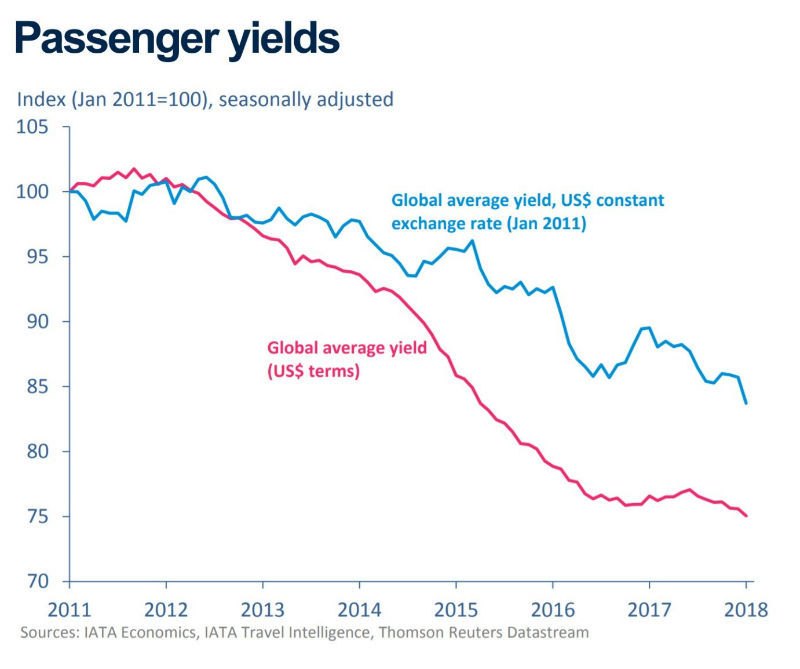
What the chart shows is that global average yields — in dollar terms — have been in decline for at least the last seven years. Even if we take yields on a constant currency basis there have been substantial declines in airfares.
So why hasn't this decline flowed through to lower spend for companies?
The key here is that this includes only base fares and does not include ancillaries and other surcharges.
Elsewhere in the monitor, it says that airline pre-tax profits for 2017 were US$9.2 billion, up from US$5.8 billion in 2016.
Clearly, airlines are making their money other than on base fares.
IATA says, "There are indications that — at least for some carriers — these other sources of passenger revenue have helped to offset the decline in passenger yields over the past year and supported the ongoing robust industry-wide financial performance."